The phrase “social media algorithm” gets thrown around so often that most marketers have stopped questioning what it actually means. We blame it when our reach drops. We try to “beat” it. We read article after article about how to “hack” it. And in the meantime, the actual mechanics of how content gets surfaced to people on social media have undergone the biggest architectural shift since the chronological feed disappeared.
In March 2026, LinkedIn published the most detailed engineering breakdown of its feed algorithm in the platform’s history. The platform confirmed it had replaced its entire ranking infrastructure with a large language model-powered system. That announcement was the loudest example of a shift happening across every major platform. Social media algorithms are no longer rule-based feature factories. They are AI systems that read your content the way a person would, and decide who else cares.
If you’re a marketer, business owner, or content creator trying to understand why what used to work isn’t working anymore, this post is the explainer I’ve spent years wishing existed. I’ve been speaking and consulting on social media since 2009. I teach digital marketing at Rutgers Business School and UCLA Extension. As a Fractional CMO, I watch what works across my clients. The frame I keep coming back to is the one I wrote about in my book Digital Threads.
In a Digital First world, marketing depends on relationships with algorithms alongside the relationships with people you’ve always managed. – Neal Schaffer
This guide covers what algorithms actually are, why they matter, and the best practices that hold up across platforms. It also explains how AI is reshaping the entire architecture of social content distribution in 2026.
Key Takeaways
? A social media algorithm is an AI-powered ranking system that decides which content each user sees, in what order, and how widely it gets distributed. It is not a single rule. It is a probabilistic prediction engine running thousands of signals.
? Engagement, relevance, and watch time are the three signal categories that hold up across every major platform. If your content earns those, it travels. If it does not, no growth hack saves it.
? In March 2026, LinkedIn confirmed it replaced its multi-system ranking infrastructure with a single LLM-based feed system. This signals where every platform is moving: semantic content understanding, interest graphs over network proximity, and sequence modeling over isolated signals.
? The biggest 2026 shift is from network-based distribution to interest-based distribution. Follower count matters less than ever. Topical relevance to a specific audience matters more than ever.
? AI-generated content is being actively penalized when it reads as generic. LinkedIn explicitly downranks “recycled thought leadership” and engagement bait. Specificity, firsthand experience, and substance are the algorithm’s new currency.
? The best long-term marketing strategy is to stop trying to beat the algorithm and start building a relationship with it. That means clear topic focus, consistent posting in your lane, and content that adds something a competitor can’t copy.
A social media algorithm is a machine learning system that ranks and personalizes content for each user, deciding what appears in their feed, in what order, and how widely each piece gets distributed. It evaluates hundreds to thousands of signals about the content and the viewer, predicts how likely the viewer is to engage, and ranks the results in milliseconds.
The word “algorithm” suggests a single set of rules. In practice, every platform runs multiple models in parallel. Take Instagram: when you open the app, the system narrows down to roughly 500 candidate posts from your network. It screens out anything that breaks Community Guidelines. It scores what remains by predicted engagement value and orders the final feed in priority order. All of that happens before your thumb lands on the screen. Facebook, TikTok, LinkedIn, and YouTube run essentially the same pipeline. What differs is the signal weights and the size of the source pool.
What makes this hard to wrap your head around is that the algorithm is not a referee watching a game. It is a prediction engine that learns from every action every user takes. Every like, comment, share, save, dwell time, swipe-past, and “not interested” tap is training data. That is why two people opening the same app at the same moment see entirely different feeds, and why the content that worked for you last year may not work this year.
A few terms are worth getting straight, because they show up in every algorithm conversation:
- Ranking signal. A factor the algorithm uses to assess content quality and likely relevance to a user. Examples include watch time, comment rate, time of posting, and follower relationship to author.
- Machine learning. A component of AI that lets a system improve its predictions from data without being explicitly reprogrammed. This is what lets algorithms “learn” what you like over time.
- Personalization. The output of all of the above: a feed tailored to each user based on their behavior, their network, and the platform’s predictions about what will keep them engaged.
Social media algorithms matter for marketers because they are now the gatekeepers between your content and your audience. Posting consistently is no longer enough. The algorithm decides whether your content earns distribution beyond your existing followers, and that decision is based on signals that are largely outside your control. Understanding how those signals work is the difference between content that compounds and content that disappears.
The strategic stakes are higher than most marketers realize.
Organic reach has been collapsing across every major platform. Facebook Page organic reach has been in the 5% range for years, and many practitioners would tell you it’s actually under 1% for most brand accounts today. Instagram organic reach for brand accounts fell 30-40% across all post formats in 2025, with average reach now sitting around 3.5%. LinkedIn organic reach dropped roughly 50% year-over-year in 2025 as the platform rolled out its new ranking system. This is not because platforms hate marketers. User feeds are finite. Competition for that real estate is infinite.
Algorithm distribution is now the primary form of distribution. The mental model that “I post, my followers see it” has been wrong for at least five years and is becoming completely untenable in 2026. Hootsuite’s research found that over 70% of TikTok video views now happen through the For You Page rather than from accounts a user follows. That number is climbing on Instagram Reels and creeping up on every other platform. Your content’s success now depends on how well the algorithm understands and matches your post to people who don’t follow you, not how big your follower list is.
The economics have flipped. Engagement rate has replaced follower count as the primary success metric, because engagement is what tells the algorithm a post deserves wider distribution. A creator with 5,000 followers and consistent 6% engagement will out-reach a brand page with 500,000 followers and 0.4% engagement almost every time. That is why employee advocacy programs and creator partnerships are outperforming brand pages even when the brand has 100 times the audience. If you want to dig into the underlying numbers, my social media marketing statistics roundup is updated regularly and pulls together the data points worth knowing.
For marketers, the question stops being “how do I post more?” and becomes “how do I earn the kind of engagement the algorithm rewards?” That is the real shift.
Is Your LinkedIn Not Delivering Results?
Just released: my new book to help professionals, entrepreneurs, and business owners maximize LinkedIn for real growth.
With years of LinkedIn expertise, Maximizing LinkedIn for Business Growth offers actionable steps to build your brand, expand your network, and drive results.
Start leveraging LinkedIn like never before—grab your copy now! Click the cover or button below to buy on Amazon.
Every modern social media algorithm follows a similar four-stage workflow: gather eligible content, evaluate ranking signals, predict engagement value, and rank the results. The specific signals and how heavily each is weighted differ by platform, but the underlying logic is consistent. What changed in 2025 and 2026 is the prediction step, where AI systems now read the actual meaning of content instead of counting surface features.
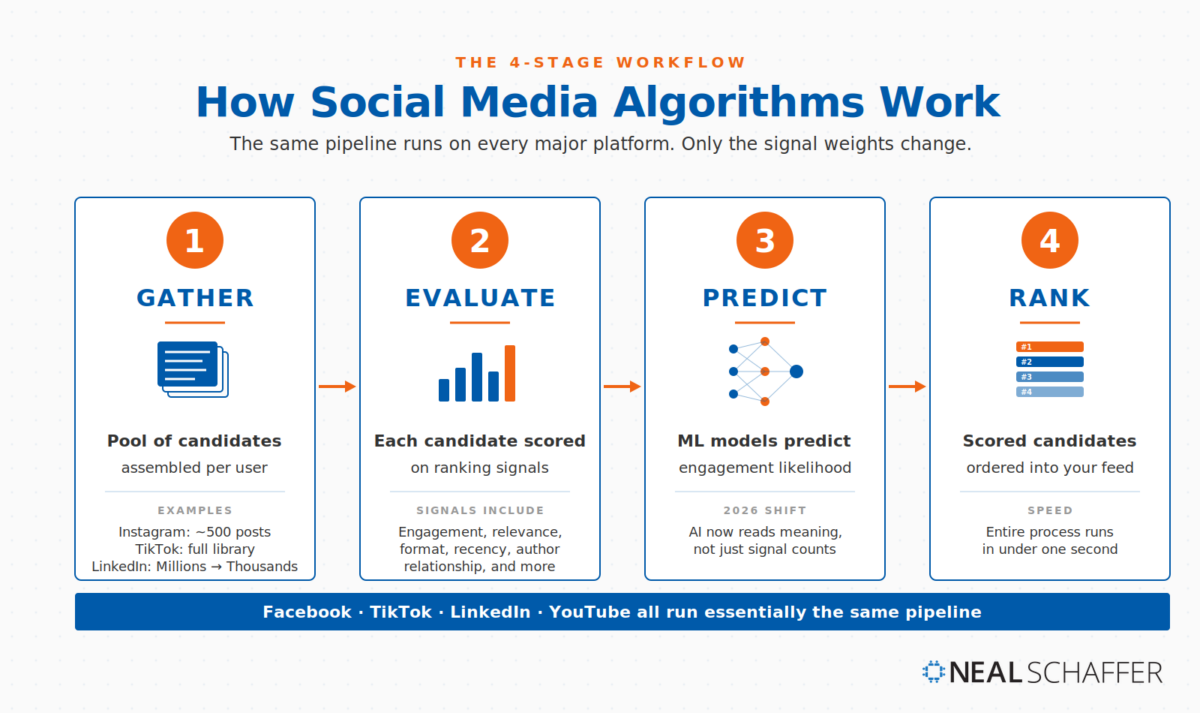 Every major social media algorithm follows the same four-stage workflow. Only the signal weights and source pool change. The biggest 2026 shift is happening inside the prediction step, where AI now reads meaning instead of just counting signals.
Here is the four-stage process broken down:
- Gather. The platform assembles a pool of candidate posts. On Instagram feed, as previously mentioned, the platform considers roughly 500 of the newest posts published by the accounts you’ve followed. On TikTok’s For You Page, the candidate pool is much larger and pulled from the entire content library, since the platform’s recommendation system ranks content based on user activity rather than network connections. For LinkedIn, retrieval now narrows hundreds of millions of posts down to a few thousand candidates per user in milliseconds using AI-generated embeddings.
- Evaluate. The platform scores each candidate using ranking signals: engagement potential, relevance to the user’s interests, content format, recency, author relationship to the viewer, and dozens more.
- Predict. Machine learning models predict how likely the user is to engage with each post. A Reel you are likely to watch for 10+ seconds gets prioritized over a photo you would scroll past. A LinkedIn post on a topic you have engaged with five times this month gets prioritized over one on a topic outside your interest graph.
- Rank. The scored candidates get ordered and surfaced into your feed. This entire process happens in well under a second.
The most consequential change in 2026 is what is happening inside the prediction step. Until recently, most platforms relied on what LinkedIn engineers have called a “feature factory” architecture. Thousands of specialized models, each predicting one narrow outcome (a click, a like, a follow), each fed by manually engineered numerical features. That approach worked at scale, but it had a ceiling. The system could count likes, but it could not understand whether a post was actually about what it claimed to be about.
The new architecture uses large language models to convert posts, profiles, and user behavior into shared semantic representations. LinkedIn’s engineering team illustrated the difference with a useful example. If a user lists “electrical engineering” as their interest but engages heavily with posts about small modular reactors, the old keyword-matching system might miss that those topics are deeply related. The new LLM-based retrieval treats them as semantically connected because the language model brings real-world knowledge into the matching process. This is the difference between a system that matches words and one that understands meaning.
Across every major social media platform, the ranking signals fall into three categories: engagement signals, relevance signals, and content quality signals. Specific weightings vary by platform, but if you optimize for those three categories, you are working with how algorithms actually think rather than against them. This is the framework I teach in my consulting work, and it has held up across at least three major algorithm overhauls.
Here is how the categories break down with platform-agnostic ranking signals:
| Signal category | What it measures | Examples |
|---|
| Engagement signals | How users react to a post | Watch time, comments, shares, saves, dwell time, scroll depth |
| Relevance signals | How well a post matches a viewer’s interests | Topic alignment, previous interactions with the author or topic, geography, hashtags, recency |
| Content quality signals | Whether the post meets platform standards | Original content vs. recycled, spam patterns, format completeness, posting cadence |
Saves and shares have become the strongest engagement signals on most platforms because they reflect lasting value, not a quick reaction. An AuthoredUp analysis of over 3 million LinkedIn posts found that one save drives roughly 5 times more reach than a like and 2 times more than a comment. The pattern is similar on Instagram and TikTok: any action that takes more effort than a tap signals stronger interest, and the algorithm reads that as a stronger vote.
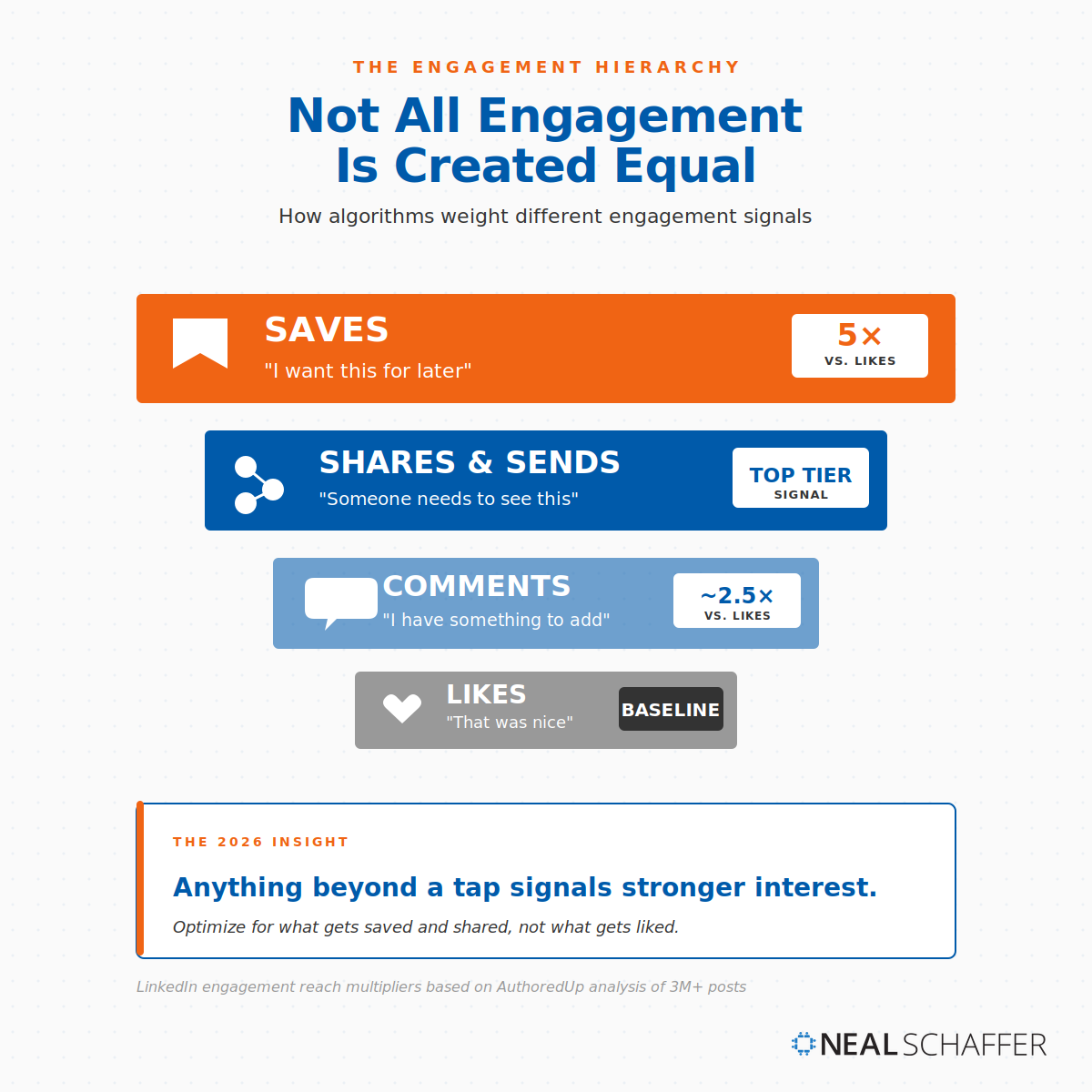 On LinkedIn, one save drives roughly 5x more reach than a like. The pattern holds across Instagram and TikTok too. The takeaway is to optimize for content that gets bookmarked and sent, not just liked.
Every major platform’s algorithm uses the same three signal categories, but the weightings, content priorities, and feed structures differ in important ways. Instagram and TikTok prioritize watch time and unconnected discovery. LinkedIn prioritizes professional relevance and comment quality. Facebook prioritizes connection-based content. YouTube prioritizes long-session retention. Knowing the priority hierarchy for each platform is what lets you tailor your content rather than spreading the same post everywhere and hoping.
Here is the practical breakdown of each major platform’s algorithm focus in 2026:
| Platform | Top ranking signals | Preferred format | Distribution model |
|---|
| Instagram | Watch time, likes, sends | Reels, carousels | Connected + unconnected reach |
| Facebook | Predicted engagement, connections | Video, photos | Heavily network-weighted |
| TikTok | Watch time, user activity | Short-form video | Almost entirely unconnected reach |
| LinkedIn | Content quality, dwell time, early engagement | Documents, text, video | Increasingly interest-based |
| YouTube | Watch time, session duration | Long video, Shorts | Mixed network + recommendation |
| X (Twitter) | Connections, recency | Text, images | Network + For You recommendations |
| Pinterest | Visual relevance, saves | Pins, images | Search and recommendation |
| Threads | Predicted engagement, view time | Text | Mixed network + recommendation |
A few platform-specific notes worth knowing:
Facebook is still the most network-weighted of the major platforms, which is why content from Pages reaches such a small percentage of followers. The Facebook algorithm heavily favors content from friends and joined Groups, with Page content fighting for the remaining slots. If you are running a Facebook strategy, organic Page reach should be a complement to community-driven content (Groups especially), not your primary play.
Instagram uses different algorithms for Feed, Stories, Reels, and Explore, each with its own ranking signals. Adam Mosseri has confirmed that the Instagram algorithm prioritizes watch time, likes, and sends overall, with sends weighted especially heavily for unconnected reach, as Buffer’s algorithm breakdown documents from Mosseri’s own creator videos. That is why “share this with a friend” content tends to travel farther than “comment your thoughts” content.
TikTok is the closest thing to a pure recommendation algorithm, which is why creators with zero followers can hit a million views and why follower count means almost nothing on the platform. The TikTok algorithm is driven by watch time and completion rate above all else. If people watch your video to the end, it gets pushed wider. If they swipe in the first three seconds, it dies.
LinkedIn has undergone the most dramatic algorithm change of any platform in 2025-2026, which I cover in detail below. The short version is that network proximity is no longer the dominant signal. Topical relevance and engagement quality are.
X (Twitter) is the only major platform where the For You and Following tabs are both prominent, giving users a choice between algorithmic and chronological. The For You algorithm weights connections, previous interactions, and topical relevance similarly to other platforms. Twitter engagement patterns remain heavily driven by replies and reposts, not likes.
What Are the Best Practices for Marketing With Algorithms?
The most effective marketing approach in the algorithm era is to stop trying to “beat” the algorithm and start aligning with how it actually works. Algorithms are designed to surface content that genuine users want to see. The marketers who win consistently are the ones who create content the algorithm wants to amplify because users do. Six practices hold up across every platform.
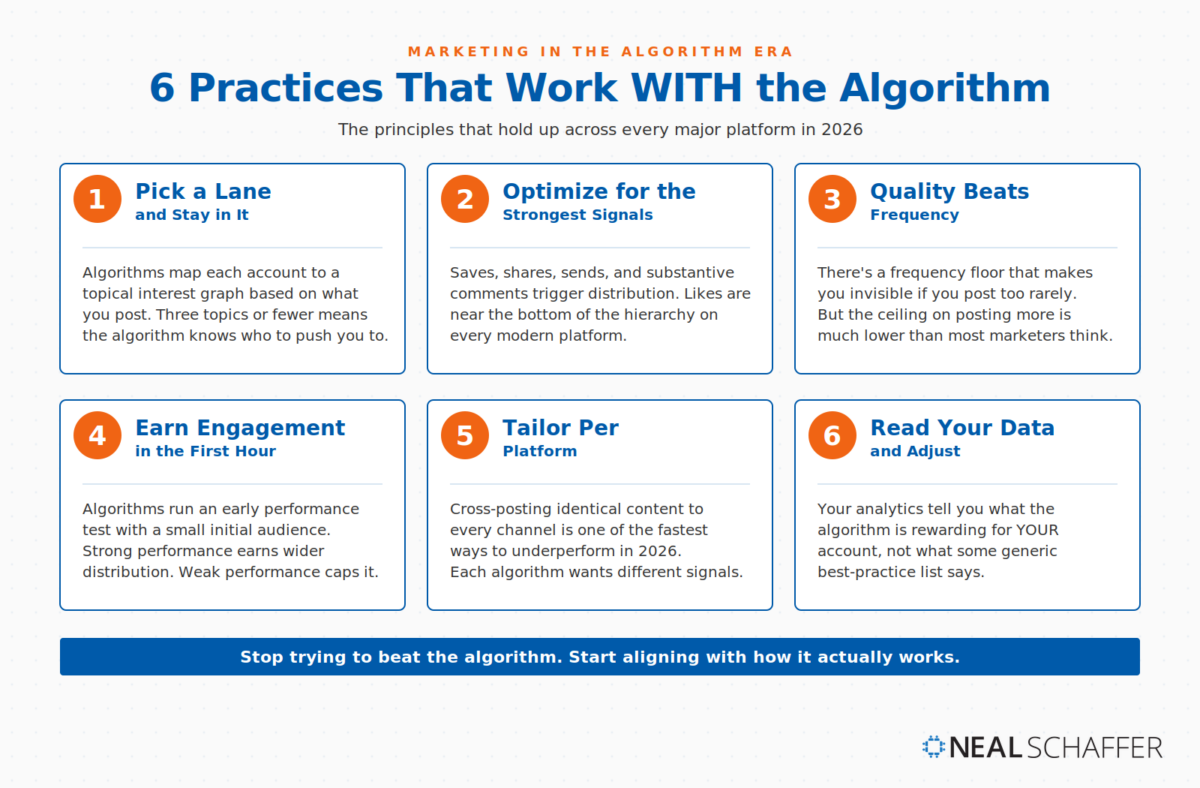 These six practices share one thing: they align with how algorithms actually work, not how marketers wish they did. They hold up across every major platform even as specific tactics keep changing.
Pick a lane and stay in it. The single biggest 2026 shift across platforms is that algorithms are getting much better at categorizing accounts by topic. LinkedIn’s new system explicitly maps each account to a topical interest graph based on profile and posting history. If your last ten posts are about three different topics, the algorithm has no anchor for who your content is relevant to. If your last ten posts are tightly about one professional domain, the algorithm has a clear model and pushes your content to people in that audience. This applies on Instagram, TikTok, and YouTube too. Topical consistency matters more than ever.
Optimize for the strongest engagement signals, not the easiest ones. Likes are nearly the bottom of the hierarchy on every modern platform. Saves, shares, sends, and substantive comments are what trigger distribution. That means your content should give people a reason to bookmark it for later, send it to a coworker, or write more than two words in the comments. If you build a social media strategy around the question “would someone save this or send this to someone?”, you are automatically optimizing for the right signals.
Post consistently, but quality beats frequency. Every platform has a frequency floor where posting too rarely makes you invisible, but the ceiling on posting more is much lower than most marketers think. On LinkedIn, posting more than once every 12 hours can trigger spam flags. On Instagram, daily posting is fine, but daily mediocre posts will train the algorithm to deprioritize you when your engagement metrics drop. If you need a starting point for cadence by platform, my post on the best times to post on social media covers frequency benchmarks alongside timing.
Earn engagement in the first hour. Most algorithms run an early performance test on new posts: how does this content perform with a small initial audience? Strong performance earns wider distribution. Weak performance caps it. This is why LinkedIn’s “golden hour” of comment activity matters. It is also why Instagram’s early-engagement test is the gate for further reach, and why scheduling tools that post when your specific audience is online genuinely help. If you are not sure how to measure this, calculating your engagement rate by platform is a useful baseline exercise.
Treat each platform’s algorithm as a separate audience. Cross-posting identical content to every channel is one of the fastest ways to underperform in 2026. Each platform’s algorithm has different priorities, and a post optimized for one will hit the wrong signals on the others. Reframe the same idea for each platform: a TikTok hook is not a LinkedIn opener. An Instagram carousel is not a Twitter thread. The underlying insight can be the same. The execution should not be.
Read the data and adjust. Social media metrics and social media analytics are how you find out what the algorithm is rewarding for your specific account, not what some generic best-practice list says. If your reach drops 30% in a month, the platform is telling you something. If your saves spike on a particular post type, the platform is telling you something. The marketers who win at algorithms are the ones who treat their own data as the most important signal.
The cleanest summary of how to work with algorithms instead of against them comes from a passage I included in Digital Threads:
Do not fear the algorithm. Embrace it. And to quote many YouTube experts on the subject: Algorithm = Audience. – Neal Schaffer
The algorithm is not your adversary. It is the proxy for the audience you are actually trying to reach. Every signal it tracks is a signal about what real people want. If you build content that real people want, the algorithm becomes your distribution engine. If you build content that tries to game signals without delivering value, the algorithm becomes your obstacle.
AI is reshaping how social media algorithms work in 2026 by replacing rule-based, feature-engineered ranking systems with large language models that understand the meaning of content directly. The shift is most visible in LinkedIn’s March 2026 announcement, but the same architectural pattern is showing up at Meta, TikTok, and YouTube. The end state is algorithms that read content the way an editor would.
LinkedIn is the cleanest case study because the company published the technical details. On March 12, 2026, LinkedIn’s engineering team released a detailed engineering blog post by Hristo Danchev, Senior Staff TPM, titled “Engineering the next generation of LinkedIn’s Feed.” The announcement confirmed three architectural changes. Taken together, they represent the biggest shift in how a major social platform ranks content in years.
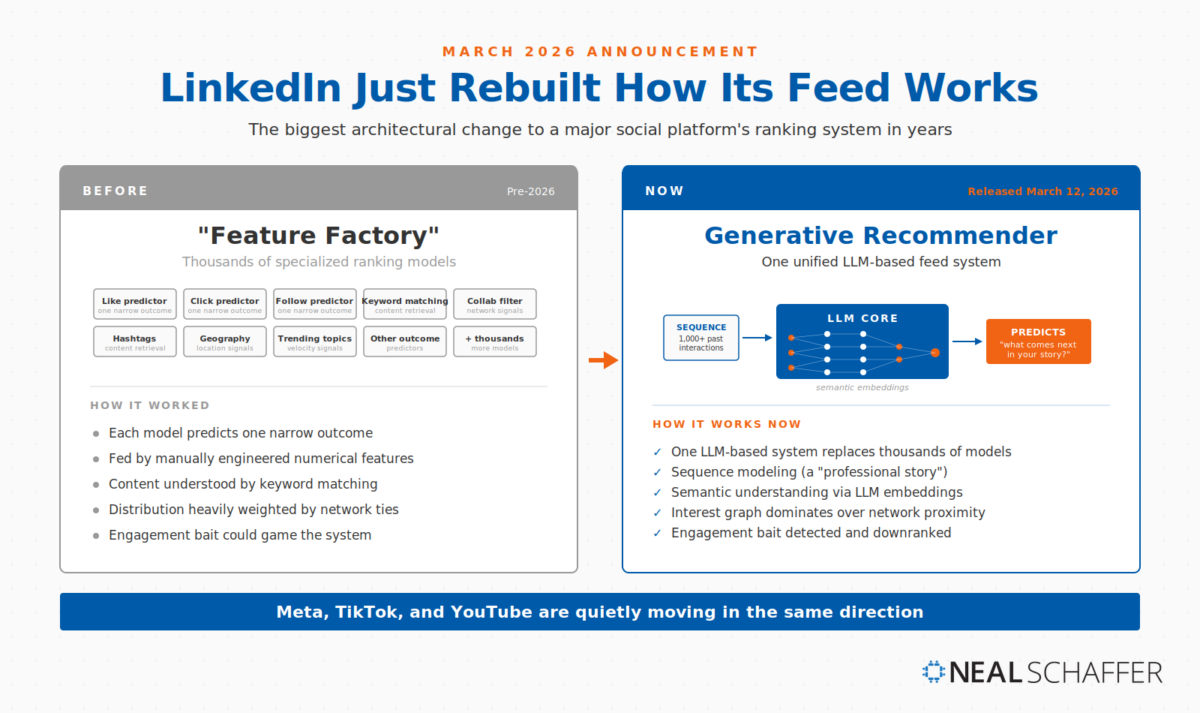 In March 2026, LinkedIn replaced its “Feature Factory” of thousands of specialized ranking models with a single LLM-based Generative Recommender. This is the architectural pattern every major platform is quietly moving toward.
First, retrieval is now LLM-based. The old approach was a patchwork of keyword matching, collaborative filtering, geography, and trending-topic systems (the “feature factory”). LinkedIn now uses a single large language model to convert both posts and member profiles into vector representations in a shared semantic space. Tim Jurka, LinkedIn’s VP of Engineering, told VentureBeat that LinkedIn replaced its entire retrieval pipeline with LLMs that understand content more richly and match it more personally to members.
Second, ranking now uses a sequence model called a Generative Recommender. Instead of scoring each post in isolation, the new ranking model processes over a thousand of a member’s past interactions as an ordered sequence (a “professional story”) and predicts what content fits next. This is structurally similar to how language models predict the next word in a sentence. The old system asked “is this user likely to engage with this post?” The new system asks “given this user’s history, what comes next in their professional journey?”
Third, LinkedIn is actively penalizing low-quality patterns. Jurka published a separate LinkedIn post announcing the platform would reduce distribution of “repetitive, click-driven posts” and explicit engagement bait. The examples LinkedIn called out by name include posts with “Comment ‘Yes’ if you agree,” posts that pair unrelated videos with text to game distribution, and recycled thought-leadership content with limited substance. This is not a small tweak. It is a structural commitment to penalize tactics that have driven LinkedIn engagement growth for years.
To put the LinkedIn change in context, here is how the old ranking architecture compares to the new one:
| Dimension | Old LinkedIn system (pre-2026) | New LinkedIn system (2026+) |
|---|
| Architecture | Many specialized ranking models, each task-specific | Unified LLM-based retrieval + Generative Recommender |
| Content understanding | Keyword matching, hashtags, manual features | Semantic interpretation via LLM embeddings |
| Distribution logic | Network proximity heavily weighted | Interest-based; topical relevance dominates |
| User history modeling | Individual signal counting | Sequence modeling (interactions as ordered story) |
| Engagement bait | Could artificially boost reach | Detected and downranked |
This matters beyond LinkedIn because every other major platform is moving in the same direction. Meta has been adding similar LLM-based content understanding to Instagram and Facebook ranking. TikTok already uses behavior-sequence modeling at scale on its For You Page. YouTube has invested heavily in semantic retrieval for its recommendation system. The platforms are converging on a shared architectural pattern: AI-driven semantic understanding of content, interest-graph-based distribution, and sequence modeling of user behavior.
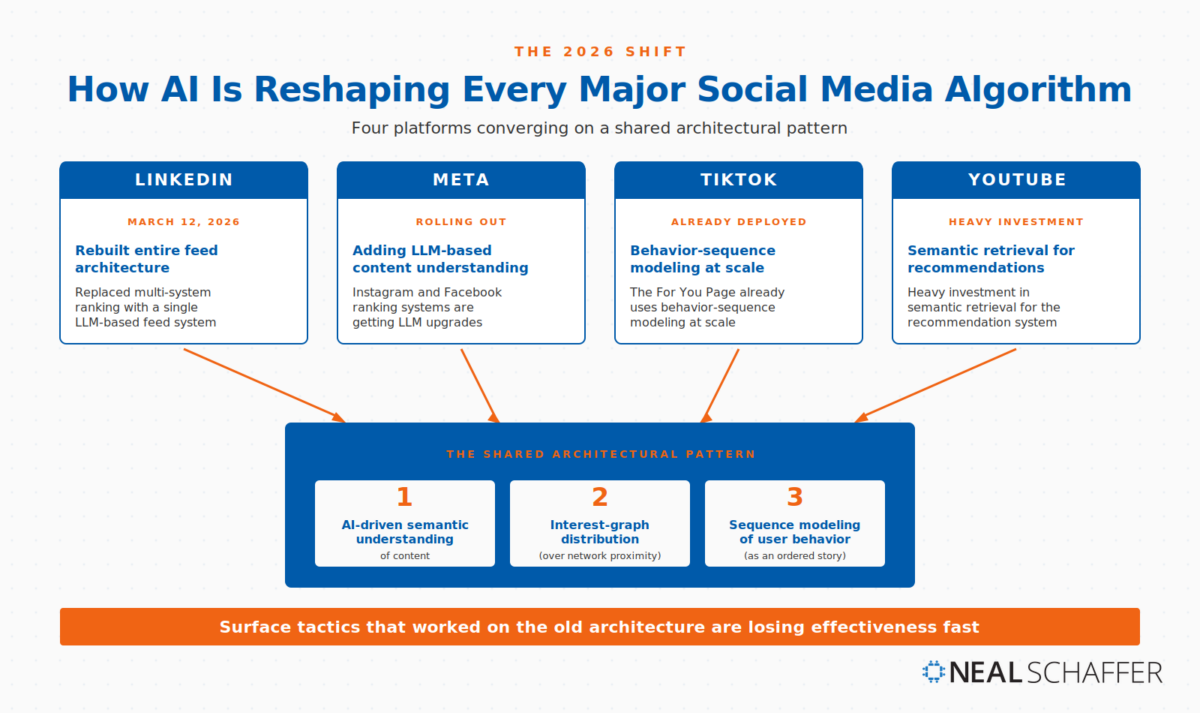 LinkedIn’s March 2026 rebuild is the loudest example, but Meta, TikTok, and YouTube are all moving toward the same three architectural elements: AI-driven semantic understanding, interest-graph distribution, and sequence modeling of user behavior.
The practical implication for marketers is sharp. The surface-level tactics that worked on the old architecture (keyword stuffing, hashtag spam, engagement bait, posting frequency hacks) are losing effectiveness fast, and in many cases are now actively penalized. The content that travels in 2026 has substance: clear topic focus, original perspective, real specifics, and writing that an AI system cannot confuse with the thousand other generic posts on the same topic.
For a deeper look at AI’s broader role in social media, including tooling, content generation, image creation, and moderation, my AI in social media post covers what is changing across the marketer’s tool stack.
What Should Marketers Do Differently Now?
Marketers who want to stay ahead in 2026 should make four specific adjustments:
- Tighten your topical focus.
- Increase the substance density of every post.
- Treat firsthand experience as a competitive moat.
- Invest in engagement-earning content rather than reach-chasing content.
These are reorientations from how most marketing teams operated even 18 months ago, not minor tweaks.
A few specific behavioral shifts I have been recommending to my consulting clients in 2026:
Audit your last five posts on each platform. Ask two questions: Would a stranger who landed on your profile immediately understand what topic you are known for? Would they want to share any of those posts with a colleague? If the answer to either is no, the algorithm probably has the same problem.
Cut your topic range by half. Most brands and creators try to cover too much. Picking three core topics and posting almost exclusively in those lanes is what trains the algorithm to associate your account with specific audiences. The accounts that wil grow the fastest in 2026 are not the most prolific. They are the most consistent in topic.
Stop using AI-generated content as your finished product. Use AI to draft, research, and outline. Then add the specifics only you have: the actual client outcome, the exact tool name, the named example, the personal experience. As Empower Agency noted in their analysis of the LinkedIn change, posts that read as generic AI-generated content are being actively suppressed on LinkedIn, with similar penalties showing up across other platforms.
Prioritize content formats that drive saves and shares. On every platform in 2026, formats that get bookmarked or sent travel farther than formats that just get liked. On LinkedIn, that means document carousels and frameworks. On Instagram, that means educational carousels and short Reels with clear takeaways. On TikTok, that means content with a strong hook and a payoff worth re-watching.
Build a content strategy that survives algorithm changes. The marketers who panic with every algorithm update are the ones who built their strategy on a specific tactic (a hashtag hack, an engagement bait formula, a posting frequency loophole). The marketers who stay steady are the ones who built their strategy on universal principles: clear positioning, valuable content, consistent posting in their lane. If your strategy still works when the algorithm changes, you built it right. If it collapses, you optimized for the wrong thing.
The broader social media trends shaping 2026 reinforce this direction. The shift toward creator-led content, the rise of social search, the dominance of short-form video, the growing role of AI in content moderation: all of them point to the same conclusion. Marketing on social media is now less about volume and more about clarity.
Frequently Asked Questions
What is a social media algorithm in simple terms? A social media algorithm is the system a platform uses to decide what content each user sees in their feed. It looks at signals like what you have engaged with before, who you follow, what topics you care about, and how other people are reacting to a piece of content. Then it ranks all the available posts and serves them in order of predicted relevance. Different platforms use different signals. They all share the goal of keeping each user engaged with content they want to see.
Why is my organic reach dropping on social media? Organic reach is dropping for most marketers because algorithms are getting better at predicting what individual users actually want to see. That often means surfacing content from creators and accounts the user has engaged with deeply, rather than every business account they once followed. Combined with the explosion in content volume and the shift from network-based to interest-based distribution, brand pages and accounts with weak engagement signals get filtered out of more feeds. The fix is rarely “post more.” It is usually “post with more specificity, substance, and topical consistency.”
Are social media algorithms biased? Social media algorithms are not biased in the sense of having personal preferences, but they reflect biases in the data they are trained on and the goals they are optimized for. They are optimized to keep users engaged on the platform, which means content that triggers strong emotional reactions (positive or negative) often gets amplified. They also tend to entrench existing patterns. If a user has historically engaged with a certain kind of content, the algorithm will keep surfacing more of it, which can narrow the range of perspectives shown over time.
How often do social media algorithms change? Major social media algorithms get small adjustments continuously and significant overhauls every one to three years on average. Platforms run thousands of experiments at any given time, tweaking signal weights, testing new ranking models, and adjusting what content gets distribution. Most of these changes are invisible to users. Major architectural shifts, like LinkedIn’s March 2026 move to an LLM-based feed system, are rarer but increasingly common as platforms adopt AI-powered ranking.
How do I find out what my audience is engaging with? The fastest way to find out what your audience engages with is to look at your own platform analytics. Every major platform (Meta Business Suite, LinkedIn analytics, TikTok analytics, YouTube Studio) shows which posts performed best by engagement rate, saves, shares, and watch time. Patterns become visible after ten to twenty posts. The temptation is to look at vanity metrics like follower count. Resist it. Saves per post and comment depth are far more useful signals of what is working.
Will AI-generated content hurt my reach? AI-generated content will not automatically hurt your reach. Generic, undifferentiated AI output increasingly will. Most major platforms now have classifiers trained to detect content patterns associated with low-effort AI generation: empty platitudes, generic phrasing, lack of specific examples, mismatched formality. The safest approach in 2026 is to use AI as a drafting assistant. Then ensure every published post has substantive specifics that an AI system writing from a generic prompt would not include: real names, real numbers, real outcomes, real opinions.
Conclusion: Stop Beating the Algorithm. Start Working With It.
Marketers have spent the last decade in an adversarial relationship with social media algorithms: trying to outsmart them, hack them, or beat them. The 2026 algorithm shift, driven by AI-powered semantic understanding and interest-based distribution, makes that adversarial approach actively counterproductive. The signals algorithms now read for are not signals you can fake. You can only earn them by producing content that real people genuinely want to engage with.
If there is one thing to take away from this guide, it is the framing from Digital Threads that I keep coming back to: Algorithm = Audience. The algorithm is the proxy for the people you are trying to reach. Build for them, and the algorithm becomes your distribution channel. Build to trick the algorithm, and you are trying to win against the very people you claim to serve.
If you want to dig deeper into how to apply this thinking across your full digital strategy, my book Digital Threads lays out the framework I’ve been using with Fractional CMO clients for years. You can also download a free preview to see the first few chapters.
For a broader strategic foundation, my full social media marketing strategy guide covers how to build a multi-platform approach that holds up across algorithm changes. The platforms will keep evolving. The principles of building real audiences with real content will not.
Actionable advice for your digital / content / influencer / social media marketing.
Join 13,000+ smart professionals who subscribe to my regular updates.