Tuesday, June 2, 2026
I’m not ashamed to admit that when I first started interviewing for jobs, way back when, I had to dig through my dad’s closet to figure out what to wear.
I did what I could. I was swimming in his dress shirts, though we could pin those and hide the worst of it under one of his jackets. Which didn’t really help matters.
Eventually I got my own clothes that actually fit, and I became gainfully employed.
Speaking of wearing gear that wasn’t made for you: take a look at this 2024 Los Angeles Times article, and pay attention to the first image. That’s LA County Supervisor Janice Hahn, trying on the turnout gear that female firefighters are issued.
And she’s swimming in it.
The difference is she’s not a kid interviewing in his father’s clothes.
Female firefighters wear this gear on the job, and it’s designed for the male body. That alone is dangerous, with potentially life-altering outcomes.
Add the effects of Fit Volatility, and the problem gets even harder to solve.
Ill-fitting turnout gear is a clear case of “Fit Failure.” The consequences here: exposed skin from physical gaps, and added heat stress from carrying more bulk than the job requires.
Women wearing PPE built for the male body have no “Fit Trust.” When you can’t trust how a garment fits, its function suffers.
We covered “Fit Trust” in an earlier edition, on the Get Low legging. The fabric was see-through, the brand’s fix was to tell customers to size up, and the returns and complaints followed.
Our take: Lulu, like a lot of brands, tries to solve fit at proto review when it should be solving much earlier in product creation, and across sizes. Same pattern: the see-through fabric is Fit Failure, and walking around in those pants is a lack of Fit Trust.
Then there’s size bracketing and vanity sizing. With no universal standard, you can’t be a “Medium” everywhere you shop. That’s a fashion-wide lack of Fit Trust!
For Lulu, the stakes are brand loyalty and more negative buzz. For turnout gear, it’s safety in high-risk situations. For the apparel business, it’s returns and excess inventory, and even the “sustainable” brands get caught in the trap.
Fit Volatility makes all of this harder.
The methods for creating garments are clearly outdated.
If turnout gear has been built around male bodies, how quickly can that be corrected while also accounting for GLP-1 use and the rise of strength training among women? And how much is male body composition data being updated to keep pace with changes in men, too?
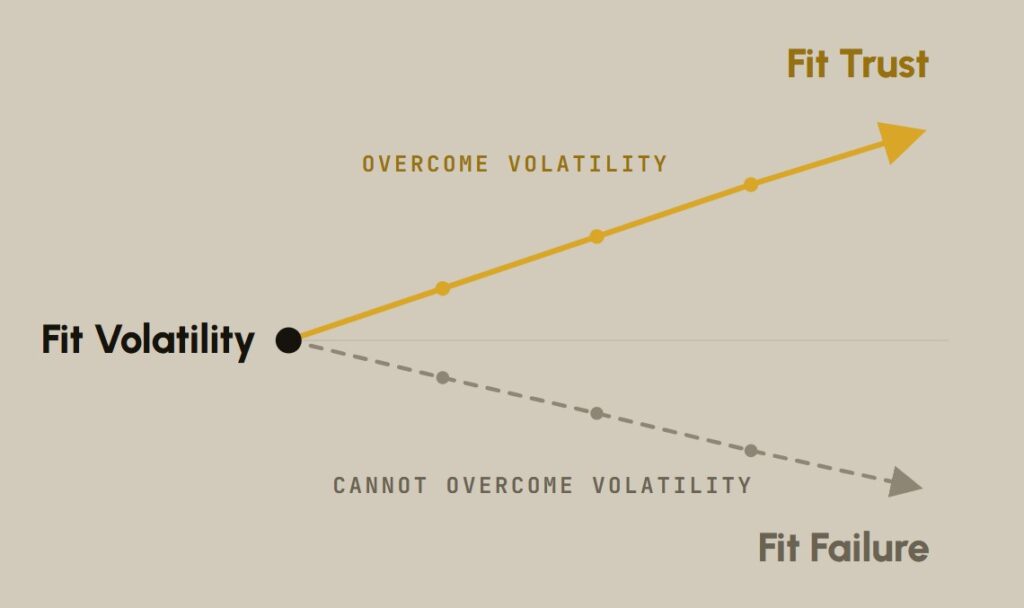
Getting a handle on Fit Volatility matters. Manage it, and you earn Fit Trust. Ignore it, and you get Fit Failure.
The diagram below makes the point:
I am glad that I was able to develop my own Fit Trust in my clothes. I discovered slim fit dress shirts, made to measure suits and stretch fabrics in my pants. The safety pins have been retired.
In my case of Fit Failure, the cost was just a few awkward conversations. For everyone else, the bill comes due in the form of returns, excess inventory, hesitant consumers, and in the worst cases, safety when it matters the most.
About Retail Strategy Group
Founded in 2020, Retail Strategy Group works with market-leading brands to help them improve profitability and increase organizational effectiveness. The firm produces a weekly newsletter, The Merchant Life, where retail executives find the best retail insights and new, provocative ideas. For more information, visit www.retailstrategygroup.com.