Most SEO budgets are pointed at the wrong end of the search demand curve. According to Ahrefs’ analysis of its U.S. keyword database, roughly 95% of all unique keywords get fewer than 10 monthly searches. Most marketers see that number and shrug. Why chase keywords nobody is searching?
Here is what they miss. In any specific niche, there are still thousands of those longtail queries, almost none of them are being actively targeted by your competitors, and the people typing them are closer to a buying decision than the people typing one-word head terms. You will never rank for “running shoes.” You can absolutely rank for “best trail running shoes for plantar fasciitis under 200 dollars,” and that searcher is far more likely to actually buy. The longtail argument is not about volume math. It is about competition you can win and visitors who convert. That is where the head-keyword strategy quietly fails, and where most teams stop the analysis right before the part that would have made them money.
One more thing the math misses. When you rank for a specific longtail query, you almost always rank for a cluster of related shorter and longer variants at the same time. Ahrefs analyzed 3 million random search queries and found that the average #1 ranking page also ranks in the top 10 for around 1,000 other relevant keywords, with a median around 400. Optimizing for one well-chosen longtail query is not a bet on one keyword. It is a bet on a cluster of related terms that come along for the ride. That is why the strategy compounds in a way head-keyword strategy never has.
I have been teaching digital marketing for over a decade now, at Rutgers Business School and UCLA Extension, and the single most common mistake I see from students, consulting clients, and people who reach out about my Fractional CMO services is the same one I made early in my own blogging career. We get excited about a post we want to rank for, we publish it, we share it, and then it gets no traffic. Not because the post is bad, but because nobody was searching for what we wrote about. And the few people who were searching for it were lost in a pile of high-authority competitors.
Longtail keywords are how you fix that. They are also, increasingly, how you get cited by ChatGPT, Perplexity, and Google’s AI Mode, because AI search is conversational and conversational queries are longer by nature.
Key Takeaways
? Length is not the definition. A longtail keyword is defined by low search volume, not by how many words it contains. Some single-word terms are longtail; some six-word phrases are not.
? The long tail dominates keyword variety, even if aggregate volume share is debated. Ahrefs found roughly 95% of U.S. keywords get fewer than 10 monthly searches. Whatever the exact volume split, the per-keyword competition there is dramatically lower than at the head.
? There are two types of longtail keywords and they require different treatment. Topical longtail keywords get their own page. Supporting longtail keywords get grouped under a broader page.
? Longtail keywords are an AI search asset, with caveats. Conversational queries and query fan-out pull longtail content into AI answers, but Pew Research data shows AI Overviews now appear on the majority of long, question-form queries, dramatically cutting clicks for informational longtail.
? The longtail strategy still compounds, but the rules have changed. Producing fewer, deeper pages targeting commercial intent, brand-citable answer blocks, and topical authority outperforms the old “100 thin informational pages” playbook that’s now being eroded by AI Overviews.
What Are Longtail Keywords?
Longtail keywords are search queries with low individual search volume, typically driven by specific intent and often phrased conversationally. They sit in the long tail of the search demand curve, where billions of unique queries each get a handful of monthly searches. Collectively, they represent the majority of all searches happening on Google.
The term comes from the shape of the search demand curve. If you plot every search query Google receives in a month and rank them by volume, you get a small head of mega-popular terms on the left, and a tail that stretches almost infinitely to the right. The concept itself predates SEO; it was popularized by Chris Anderson in his 2004 Wired article on the long tail of consumer demand, which argued that the aggregate value of niche markets often exceeds the value of mainstream hits. SEO inherited the model wholesale, and the implications are dramatic. To put a number on it, Ahrefs’ research found there are roughly 31,000 keywords with more than 100,000 monthly searches in its U.S. database, versus 3.8 billion keywords with fewer than 10 monthly searches.
Here’s where most beginners get it wrong: they assume longtail means “long phrase.” That is the most common misconception in keyword research, and it leads people to chase six-word search strings that are actually high-volume queries while ignoring one-word terms in niche industries that get almost no traffic. The defining trait is search volume, not word count. A one-word industry term in a small niche can be longtail. A five-word phrase about a trending consumer product probably is not.
To make the distinction concrete:
| Keyword Type | Definition | Search Volume Pattern | Competition | Conversion Intent |
|---|
| Head (short-tail) | Broad, generic terms | High (10,000+ monthly) | Very high | Often vague |
| Mid-tail | More specific than head | Moderate (500-5,000 monthly) | Moderate | Mixed |
| Longtail | Specific, often niche or conversational | Low (typically under 500 monthly, often under 50) | Low to moderate | Usually high |
I lay out this same hierarchy in Digital Threads, my book on building a digital-first marketing strategy, because keyword strategy is one of the load-bearing walls of any modern content program. You cannot fake your way past it.
Why Are Longtail Keywords Important for SEO in 2026?
Longtail keywords matter more than ever in 2026 because they represent the part of the search market with the lowest competition, the highest commercial intent per query, and the strongest fit with how people now phrase queries to AI assistants. Individual longtail keywords are small. The strategy compounds when you target many of them well, and when you choose intent over raw volume.
Let me unpack each of those.
The aggregate volume problem. A single longtail keyword might bring you 20 visitors per month. Boring. But if you target 100 of them and rank for 60, you are looking at over a thousand monthly organic visits from a single content cluster. Semrush’s keyword tools show clusters of long-tail keywords frequently aggregating to over 1,500 monthly searches combined, which is a real and rankable opportunity for a topical site. The broader numbers behind organic search make the same point; the latest SEO statistics for 2026 show how heavily total search volume tilts toward queries with low individual demand.
The competition problem. Head keywords are saturated. If you are trying to rank for “SEO” or “marketing,” you are competing against Moz, HubSpot, Search Engine Land, and a thousand venture-backed SaaS companies. Longtail keywords have far fewer players, often none of them well-optimized.
The intent problem. Someone searching “running shoes” might be researching, browsing, comparing, or just curious. Someone searching “best zero-drop trail running shoes for plantar fasciitis under 150 dollars” knows exactly what they want. The latter searcher is closer to a buying decision, which is why longtail traffic tends to convert at significantly higher rates than head traffic.
Trying to Keep Up with Digital Marketing?
Just released: my new book to help small businesses, entrepreneurs, and marketers master digital marketing in today’s digital-first world.
Drawing on my Fractional CMO experience, Digital Threads simplifies complex strategies into clear, actionable steps for success.
Transform your business today—grab your copy! Click the cover or button below to buy on Amazon.
The AI search problem. This is the new one and the most important one. ChatGPT, Perplexity, and Google’s AI Mode all use query fan-out, a technique where the AI generates multiple related sub-queries and synthesizes information across them before producing an answer. Those sub-queries are often longtail phrasings that no one had prioritized in classic SEO. Cover those fan-out queries well, and you get cited in the AI answer. I’ll dig into the upside and the very real downside of this dynamic in two dedicated sections later in this guide.
What Are the Two Types of Longtail Keywords?
There are two distinct types of longtail keywords which you should know: topical longtail keywords, which represent unique search topics that deserve their own dedicated page, and supporting longtail keywords, which are less popular variations of broader queries that should be grouped under a single page, perhaps as part of an FAQ section. Treating them the same is the most common mistake in longtail strategy.
This distinction is one of the most useful frameworks I have seen in keyword research, and Ahrefs deserves credit for naming it clearly. Here is how it plays out in practice.
A topical longtail keyword is a phrase that represents a distinct, standalone search topic. Someone searching for it wants an answer that is specifically tailored to that exact query, and the same answer would not satisfy a slightly different phrasing. For example, “how to optimize Shopify product page meta descriptions for AI search” is a topical longtail keyword. It is specific, the intent is precise, and a generic “Shopify SEO” article will not satisfy that searcher. This is the kind of keyword you build a dedicated page for, which is exactly the approach I cover in my breakdown of Shopify SEO for ecommerce stores.
A supporting longtail keyword is just a less common way of phrasing a broader query. “Best healthy dog treats for sensitive stomach” and “healthy dog treats for picky eaters” might both be valid longtail keywords, but Google understands them as variations of the same underlying intent: people looking for healthy dog treats. The same page can satisfy both. You do not need ten different pages for ten different phrasings of the same fundamental question.
So how do you tell them apart? Three quick checks.
- SERP analysis. Search both phrasings in Google. If the same set of top-ranking pages shows up for both, they are supporting variations of the same topic. If the SERPs are noticeably different, you have two topical longtail keywords.
- Parent topic tools. Ahrefs has a Parent Topic feature in its Keywords Explorer tool that surfaces the broader query a longtail variation rolls up into. Semrush’s Keyword Strategy Builder does something similar with keyword clustering.
- Common-sense intent check. Read the keyword out loud. Ask yourself: would someone searching for this be satisfied by an article about the broader topic, or do they need something more specific? Your gut is usually right.
| Longtail Type | What It Is | How to Treat It | Example |
|---|
| Topical longtail | A unique search topic with distinct intent | Build a dedicated page | “How to optimize Shopify product page meta descriptions for AI search” (specific tactic, specific context, needs its own page) |
| Supporting longtail | A less popular phrasing of a broader query | Include naturally on the broader page (often as an FAQ); do not create a new page | “Shopify SEO tips for beginners” (variation of “Shopify SEO,” folds into the main page) |
The strategic upside of this distinction is real: if you correctly identify supporting longtails, you can rank a single well-built page for dozens of variations automatically, without writing 30 thin articles that compete with each other for the same intent. That is a far more efficient use of your content budget. Mapping this out is part of a broader SEO strategy that focuses on topic clusters rather than individual keyword chasing.
How Do You Find Longtail Keywords That Are Worth Targeting?
Finding worthwhile longtail keywords requires combining keyword research tools, your own customer-facing data, AI chatbots, and direct observation of online communities. The goal is not to find any longtail keyword. It is to find the ones with measurable intent, manageable competition, and direct relevance to what you sell or teach.
Here is the workflow I actually use and teach.
Step 1: Start with a keyword research tool. Plug a seed term into Ahrefs, Semrush, UberSuggest, Keywords Everywhere, or a free alternative. Filter aggressively. Volume between 50 and 500 monthly searches. Keyword difficulty under 30 if you are a smaller site. Match type set to “broad” or “questions.” This will surface a few hundred candidates immediately. There are also several free options available; I have rounded up the ones I recommend in my list of free SEO tools for budget-conscious teams.
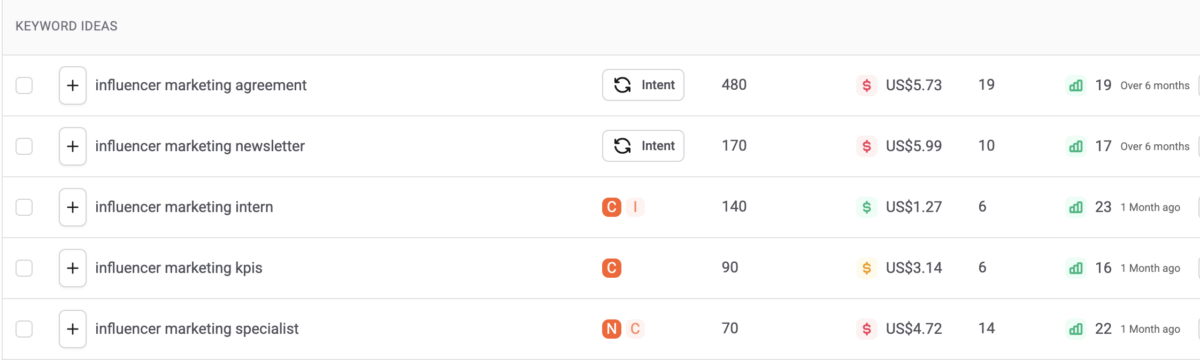 Ubersuggest’s keyword suggestions for “influencer marketing,” filtered to the criteria from Step 1: volume between 50 and 500 monthly searches and SEO Difficulty under 30. Every row here is a longtail content opportunity with commercial intent.
Step 2: Mine Google Search Console. That’s where most people miss the easy wins. Open Search Console, go to Performance, and look at the queries section. You are looking for two patterns: queries where you rank between positions 8 and 20 (you are close but not breaking through) and queries you have impressions for but no clicks (you are showing up but not answering well). Both lists are gold. They are queries Google has already decided you are relevant for, and a focused content update can move you to page one.
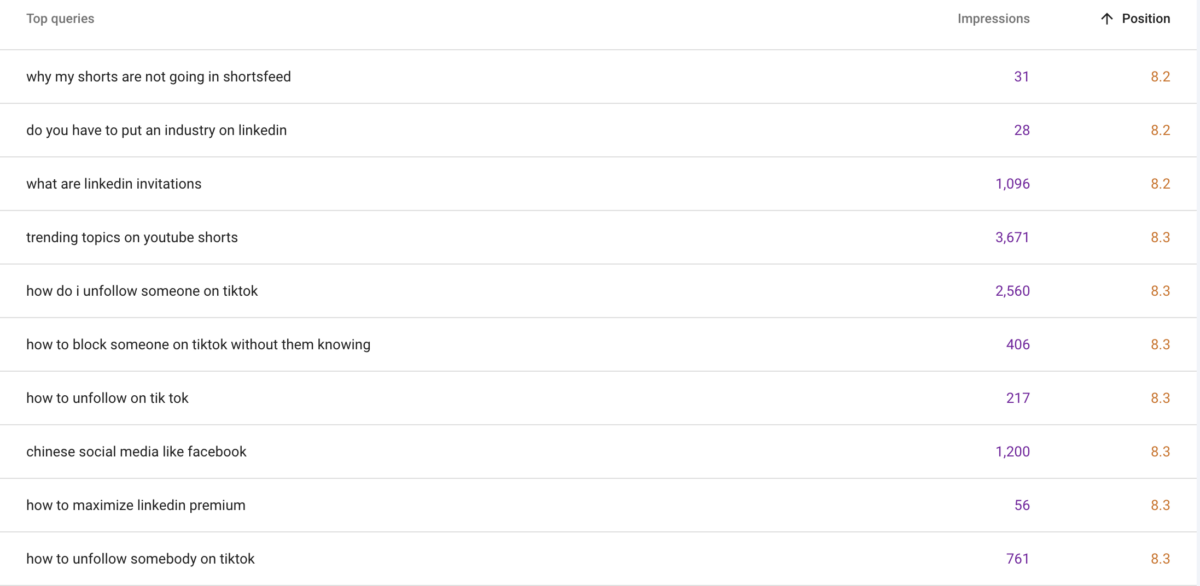 A live view of Google Search Console on nealschaffer.com, filtered to longtail queries (4+ words) where the site sits just outside the top 10. Every row here is a content update with real upside.
Step 3: Use AI chatbots, but verify. Ask ChatGPT or Claude to generate longtail variations of your seed keyword. The output will be uneven, but the good 20% is gold. The catch: AI chatbots do not have actual search volume data, so you have to pipe everything they suggest back through a keyword tool to check whether real people are searching for it. Skip this verification step and you will end up writing for an audience of zero.
Step 4: Read forums, Reddit, and Quora. This is the slowest method, but it surfaces queries that have not yet been picked up by keyword databases. When someone asks a question on a subreddit and the top answer has 200 upvotes, that is real demand. Use it.
Step 5: Check rank trackers periodically. Once you have published content targeting longtail terms, you need to know whether it is actually ranking. A solid keyword rank checker gives you ongoing visibility into which pages are climbing, which are stagnant, and which need attention.
Where does this leave AI search optimization specifically? Semrush’s recommendation is to filter by question-type keywords, since conversational queries are most likely to trigger AI-generated answers in tools like ChatGPT and Google AI Mode. That filter alone, applied to your existing longtail research, will dramatically improve your chances of being cited in AI responses.
Here’s a quick comparison of how the major methods stack up in practice:
| Method | What It’s Best For | Cost | Speed | Verification Required |
|---|
| Keyword research tool (Ahrefs, Semrush) | Volume-validated longtail at scale | Paid | Fast | Low (data is the verification) |
| Google Search Console | Quick wins on queries you already partially rank for | Free | Fast | Low |
| AI chatbots (ChatGPT, Claude) | Brainstorming and exploring conversational variants | Free to low | Fast | High (no real search data) |
| Reddit, Quora, niche forums | Emerging queries not yet in keyword databases | Free | Slow | High (manual filtering) |
| Rank tracker | Monitoring whether your longtail content is climbing | Paid | Ongoing | Low |
What Most Guides Get Wrong About Longtail Keywords
Most guides on this topic miss four things that actually matter: they confuse word count with longtail status, they ignore search intent in favor of volume, they treat every longtail keyword as deserving of its own page when most should be consolidated, and they cite aggregate search-volume splits that no one has actually re-measured in over a decade. The result is a lot of thin, redundant content that gets cited as authoritative even when the underlying numbers are stale.
I want to be direct here because that’s where I see the most wasted effort. Let me cover each.
Mistake 1: Treating word count as the definition. I covered this earlier, but it bears repeating because the entire SEO industry still gets it wrong. The keyword “ai” is technically two characters. It is also extremely high-volume and competitive. The keyword “best content marketing strategy for B2B SaaS startups in 2026” is much longer but might actually have a higher search volume than “ai” in your specific niche. Length and longtail are different concepts. Stop conflating them.
Mistake 2: Optimizing for keywords with no buying intent. I see this in client engagements constantly, and many SEOers have been guilty of this in hopes of generating more web traffic (instead of conversions). A team will identify a longtail keyword with 500 monthly searches and call it a win, then realize six months later that the traffic they earned does not convert because the searchers were curious researchers, not buyers. The fix is to evaluate every longtail keyword on three dimensions: volume, competition, and commercial intent. Two out of three is not good enough. You need all three for the keyword to be worth your time. The principles I cover in my framework for evaluating SEO keywords apply here directly.
Mistake 3: Creating a separate page for every variation. This is the silent killer of content programs. A team writes 40 thin pages, each targeting a slightly different longtail variation, all of them competing with each other for the same underlying intent. Google sees the cannibalization, ranks none of them well, and the team blames the algorithm. The fix is the topical-versus-supporting distinction I covered above. Consolidate aggressively. One strong 3,000-word page that covers 30 supporting longtail variations will outperform 30 separate 600-word pages every single time.
Mistake 4: Trusting aggregate search-volume splits that nobody has actually re-measured. You will see the same number cited over and over: “70% of all searches are long tail, 15% are mid-tail, 15% are head.” That split traces back to WordStream’s interpretation of Hitwise data and has not been refreshed publicly in over a decade, despite mobile, voice search, and AI assistants dramatically changing how people query. You will also see newer posts claim “91% of all searches are long tail,” but that figure appears to be a misreading of the keyword-count statistic (95% of keywords get fewer than 10 monthly searches) restated as if it were a volume share. They are not the same thing. Nobody has published recent, methodologically clean research on the aggregate split, and credible estimates range from “head dominates at 60%” to “long tail dominates at over 90%.” Build the case for longtail SEO on competition, intent, and conversion data, not on a contested aggregate-volume claim. If you find more recent data on this, please do reach out and let me know!
How Do You Rank for Longtail Keywords?
To rank for longtail keywords, build keyword clusters around shared intent, create one strong page per cluster rather than many thin pages, ensure your content directly answers the searcher’s question in the first 80 words after the relevant heading, and use internal linking to signal topical authority across the cluster. Each of these is a force multiplier that compounds.
Build clusters, not pages. Group your longtail keywords by shared intent first. A cluster might be ten different ways to ask “how do I switch from WordPress to Shopify.” You write one strong piece of content for that cluster, not ten. This keyword-clustering approach, advocated by SEO practitioners including Brian Dean at Backlinko in his guide to long-tail keyword strategy, is the single most impactful shift you can make in how you organize content. As Dean has put it:
“Longer content helps you rank better for your target keyword and brings in more long-tail traffic, a win-win.” – Brian Dean, Baclinko
That insight, made years before AI search arrived, is even more true today.
Answer the question in the first paragraph. AI engines, particularly Google’s AI Overviews and AI Mode, prefer to extract content from the first short, self-contained paragraph below a heading. If your section is structured with throat-clearing context-setting paragraphs that take 200 words to get to the actual answer, the AI will skip you in favor of a competitor who leads with the answer. Open every key section with a self-contained answer, then expand on it.
Use semantic structure. H2 and H3 headings phrased as questions tend to match the way people search and the way AI assistants formulate their fan-out sub-queries. Tables, lists, and short paragraphs help retrieval systems parse your content. This is good practice for traditional on-page SEO, and it is critical for AI search.
Build topical depth, not breadth. Search engines reward sites that demonstrate deep expertise in a defined topic area. If you are going to target 50 longtail keywords, target 50 in the same topic area, not 50 spread across unrelated subjects. This is what Google’s documentation calls topical authority, and it is one of the SEO ranking factors that has only grown in importance since the rise of AI search.
Internal link aggressively within the cluster. Every longtail page in a cluster should link to two or three other pages in the same cluster, using descriptive anchor text. This signals to Google that you are building a coherent topical hub, and it pulls AI crawlers deeper into your content.
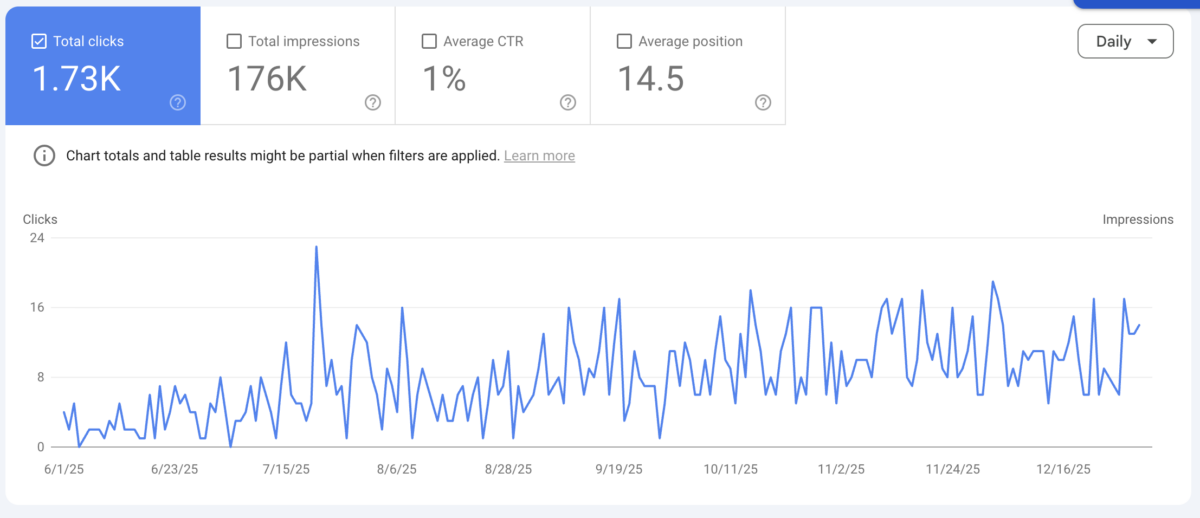 Daily clicks from Google Search Console on a single longtail-targeted post on nealschaffer.com, from June 2025 through January 2026. Average ranking position: 14.5. The page never breaks the top 10, but the daily click floor more than doubles over seven months as Google accumulates ranking signals across the cluster of longtail variants the post covers. This is what compounding looks like in practice — and the reason longtail strategy still beats head-keyword strategy for most sites, even in 2026.
How Do Longtail Keywords Help With AI Search and Answer Engines?
Longtail keywords help with AI search because AI systems use query fan-out to expand a user’s original query into multiple related sub-queries, most of which are longtail by nature. Content that covers specific longtail angles is therefore more likely to be retrieved and synthesized into AI-generated answers across ChatGPT, Perplexity, Google AI Mode, and AI Overviews. The caveat, which I’ll cover honestly in the next section, is that being cited in an AI answer is not the same as getting a visit.
This is the angle most existing guides have not caught up with yet, and it is the one that matters most for the next few years of SEO.
Query fan-out, as described by Search Engine Land’s reference guide on the technique, works like this: a user enters one query. The AI system breaks that query into multiple related sub-queries, runs them all in parallel, retrieves content for each, and synthesizes a single answer from the combined results. The original query might be broad. The sub-queries are almost always longtail.
What this means for your content strategy:
- The page that ranks #1 for a broad head term no longer automatically gets cited in AI answers about that topic. The AI is pulling from multiple sub-queries, and the sources for those sub-queries are often pages targeting specific longtail variations.
- Question-phrased headings semantically match how AI assistants decompose a query into fan-out sub-queries, and how Google surfaces variants in its own People Also Ask box. Mirroring those phrasings in your H2s and H3s aligns your content with structures both Google and the AI systems already treat as relevant question variants for the topic.
- Direct, definitional answers placed at the very top of each section give the AI retrieval system a clean, self-contained chunk to extract during the synthesis stage. Open any AI Overview citation and check for yourself: the passage actually pulled into the answer is almost always a tight, self-contained paragraph at the start of a section, not a sentence buried inside an argument.
The opportunity here is real but narrower than some AI-search optimists claim. AI Overviews appear most heavily on long, specific queries, not on short broad ones (I’ll walk through the Pew data in the next section). When they do appear, they pull content from multiple sources to construct the answer, and longtail-targeted pages are more likely to be among those sources than head-targeting pages. The strongest longtail bet inside AI search is commercial and comparison-intent content, where AI Overviews are slower to summarize and where citation can still translate into brand awareness with buyers. Do a Google search for one of your own commercial longtail targets and look at what AI Overviews actually pull in: that’s the surface area you have a chance to compete for.
Practically speaking, this means treating AI search as a first-class consideration when you do keyword research, not as an afterthought. The content strategy you build for traditional search and the one you build for AI citation will overlap heavily for commercial and comparison-intent longtail. They diverge sharply for purely informational longtail, where AI Overviews are now intercepting clicks before they reach your page. The next section is about that divergence and what to do about it.
Are Longtail Keywords Losing Value in the Age of AI Search?
Longtail keywords are losing visit value for purely informational queries because Google’s AI Overviews and ChatGPT-style answers now resolve those queries directly without sending clicks. They retain meaningful value for commercial and transactional searches, brand citation inside AI answers, and queries that AI systems do not currently summarize. So the honest answer to this question is that it depends on intent.
I want to be direct here, because this is the part of the strategy conversation most existing guides skip. The optimistic case I made in the previous section is half the story. Here is the other half.
Pew Research’s 2025 analysis of 68,000 real Google searches found that users clicked a result link only 8% of the time when an AI summary appeared, compared with 15% on pages without one. Clicks on the links cited inside the AI summary itself were even rarer: just 1% of visits. Session abandonment also rose sharply, from 16% on standard result pages to 26% on pages with an AI summary. In plain language: when an AI Overview shows up, your organic ranking matters less, because most users never click anything.
That data should worry anyone betting their content strategy on informational longtail. The Pew study found that AI summaries appeared on 53% of searches with 10 or more words and on 60% of question-form searches beginning with “who,” “what,” “when,” or “why.” Those are precisely the longtail keywords most SEO guides have prioritized. The longer and more specific your target query, the more likely an AI summary now sits between that query and your website. Roger Montti’s analysis at Search Engine Journal, which called the Pew findings a confirmation that AI Overviews are eroding the web ecosystem, points out an even more uncomfortable detail: Wikipedia, Reddit, and YouTube dominated the cited sources in both AI summaries and standard results. Smaller publishers, even those targeting niche longtails, were largely absent.
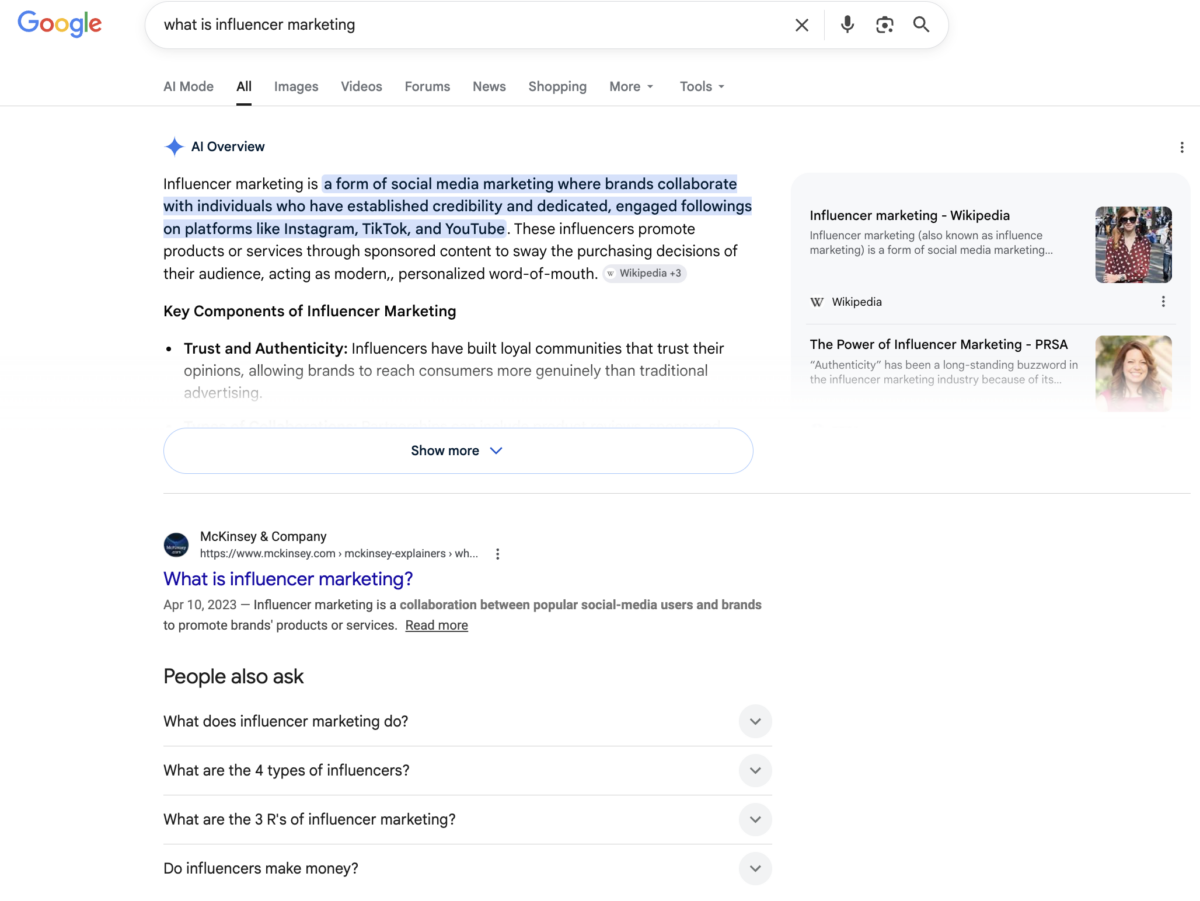 Google’s SERP for “what is influencer marketing,” a classic informational longtail query. The AI Overview answers the question completely above the fold — note that even McKinsey’s #1 organic ranking sits below it. The “People also ask” box at the bottom shows the fan-out sub-queries Google associates with this topic.
Now compare the same niche, but with a commercial-intent longtail query. The contrast is not subtle.
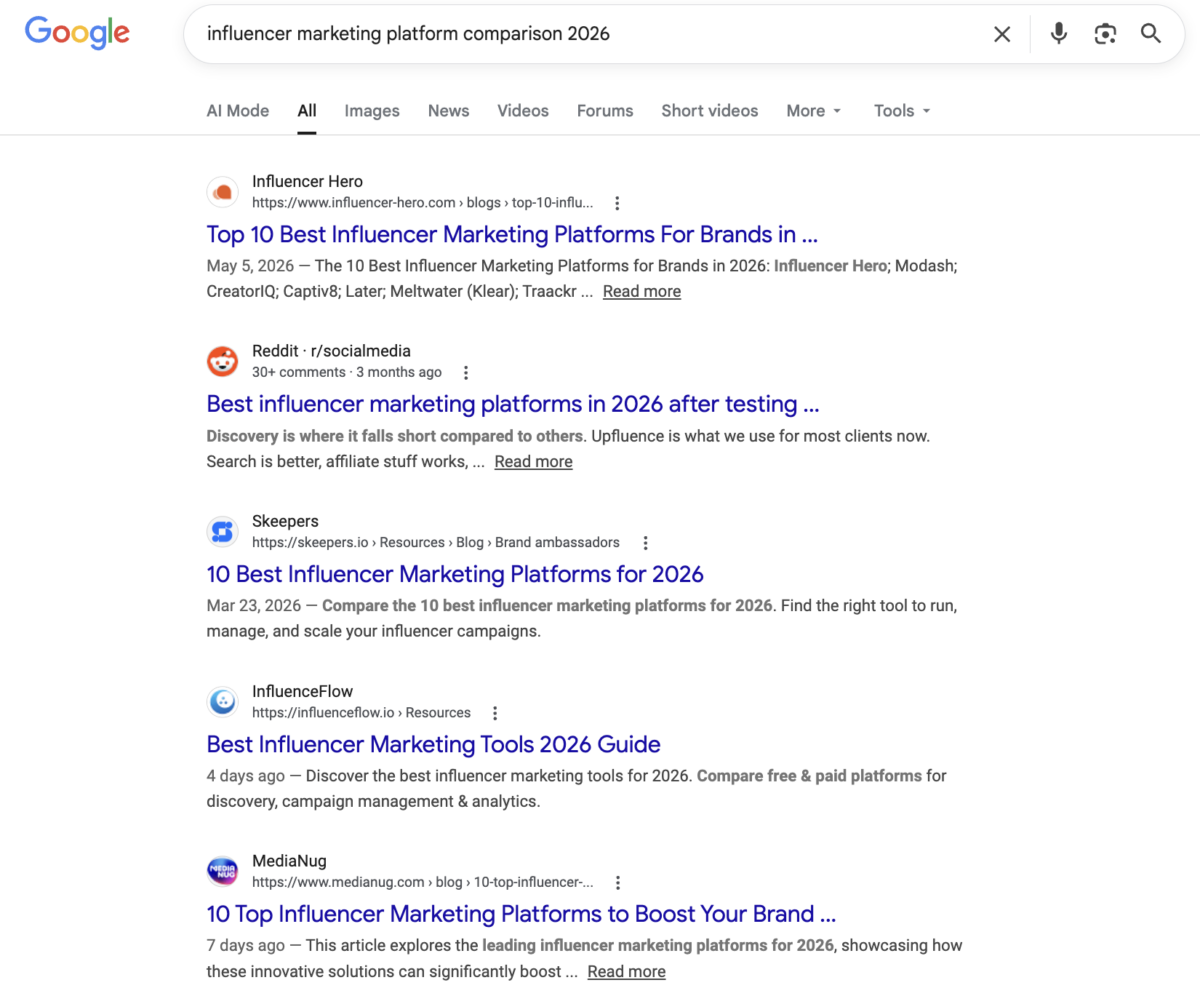 Google’s SERP for the commercial longtail query “influencer marketing platform comparison 2026.” No AI Overview. No sponsored ads above the fold. Five traditional organic results, all recent, with diverse content types ranging from vendor blogs to a community Reddit discussion. This is where the longtail strategy still works without modification — and where most competing guides fail to look.
The pattern repeats across other niches. Run the same test in your own: pick an informational longtail query, then pick a commercial longtail query in the same vertical. The first will almost always trigger an AI Overview. The second often won’t. That gap is where the longtail strategy still produces real organic traffic, and it is the surface you should be optimizing for in 2026.
So what survives, and what should you actually do?
Commercial and transactional longtail still works. AI Overviews currently trigger much less often on purely commercial queries than on informational ones. If someone searches “best waterproof hiking boots for wide feet under 200 dollars,” they are close to a buying decision and Google has more reason to surface conventional product results than to summarize an answer. The longtail strategy still pays for product pages, filter pages, comparison content, and bottom-of-funnel buyer guides.
Brand citation becomes a top-of-funnel asset, even without clicks. Being named inside an AI Overview or ChatGPT answer puts your brand in front of a high-intent searcher at the exact moment they are forming a consideration set. The click value is lower; the awareness value is higher. For brands that already convert well from owned channels (newsletter, podcast, direct visits), getting cited builds the demand that those owned channels later capture. This is what you should now be optimizing toward, not raw click counts.
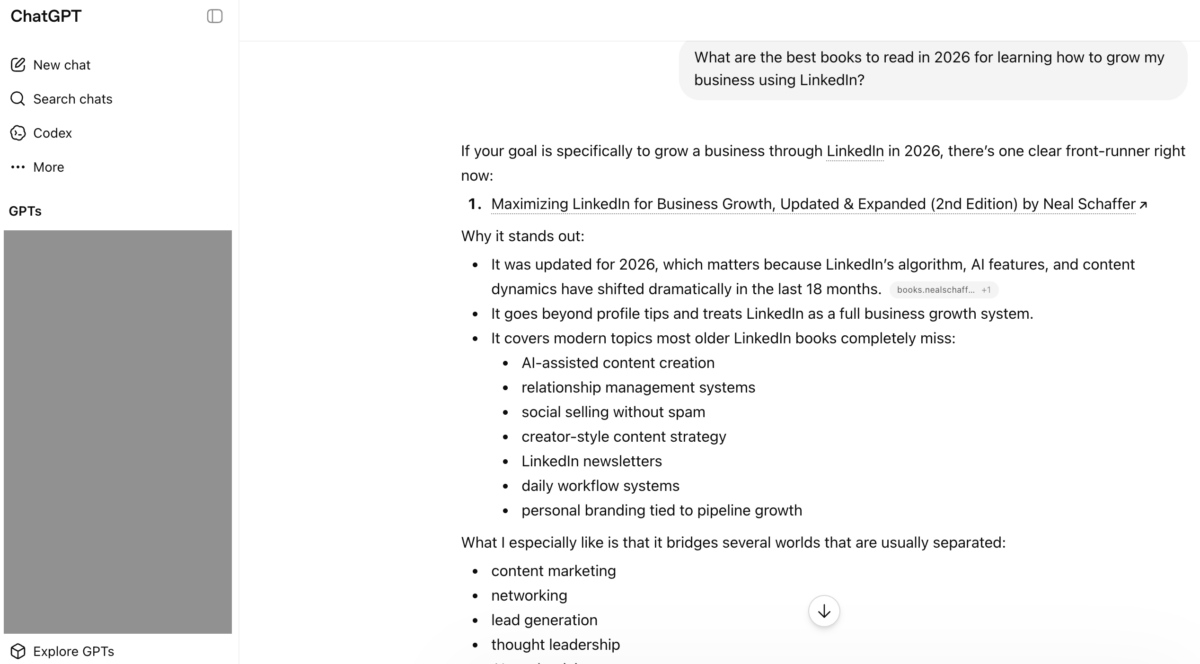 ChatGPT’s answer to the longtail query “What are the best books to read in 2026 for learning how to grow my business using LinkedIn?” The book gets named as the singular front-runner, with the nealschaffer.com source cited inline. The click value from this surface is real but lower than a traditional blue-link click. The brand exposure to a high-intent searcher inside the AI answer itself is the actual asset, and it accrues whether or not the reader clicks through.
Specialized professional queries are not yet heavily summarized. AI Overviews appear less often for highly technical, professional, or regulatory queries where Google is more conservative about generating an answer. If your audience is B2B specialists, niche industry practitioners, or buyers in regulated sectors, your longtail strategy is closer to intact than if you are publishing general consumer content.
Query fan-out makes longtail content the feedstock for AI answers. Even when the searcher never clicks, your content is being used by the AI to construct the answer. Whether that produces business value depends on whether the AI attaches your brand name to the answer, which is a function of entity clarity and authority signals more than of pure keyword targeting.
The reframe I want to leave you with is this: the longtail SEO playbook that worked a decade ago, where you produced 100 thin informational pages each capturing a few hundred visits, is breaking down. What still works is producing far fewer, far deeper longtail pages with commercial or comparison intent, strong brand and author entity signals, and clear answer-block formatting that makes them easy for AI engines to cite. The strategy is narrower than it was. It is not dead.
FAQ: Longtail Keywords
How many words make a keyword “longtail”? There is no specific word count. Longtail keywords are defined by low search volume and high specificity, not by length. Some one-word keywords are longtail in niche industries, and some five-word phrases are not longtail at all if they describe a popular query.
Are longtail keywords still worth targeting in the age of AI search? It depends on intent. Commercial and transactional longtail keywords still drive valuable traffic and AI citations. Pure informational longtail has lost visit value as AI Overviews answer those queries directly without sending clicks. A modern longtail strategy focuses on buyer-intent queries and brand citation, not on volume.
How many longtail keywords should one page target? A well-built page can rank for dozens of supporting longtail variations of the same core topic. The right approach is to identify one topical longtail keyword as the main target, then naturally cover 10 to 30 supporting variations through your subheadings and body content.
What is the difference between a longtail keyword and a long search query? A long search query is simply a query with many words. A longtail keyword is a query with low search volume, regardless of word count. The two often overlap but they are not the same thing, and confusing them leads to bad targeting decisions.
How long does it take to rank for a longtail keyword? There is no published Google data on this and timelines vary widely. In my own consulting practice and in what I see from other practitioners, well-built longtail content on a site with established authority often starts showing real ranking movement within a few months, while newer sites typically take longer because they have less topical authority for Google to weigh. The three factors that move the timeline most are keyword difficulty, how closely the content matches search intent, and the existing topical authority of the domain.
Ready to Build a Longtail Strategy That Actually Compounds?
If you take one thing from this article, take this: stop chasing the words everyone else is chasing. Start identifying the specific questions your future customers are actually asking, build one strong page per cluster of those questions, and let the long tail compound over the following year. That is the playbook that wins both traditional rankings and AI citations in 2026.
If you want the bigger picture on building search visibility from scratch, my breakdown of how to do SEO walks through the foundations that make a longtail strategy actually compound over time. And if you want help building this kind of program inside your own organization, you can download a free preview of Digital Threads for the broader strategic framework, or reach out about my Fractional CMO services if you need direct hands-on support.
Actionable advice for your digital / content / influencer / social media marketing.
Join 13,000+ smart professionals who subscribe to my regular updates.