LinkedIn now connects more than 1.3 billion members across more than 200 countries, and it earned Microsoft $17.8 billion in its latest fiscal year. Those two numbers alone should tell you this is not the sleepy resume database that way too many marketers still imagine it to be.
I have been blogging and writing about LinkedIn since 2008, and my most recent book, Maximizing LinkedIn for Business Growth, opens with an entire chapter on LinkedIn statistics, because the numbers are where every smart LinkedIn strategy starts. What is really interesting is that most social media marketers today would argue that organic content visibility is highest on Instagram and LinkedIn. In fact, I have clients who consistently receive more impressions from their LinkedIn Company Page posts than the amount of followers that they have on any social network!
Every figure below traces to a primary source. Here is what the numbers say about who is on LinkedIn, what the platform earns, and what actually works there in 2026.
Key Takeaways
? More than 1.3 billion members make LinkedIn the largest professional network in the world, spanning over 200 countries and territories.
? LinkedIn earned $17.8 billion in fiscal year 2025, up 9 percent, and growth has accelerated into fiscal 2026.
? 85% of B2B marketers say LinkedIn delivers the best value of any social platform, with Facebook a distant second at 28 percent.
? The average LinkedIn engagement rate hit 5.20% in 2026,, and LinkedIn carousel posts lead every format at 7.00 percent.
? 4 out of 5 LinkedIn members drive business decisions, which is why content published there reaches actual buying power.
How Many People Use LinkedIn in 2026?
LinkedIn has more than 1.3 billion members in over 200 countries and territories, making it the largest professional network in the world. Its advertising reach extends to roughly 1.43 billion registered profiles, the audience skews heavily toward college-educated professionals, and adoption climbs sharply with education level.
1. More than 1.3 billion people are on LinkedIn
LinkedIn reports more than 1.3 billion members in more than 200 countries and regions, making it the world’s largest professional network. Microsoft’s fiscal 2025 proxy put membership at 1.2 billion during the fiscal year, marking four consecutive years of double-digit member growth, so the current 1.3 billion figure reflects continued momentum since. The platform launched back in 2003, months before Facebook, and it is the only network from that era that grew more valuable for business as it aged rather than less.
What this means for you: your buyers, your future hires, and your competitors are already here. The question is not whether to show up but how. If you are starting from zero, begin with the basics of what LinkedIn is and build from there.
2. Over 69 million companies maintain a LinkedIn presence
More than 69 million companies have pages on the platform as of 2026, per LinkedIn’s company overview. That number has grown by millions year after year as B2B buyers increasingly check a company’s LinkedIn page the way a previous generation checked its website.
What this means for you: a bare or abandoned Company Page now reads as a credibility problem. If yours needs work, my walkthrough on how to create a company page on LinkedIn covers the setup, and remember what I said in the introduction: my clients regularly earn more impressions from Company Page posts than they have followers.
3. The United States leads LinkedIn with 280 million users, ahead of India and Brazil
The United States has 280 million LinkedIn users, followed by India with 190 million and Brazil with 100 million, based on my own analysis of LinkedIn Ads platform audience data in May 2026, which I published in the first chapter of Maximizing LinkedIn for Business Growth. One thing to keep straight: ad-platform reach measures the targetable audience LinkedIn reports to advertisers, which is a different measure from total registered members. What surprised me most in that analysis is that LinkedIn has more users than Facebook in the United States, the United Kingdom, and France.
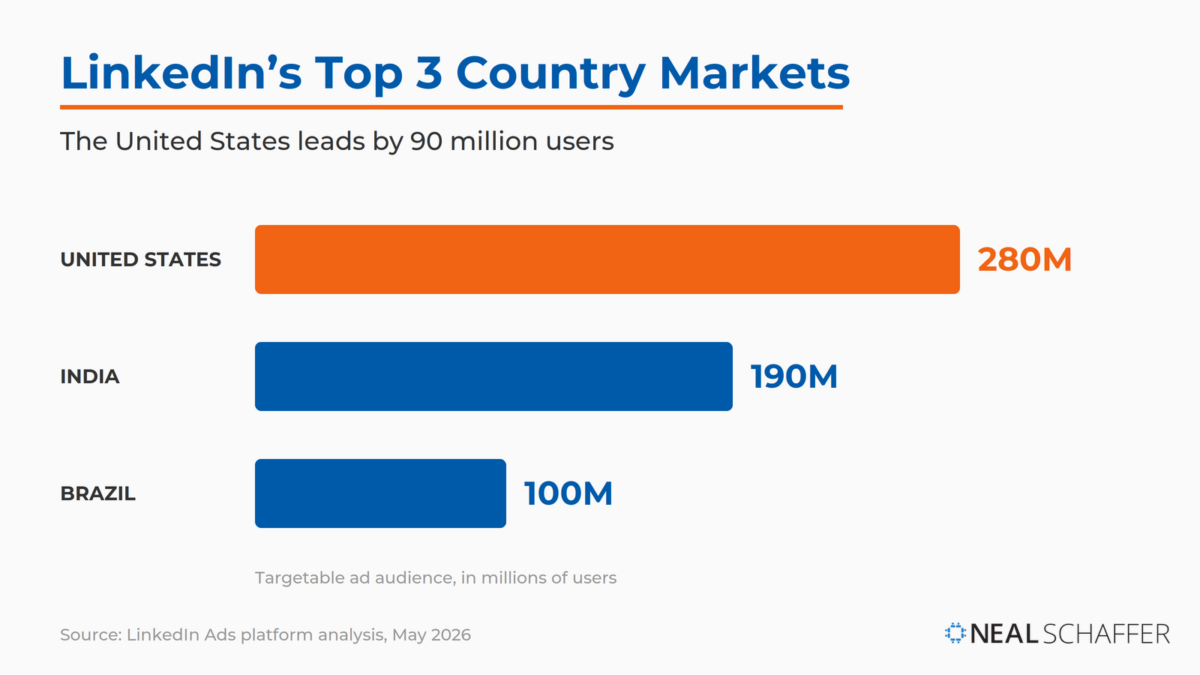 The United States leads LinkedIn with 280 million users, 90 million ahead of India, based on my May 2026 analysis of LinkedIn Ads platform audience data.
What this means for you: if you sell internationally, LinkedIn already concentrates professional audiences in your growth markets. And in the U.S. and parts of Western Europe, it is not the smaller alternative to Facebook anymore. Posting schedules, language choices, and targeting should reflect where your actual audience sits, not just where your headquarters does.
4. 32% of U.S. adults use LinkedIn
Roughly one in three American adults reports using LinkedIn, per Pew Research Center’s Americans’ Social Media Use study (2024), and usage peaks at 40% among 30-to-49-year-olds, the prime career-building years. That puts LinkedIn well behind Facebook and YouTube in raw reach, and that is precisely the point: it trades breadth for professional concentration.
What this means for you: stop comparing LinkedIn’s audience size to consumer networks. You are not buying reach here. You are buying a room where a third of American adults, skewed heavily toward working professionals, gather with business intent.
5. 53% of college-educated Americans use LinkedIn, the widest education gap Pew measures
Among U.S. adults with at least a bachelor’s degree, 53% use LinkedIn, versus 28% with some college experience and just 10% with a high school diploma or less, according to Pew Research Center (2024). No other social platform Pew tracks shows an education gap anywhere near this wide.
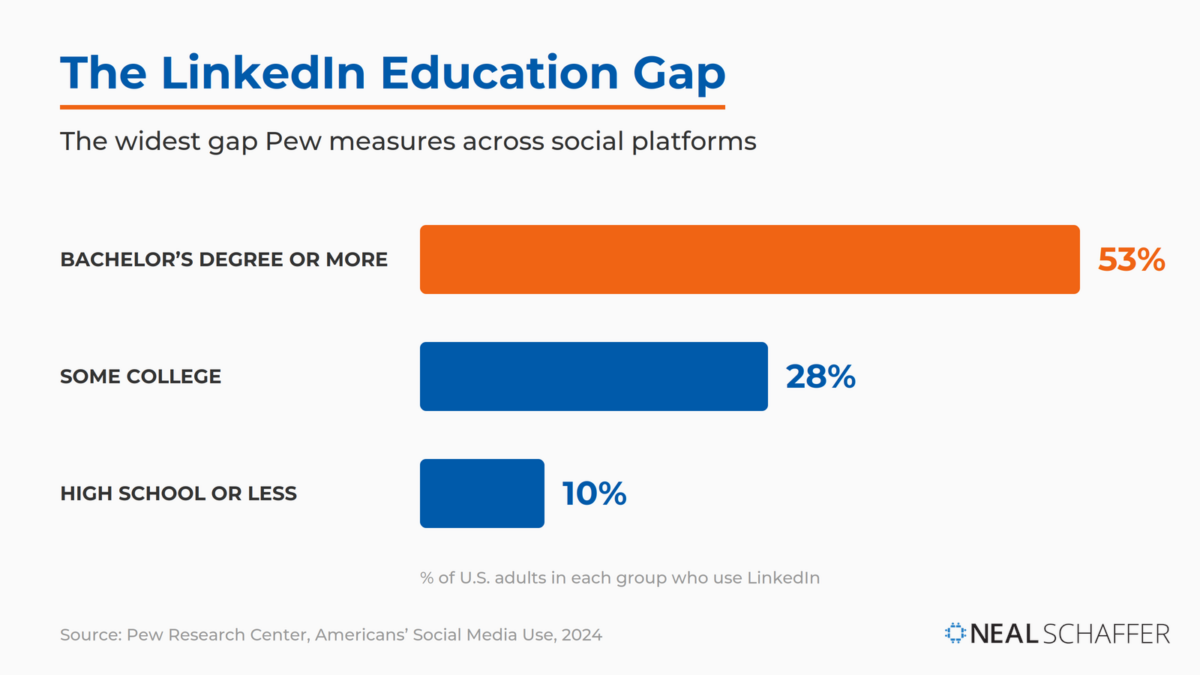 LinkedIn use among U.S. adults climbs from 10% of those with a high school education to 53% of college graduates, the widest education gap Pew Research Center measures across social platforms.
What this means for you: this is the single demographic statistic I quote most often on stage. That education skew is exactly why the platform deserves a dedicated LinkedIn lead generation strategy rather than recycled Facebook tactics.
How Much Money Does LinkedIn Make?
LinkedIn generated $17.8 billion in revenue in Microsoft’s fiscal year 2025, a 9 percent increase over the prior year, and growth has accelerated since. Quarterly revenue now tops $4.8 billion, with Marketing Solutions driving much of the gain and LinkedIn’s new agentic AI hiring tools already producing hundreds of millions in annualized revenue.
6. LinkedIn generated $17.8 billion in fiscal year 2025
LinkedIn delivered $17.8 billion in revenue in Microsoft’s fiscal year 2025, up 9% from $16.4 billion the year before, per Microsoft’s FY2025 Annual Report. For perspective, that is more than most of the software companies whose logos fill B2B marketing decks.
What this means for you: platforms invest where they earn. LinkedIn’s revenue base funds the steady stream of creator tools, video features, and newsletter infrastructure the rest of this post measures.
7. Revenue grew 11% in the most recent holiday quarter, driven by Marketing Solutions
LinkedIn revenue increased $495 million, or 11%, in the October to December 2025 quarter, with the growth driven by Marketing Solutions, according to Microsoft’s Q2 FY2026 earnings release. Marketing Solutions is LinkedIn’s advertising business.
What this means for you: when the ads business leads growth, more brands are competing for the same feed attention you want organically. The organic formats that still over-deliver, which I break down later in this post, matter more every quarter.
8. LinkedIn now earns $4.8 billion in a single quarter
LinkedIn booked $4.83 billion in revenue for January through March 2026, up 12% from $4.31 billion in the same quarter a year earlier, bringing its fiscal-year total to $14.6 billion through nine months, per Microsoft’s SEC Form 10-Q (2026).
Is LinkedIn Actually Bringing You Business?
My latest book helps professionals, entrepreneurs, and business owners turn LinkedIn from a static profile into a real source of clients and growth.
Maximizing LinkedIn for Business Growth gives you clear, practical steps to build a profile that gets noticed and a network that actually sends business your way.
Grab your copy on Amazon and put it to work this week. Click the cover or the button below to get started.
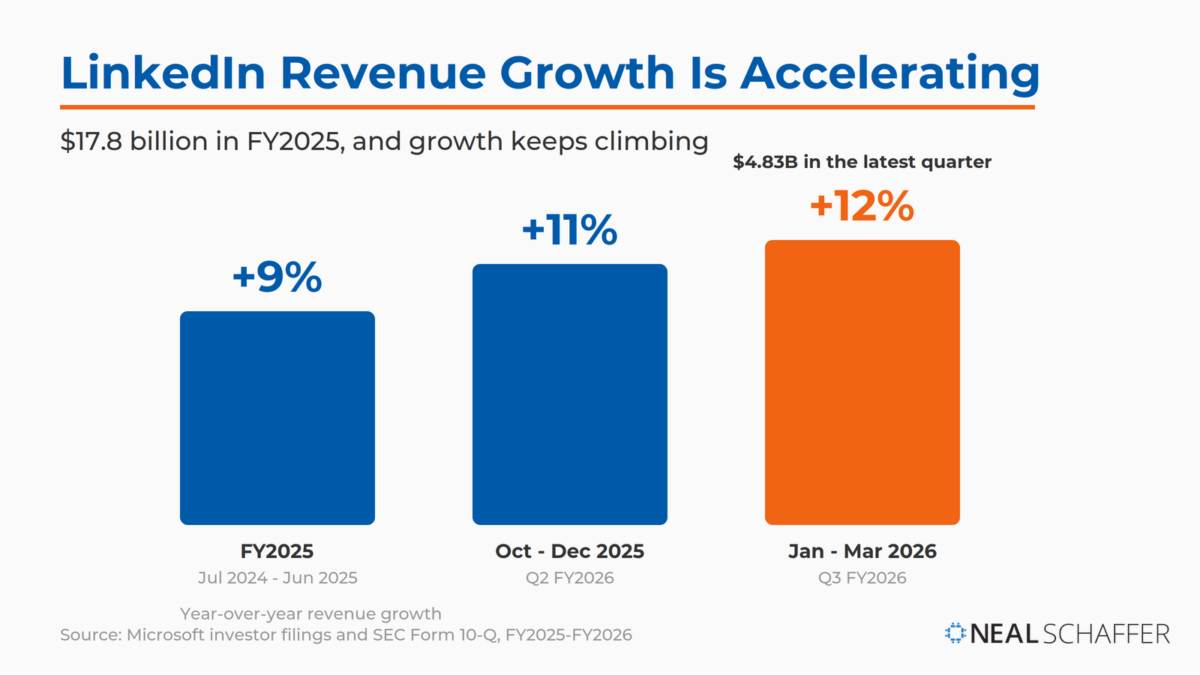 LinkedIn’s year-over-year revenue growth climbed from 9% in fiscal 2025 to 12% in the January to March 2026 quarter, reaching $4.83 billion in quarterly revenue.
What this means for you: growth is accelerating, not plateauing. The 9% annual pace of fiscal 2025 became 11% and then 12% in the two most recent quarters. LinkedIn is gaining momentum at a scale where most platforms slow down.
LinkedIn’s agentic products in Talent Solutions, which automate sourcing, screening, and drafting recruiter messages, have surpassed a $450 million annualized revenue run-rate, per Microsoft’s Q3 FY2026 earnings call (April 2026).
What this means for you: AI is not coming to LinkedIn. It is already a nine-figure business line there. Expect AI-assisted features to keep spreading from recruiting into the subscription tiers; my post on what LinkedIn Premium costs covers where the paid plans stand today.
Who Actually Uses LinkedIn? The Decision-Maker Numbers
LinkedIn’s audience is unusually senior. By the platform’s own audience research, four out of five members drive business decisions at their organizations, and the network counts tens of millions of decision-makers and C-level executives among its members. No other social platform puts your content in front of buying power at this concentration.
10. 4 out of 5 LinkedIn members drive business decisions
Four out of five members drive business decisions at their organizations, according to LinkedIn Marketing Solutions audience data (2026). The figure covers direct decision-makers plus the managers and committee members who shape purchases without signing the contract.
What this means for you: on LinkedIn, the bystander problem mostly disappears. The person scrolling past your post can usually act on it, budget for it, or champion it internally.
LinkedIn counts 65 million decision-makers among its members, per LinkedIn’s own audience research (2026). That is a population larger than most countries, all reachable through organic content and targeting.
What this means for you: I have built my entire Fractional CMO practice on this concentration of seniority. When I publish a LinkedIn newsletter, I know the people reading it can actually sign off on an engagement. That changes the math on every hour you invest here.
12. 10 million C-level executives hold LinkedIn accounts
Ten million C-level executives are on LinkedIn, according to LinkedIn Marketing Solutions (2026). These are typically busy people with gatekeepers, yet they check their own LinkedIn feeds.
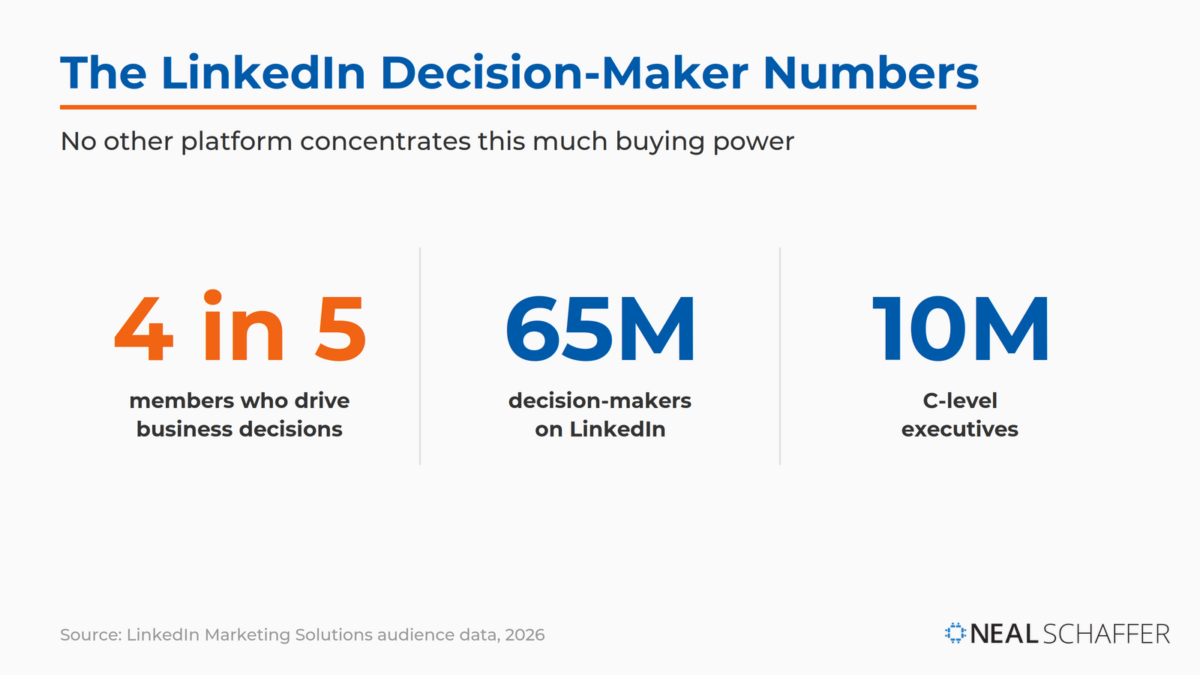 Four out of five LinkedIn members drive business decisions, and the platform counts 65 million decision-makers and 10 million C-level executives, per LinkedIn Marketing Solutions audience data.
What this means for you: this is the one channel where your content can land in front of a CEO without a secretary, a cold call, or a conference badge in between. Make sure your own LinkedIn profile is built to convert that senior attention before you scale up your posting.
Is LinkedIn Worth It for B2B Marketing?
Yes, and the gap is not close. In Content Marketing Institute’s annual B2B research, 85 percent of marketers name LinkedIn the social platform that delivers the best value, with Facebook a distant second at 28 percent. Statista’s marketer surveys point to the same conclusion from a different angle.
In Content Marketing Institute’s annual survey of 980 B2B marketers, 85% named LinkedIn the social platform that delivers the best value for their organization, far ahead of Facebook at 28%, YouTube at 22%, and Instagram at 21%, per CMI’s B2B research (2025).
| Platform | B2B marketers naming it the best-value social platform |
|---|
| LinkedIn | 85% |
| Facebook | 28% |
| YouTube | 22% |
| Instagram | 21% |
| Twitter / X | 7% |
| TikTok | 3% |
Source: Content Marketing Institute, B2B Content Marketing Benchmarks, 2025.
What this means for you: this is not a close race where channel choice depends on taste. For B2B, the practitioners doing the work have rendered a verdict by a three-to-one margin.
14. B2B marketers give LinkedIn a 76% effectiveness rating in 2026
LinkedIn carries a 76% effectiveness rating among B2B marketers in Content Marketing Institute’s 2026 B2B Content and Marketing Trends research, a survey of more than 1,000 B2B marketers. LinkedIn’s own B2B Institute frames the platform as the place to build what it calls compound credibility, where each strong piece of content earns trust that accumulates.
What this means for you: effectiveness ratings reward consistency. The marketers scoring LinkedIn highly are posting on LinkedIn regularly, not occasionally, and the compounding only kicks in when you do the same.
15. 44% of B2B marketers call LinkedIn their most significant social network
Among B2B marketers worldwide, 44% say LinkedIn is the most significant social media platform for their business, according to Statista (2024). No other single platform comes close to that share of first-place votes in B2B.
What this means for you: when nearly half of your B2B peers name one channel as their most important, the channel has stopped being optional. The real differentiator now is execution quality, not presence.
16. 65% of global marketers used LinkedIn in 2024
Almost two thirds of global online marketers, 65%, used LinkedIn for marketing in 2024, a slight increase over the prior year, per Statista’s platform research. Statista’s same research ranked LinkedIn the third-most important social platform for marketers overall, behind only Facebook and Instagram and ahead of YouTube, TikTok, and X.
What this means for you: B2C marketers are on LinkedIn too, not just your B2B competitors. Wealthy, educated consumer segments are reachable here, which is why I tell even consumer brands targeting professionals not to write the platform off.
What Content Actually Works on LinkedIn in 2026?
Engagement on LinkedIn is rising, and the formats driving it have shifted. Socialinsider’s 2026 benchmarks, built on 1.3 million posts from more than 16,000 business pages, put the average engagement rate at 5.20 percent, with LinkedIn carousel posts leading every format and video views falling sharply even as per-post video engagement holds up.
17. The average LinkedIn engagement rate hit 5.20% in 2026
LinkedIn’s overall engagement rate now averages 5.20%, an 8% year-over-year increase, per Socialinsider’s 2026 LinkedIn Benchmarks, which analyzed 1.3 million posts from 16,645 business pages across two full years. That is a remarkably healthy number for a platform this mature.
What this means for you: you finally have a real benchmark. If your page consistently clears 5.20%, you are beating the typical brand. If you are nowhere near it, the format choices in the next three statistics are usually the reason.
18. LinkedIn carousel posts lead every format with a 7.00% engagement rate
LinkedIn carousel posts, PDFs uploaded directly to the platform (Socialinsider’s research calls them native documents), lead all content formats with a 7.00% average engagement rate, up 14% year over year, according to Socialinsider (2026). As Julia Holmqvist, Social Media Manager at Semrush, put it in the report, “Document posts perform well because they behave like ‘free value’ on a platform where people actively want to learn.”
| Content format | Average engagement rate |
|---|
| LinkedIn carousels (native documents) | 7.00% |
| Multi-image posts | 6.45% |
| Video posts | 6.00% |
| Image posts | 5.30% |
| Text posts | 4.50% |
| Polls | 4.20% |
| Link posts | 3.25% |
Source: Socialinsider 2026 LinkedIn Benchmarks, full-year figures.
What this means for you: swipeable, save-worthy resources are the platform’s best organic bet, which is why I recommend every serious creator learn the LinkedIn carousel format. Frameworks, checklists, and step-by-step breakdowns earn the engagement that polished announcements never will.
19. Video views dropped 36% year over year
Across every page size, LinkedIn video views declined 36% year over year, even though the biggest pages still generate the most views, per Socialinsider’s benchmark data (2026). One nuance worth keeping straight: engagement per video post actually rose, so the videos that do get watched perform fine. Fewer of them are getting watched.
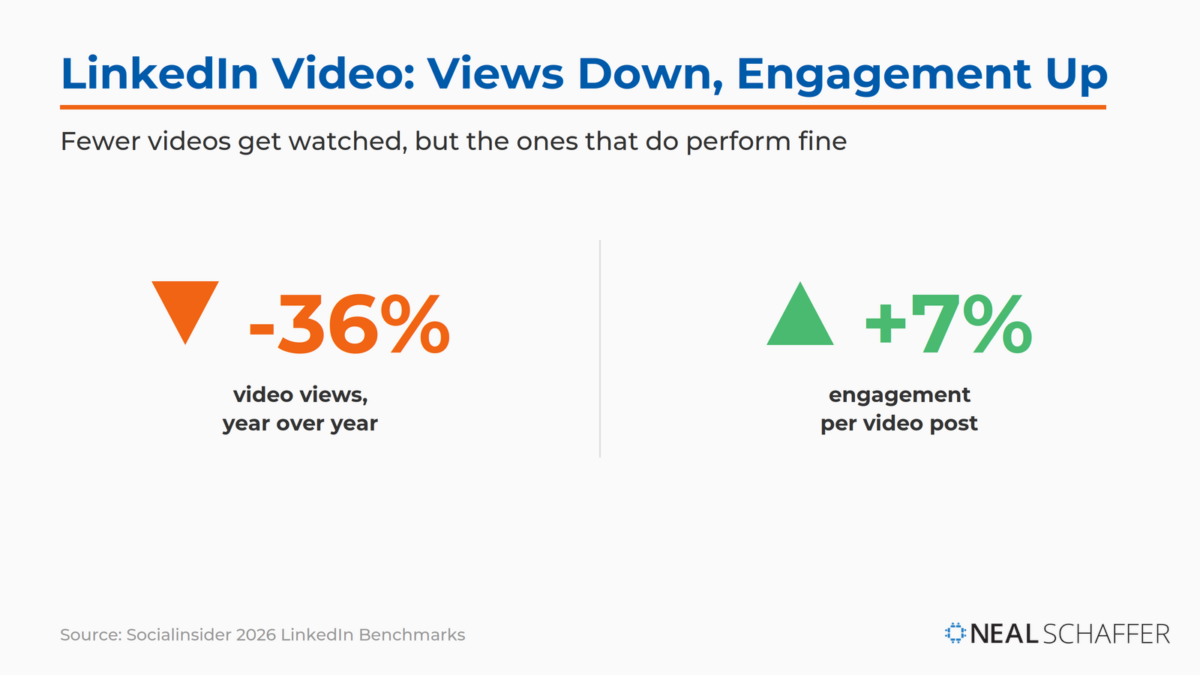 LinkedIn video views fell 36% year over year even as engagement per video post rose 7%, so the videos that get watched still perform, per Socialinsider’s 2026 benchmarks.
What this means for you: don’t bet your whole strategy on video. My advice on LinkedIn video now treats it as one ingredient rather than the main course.
20. Engagement grew across every format: text up 12%, images up 9%, video up 7%
Engagement rates rose across all content formats in Socialinsider’s data, with text posts up 12%, images up 9%, and video up 7% year over year, according to Socialinsider (2026). The platform as a whole is rewarding participation more, not less.
What this means for you: these numbers match exactly what I see in my own work. On a recent episode of my podcast Your Digital Marketing Coach, I shared that “when I do the audits of my students in this class at Wharton, there are clear discrepancies between engagement on images versus non-images.” Visual-first content wins. Study your own numbers in LinkedIn analytics and post when your audience is actually online, which I cover in my post on the best time to post on LinkedIn.
Frequently Asked Questions About LinkedIn Statistics
How many users does LinkedIn have in 2026? LinkedIn has more than 1.3 billion members across more than 200 countries and territories as of 2026. Its advertising tools report a wider potential reach of about 1.43 billion registered profiles, which is larger than the active-member count because it includes everyone who has ever registered.
How much revenue does LinkedIn generate? LinkedIn generated $17.8 billion in Microsoft’s fiscal year 2025, up 9 percent year over year. Growth has since accelerated, with the January to March 2026 quarter reaching $4.83 billion, a 12 percent increase, per Microsoft’s SEC filings.
What is a good engagement rate on LinkedIn in 2026? The platform average is 5.20 percent for business pages, per Socialinsider’s 2026 benchmarks. If your page consistently clears that number you are outperforming the typical brand, and native document posts, which average 7.00 percent, are the most reliable way to get there.
Is LinkedIn still the best platform for B2B marketing? Yes. 85 percent of B2B marketers tell Content Marketing Institute that LinkedIn delivers the best value of any social platform, with Facebook a distant second at 28 percent. LinkedIn’s own audience data showing 4 out of 5 members drive business decisions explains the gap.
What type of content performs best on LinkedIn? LinkedIn carousel posts, PDFs uploaded as native documents, lead every format with a 7.00 percent average engagement rate in 2026. Multi-image posts follow closely, while video views have declined 36 percent year over year, so visual-first static formats are currently the safest bet.
Put These LinkedIn Statistics to Work
The numbers tell one consistent story: LinkedIn concentrates educated, senior, decision-making professionals, rewards visual-first content, and keeps growing at a pace most mature platforms cannot match. Pick the statistic that stings a little, maybe your engagement rate against that 5.20% benchmark, and make it the one thing you improve this quarter.
If you want help turning these numbers into an actual plan, start with my post on LinkedIn marketing strategy. You can also download a free preview of Maximizing LinkedIn for Business Growth, or if you would rather have me build the strategy alongside your team, learn more about my Fractional CMO services.
Actionable advice for your digital / content / influencer / social media marketing.
Join 13,000+ smart professionals who subscribe to my regular updates.