“LinkedIn LION” is one of the oldest topics I have ever written about, and somehow it still sends people to my site every month. Most of that traffic comes from Google, and a growing share now comes from AI assistants like ChatGPT and Perplexity that surface my older writing when someone asks what a LION is. That tells me the term still confuses people in 2026, more than fifteen years after it caught on.
So rather than leave a dated post to answer the question, I want to give you the honest version: what a LinkedIn LION is, where the idea came from, why the movement faded, and what I actually recommend today. I helped popularize the concept back in 2009, and I am also the person who later called for ending it, so you are getting the full arc from one source.
Key Takeaways
? A LinkedIn LION is a LinkedIn Open Networker. It describes someone who keeps their profile open to connection requests from people they have never met, often signaled by putting “LION” in their name or headline.
? The movement started around 2009, and I was one of its earliest evangelists. My first book, Windmill Networking, was built on the idea of open networking and included a dedicated chapter on LinkedIn LIONs.
? The label is largely obsolete now. Open networking became the default across social platforms, and the LION tag got co-opted by marketers harvesting connections, so it stopped signaling much of anything.
? More connections is not the goal. A smaller network of people you have a reason to know beats thousands of strangers, and that matters more now that fake and AI-generated profiles are everywhere.
? You can still network openly, just do it deliberately. Skip the label, vet who you let in, and lead with relationships rather than raw connection counts.
What Is a LinkedIn LION?
A LinkedIn LION is a LinkedIn Open Networker, someone who accepts connection requests from people they have never met instead of limiting their network to known contacts. Many of them signal it by adding “LION” or “L.I.O.N.” to their name or LinkedIn headline. The original goal was to grow reach and help bridge networks that would otherwise stay closed off from each other.
In the early days of the platform, declaring yourself a LION was a quick way to tell other users that you welcomed invitations, no prior relationship required. It was part identity, part networking strategy, and for a few years it was a real movement with its own groups and etiquette.
How the LinkedIn LION Movement Started
The LION movement grew out of LinkedIn’s early years, around 2009, when open networking was a fresh idea and the platform was still small. I was one of the first and most visible people writing about it. My first book, Windmill Networking: Understanding, Leveraging and Maximizing LinkedIn, was built on the concept of open networking and devoted an entire chapter to LinkedIn LIONs.
The thinking was simple. Back then LinkedIn was a young network, and most people only connected with colleagues they already knew. It is a very different platform today, as my LinkedIn statistics show. Open networkers were the ones willing to accept invitations from strangers, which helped otherwise siloed networks grow into each other. I coined the idea of “Windmill Networking” to describe building a wide network of trusted connections, helping others, and reaping the benefits over time. The “LION” label, generally credited to the early networker Christian Mayaud and his Lions’ Lair group, became the public badge for that approach. For a stretch, putting LION next to your name genuinely meant something.
How LinkedIn Treated LIONs
LinkedIn was never fully comfortable with open networking. It originally displayed only up to 500 connections on a profile, capped total connections at 30,000, and limited how many invitations you could send. The platform also gave people the “I Don’t Know” response, or IDK, as a way to decline invitations from strangers, and too many IDKs could get your account restricted.
Over the years, LinkedIn shifted to a more neutral stance. It allowed LinkedIn groups built around open networking to exist, and finding fellow LIONs became easier. But the connection cap and the invitation limits never really went away, which is a big part of why the strategy eventually stopped making sense.
Why the LinkedIn LION Movement Is Over
The LION movement faded for three reasons: open networking became normal everywhere, the label got hijacked by marketers, and LinkedIn itself started throttling the behavior. None of those is reversible, which is why I no longer recommend the label to anyone.
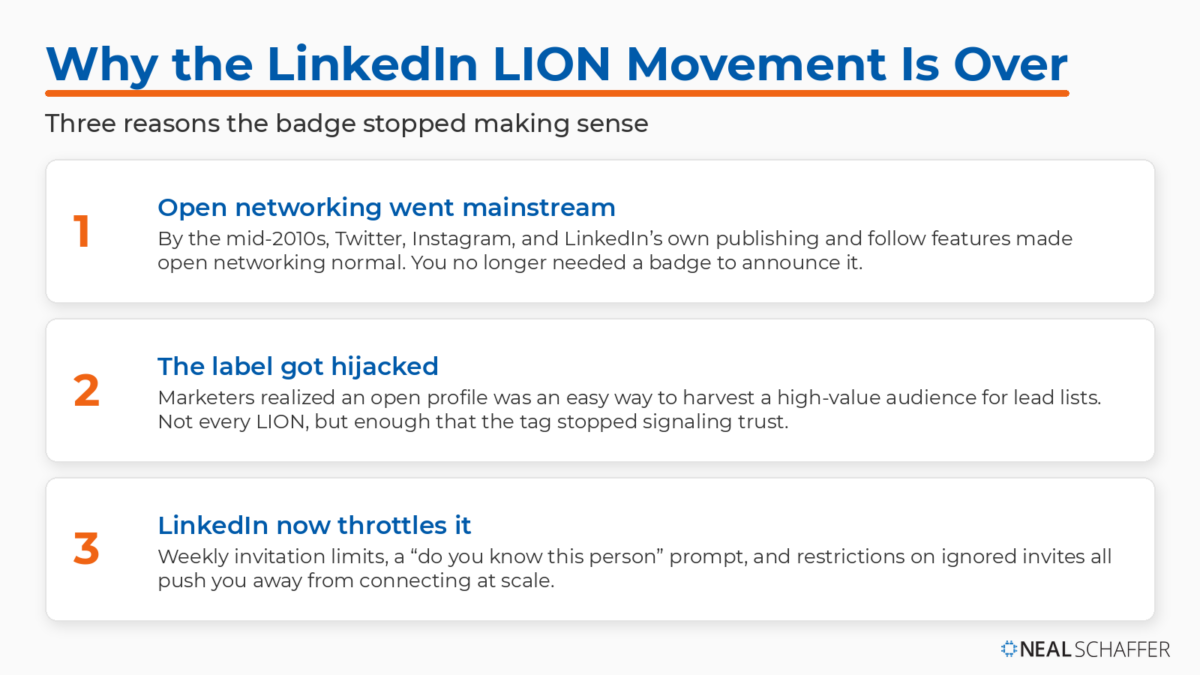 The LION movement didn’t die for one reason. Open networking became the norm everywhere, spammers co-opted the label, and LinkedIn itself started limiting how freely you can connect. Together they made the badge pointless.
First, open networking went mainstream. By the mid-2010s, Twitter, Instagram, and LinkedIn’s own publishing and follow features made it normal to connect with and learn from people you had never met. You no longer needed a badge to announce that you were open to it. The whole social web worked that way.
Second, the label got hijacked. Marketers and spammers realized that an open networker’s profile was an easy way to reach a high-value professional audience and pull those connections into lead generation and email lists. Not every LION had ulterior motives, but enough did that the tag stopped signaling trust and started signaling caution. That is exactly why I publicly called for an end to the movement back then, even though I had helped build it.
Third, LinkedIn now actively discourages connecting at scale. There are weekly invitation limits, a “do you know this person” prompt on many requests, and restrictions if too many of your invites get ignored. The platform itself nudges you away from the behavior that defined being a LION.
Here is the shift in one view:
| The LION era (around 2009) | LinkedIn today |
|---|
| How you signaled openness | Added “LION” to your name or headline | Not needed; open networking is the norm |
| What the label meant | A trusted “I welcome invitations” badge | Often a flag for spam or lead harvesting |
| What LinkedIn allowed | Larger open networks, looser invite limits | Weekly invite caps and “do you know this person” friction |
| The goal | Maximize total connections | Connect with intent and vet who you let in |
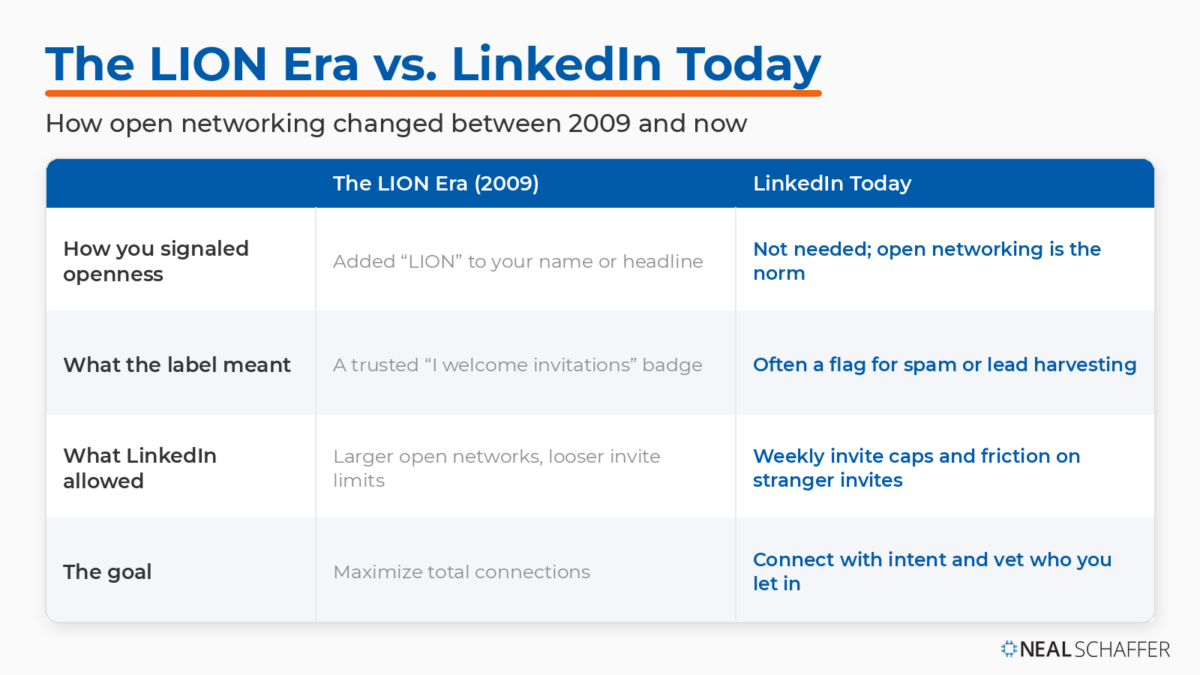 Open networking went from a badge you advertised to the default everyone uses. The same move that signaled openness in 2009 now mostly signals spam, which is why the LION label stopped doing any work.
More Connections Is Not the Goal
Chasing a bigger number was always the weakest part of the LION idea, and it ages worse every year. A focused network of people you actually have a reason to know is more useful than thousands of strangers, and vetting who you let in matters more now than it ever did.
The most common pushback I heard back when I wrote about LIONs is something I still agree with: every connection should have a purpose. Fifty meaningful connections will do more for you than five hundred random ones. And in 2026, with fake and AI-generated profiles common, accepting anyone is a real risk. A connection gets a closer look at your network and your activity, so it is worth checking a profile before you accept and removing connections that turn out to be spam. If you do want to find and verify specific people deliberately, LinkedIn’s search is a far better tool than waiting for open invitations.
What to Do Instead of Chasing LIONs
Skip the label and network with intent. My two long-standing recommendations still hold: do not accept LION-branded invitations without a personal note, and remove any open-networker branding from your own profile. Then focus on connecting with people you have a genuine reason to know.
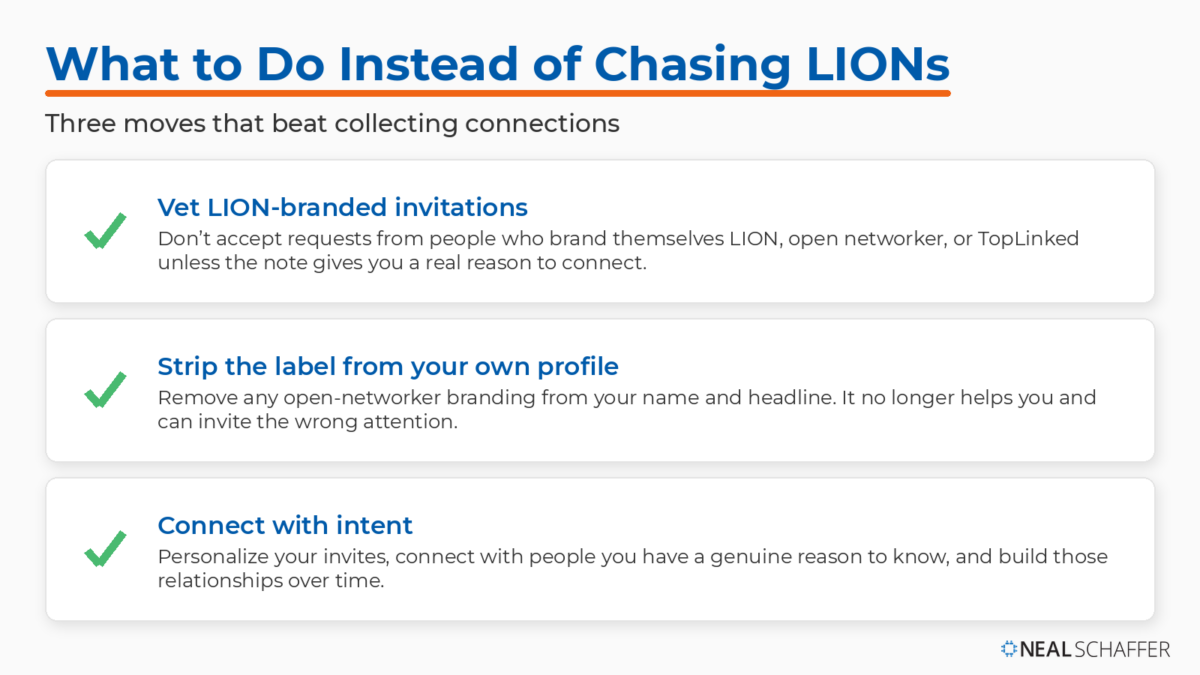 You don’t need the LION label to network openly. Vet who you let in, take the badge off your own profile, and lead every connection with a real reason. That’s the version of open networking that still works.
Here is what that looks like in practice. When you get an invitation from someone who labels themselves a LION, open networker, or TopLinked in their name or headline, do not accept it unless the message gives you a real reason to connect. And take that same branding off your own LinkedIn profile, because it no longer helps you and may invite the wrong attention. From there, personalize your invites, connect with purpose, and build relationships over time. If you are new to LinkedIn and trying to grow from zero, that deliberate approach beats collecting strangers, and it fits naturally into a broader LinkedIn marketing strategy.
If You Still Want to Network Like a LION
I have never turned on open networking as a philosophy. The Windmill Networking idea I wrote about still works. What changed is the execution. If you want to network the way the best LIONs once did, openly and generously but built for how LinkedIn works now, you can absolutely do that.
That is exactly what I teach in my book, Maximizing LinkedIn for Business Growth. It is the modern playbook for building a LinkedIn network that produces actual relationships and business, without the outdated label or the spammy tactics that gave open networking a bad name.
Frequently Asked Questions
What does LION stand for on LinkedIn? LION stands for LinkedIn Open Networker. It describes a user who keeps their profile open to connection requests from people they have not met, and who often adds “LION” to their name or headline to signal it.
The Digital Marketing Playbook for Small Teams
My latest book helps small businesses, entrepreneurs, and marketers bring search, email, and social together into one digital marketing strategy that actually compounds.
Drawing on my work as a Fractional CMO, Digital Threads turns complicated tactics into a clear, practical plan you can follow, whatever your budget or team size.
Grab your copy on Amazon and start weaving your own digital threads. Click the cover or the button below to get started.
How do you become a LinkedIn LION? Historically, you became a LION by accepting invitations from anyone and adding the label to your profile. Today I do not recommend the label at all. If your goal is a wider network, connect deliberately with people you have a reason to know instead.
Is it still worth being a LinkedIn LION in 2026? No. The label is obsolete, it can attract spam and scam invitations, and LinkedIn now limits the open connecting that made it work. You can still network openly without ever calling yourself a LION.
Is it better to have more LinkedIn connections or fewer, higher-quality ones? Quality wins. A smaller network of people you actually know or have a clear reason to know is more valuable than a huge list of strangers, and it is safer given how many fake profiles exist now.
I am new to LinkedIn. Should I connect with LIONs to grow my network fast? I would not. Building deliberately, with personalized invitations to people relevant to your goals, gives you a network that actually helps you, rather than a large but useless connection count.
Network Openly, but Skip the Label
The LinkedIn LION movement made sense in 2009. It does not anymore. Open networking won, which is exactly why the badge became unnecessary, and the people who hijacked it finished the job. If you remember nothing else: connect with intent, vet who you let in, and drop the label.
If you want to do open networking the right way for today’s LinkedIn, my book Maximizing LinkedIn for Business Growth walks through the entire approach step by step. And if you would rather keep learning here first, I share practical LinkedIn and digital marketing tactics in my newsletter.
For more on how I think about LinkedIn and where I speak and consult on it, here is more about me.
Actionable advice for your digital / content / influencer / social media marketing.
Join 13,000+ smart professionals who subscribe to my regular updates.