Thursday, April 16, 2026
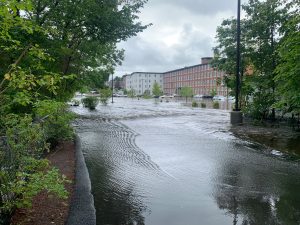
Many believe that climate change is caused by the Industrial Revolution, that it all began with a forge for working brass for buttons built next to a grist mill and sawmills on the Ten Mile River in 1780. By 1855, 24 jewelry mills were operating in Attleborough (a town that would later split into Attleboro and North Attleboro).
The Ten Mile River runs 22 miles through North Attleboro, Attleboro Falls, and Attleboro to Pawtucket, Rhode Island, where it joins the Sevenmile River. The Ten Mile drains a watershed of 54 square miles.
Then, on a fateful day in September 2023, an unprecedented ten inches of rain fell on North Attleboro. Water cascaded in torrential sheets down the land, including Bristol County’s highest peak, the aptly named Watery Hill (390 feet). Raging floodwaters inundated streets, washing away everything in their path—from automobiles to the foundation footings of buildings. At least 200 homes were damaged by stormwater, and many were left uninhabitable. There were street closures, water undermining roads, sinkhole formations, and power outages. The Middle School was opened as a temporary shelter, and a state of emergency was declared.
We have crossed a tipping point where too much vegetation and soil are being removed, replaced with hardscapes and heat islands. Water that once soaked into the ground now rushes away, carrying sediments and heat to become destructive stormwater. We have disrupted the natural water cycle and turned a vital, life-giving force—water—into a destructive one.
Plants release bacteria and fungi into the air. Water vapor condenses around organic particles to form raindrops and clouds. Water in the atmosphere retains heat. White, puffy cumulus clouds are the exception; they reflect more heat energy back into space than they trap, helping cool the planet. Currently, globally, there are slightly fewer cumulus clouds, and the balance has shifted toward more haze and bright sunlight.
Wind off water absorbs moisture. However, when shoreline vegetation is replaced by buildings and highways, the hardscapes heat the air, causing it to expand. Warmer air becomes thirsty and draws moisture from the land, drying it out while increasing heat-energy-bearing moisture in the atmosphere. As a result, stronger storms with heavier rainfall follow.
The solution to slowing the water cycle’s turning is to recognize the land’s natural right to retain the rainwater that falls on it. Rainwater should not be viewed as a nuisance to be quickly drained away. Water is a vital resource best kept where it falls to support the complex web of soil life and plant growth, recharge rivers, reduce the frequency of drought stress, and regulate local climate by plants releasing water vapor to warm the air through condensation into dew or cool the air through evaporation.
When property owners redesign their landscapes to absorb and retain water, the volume of stormwater will decrease, leading to less costly management by the municipality and lower repair costs. By reducing stormwater, flood risks are minimized, which benefits residents of low-lying and economically vulnerable areas, as well as downtown businesses along the river.
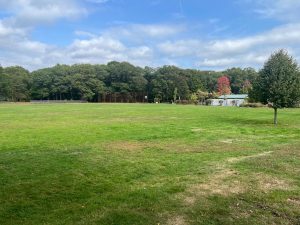
Attleboro is planning a pilot project that involves significant community engagement. A small forest of just 2,000 square feet is planned for about one-fifth of O’Connell Field, on the diamond of the former baseball field near the High School and by Capron Park Zoo. Here, 35 native woody plant species—ranging from the pioneer sumacs to stately oaks and graceful maples—will be carefully selected and arranged to reflect a mosaic of successional stages that mirror the natural development of a forest.
The roots of different trees connect with fungal strands to form a mycorrhizal network, enabling all to access a galaxy of bacteria for enzymes and nitrogen fixation. With access to a broader palette of enzymes and mutualistic microbes, the forest grows not only more robust but also more quickly.
Known as a Miyawaki forest, this method yields ten times more biomass and enhances soil water retention tenfold compared to a stand of a single tree species. If successful, the pilot forest will be expanded into larger pocket forests, strategically positioned to prevent stormwater runoff from damaging nearby properties.
The Earth Rehydration Revolution ends tyranny by recognizing the land’s natural rights to the rains that fall on it, beginning with a small pocket forest in an abandoned ball field in an intrepid New England mill town. There’s a new stewardship practice that involves holding more water in the land and less in the atmosphere, where it has been trapping heat and energy, contributing to climate change. People are rallying for more soil, greater diversity of native plants, increased plant growth, and deeper, more alive soils; actions that will ripple well beyond humble beginnings to create a healthier life for all through diverse communities working together, thriving ecosystems, and a cooler climate.
Published Op-ed: Let the earth rehydration revolution begin
Lowell Sun, September 25, 2025
Nashoba Valley Voice, September 25, 2025
The Salem News, October 9, 2025
Also
Op-ed: Water lessons from Leominster, stormwater actions in Attleboro. Fitchburg Sentinel & Enterprise, August 7, 2025
Environmentalist: Water lessons from Leominster lead to stormwater action in Attleboro. MetroWest Daily News, August 9, 2025

Planting trees and increasing soil depth to reduce storm and flood waters also helps save whales by creating healthier and cooler ocean ecosystems.
The Ocean River Institute provides opportunities to make a difference and go the distance for savvy stewardship of a greener and bluer planet Earth. www.oceanriver.org