On May 15, 2026, Google published its official guide to optimizing for generative AI features and used it to push back on much of what the GEO industry has been selling. According to Search Engine Journal’s coverage of the announcement, Google told site owners they can ignore content chunking, llms.txt files, special markup, and AI-specific rewriting. The headline: AEO and GEO are still SEO.
What Google did not dismiss is internal linking. The fundamentals still matter, and in an AI-first search environment they matter more. The reason is mechanical. AI Overviews, ChatGPT, Perplexity, and Gemini do not behave like the old ten blue links. They build answers by pulling specific passages from multiple sources and stitching them together. Your site gets read at the section level, not the page level. Internal linking is one of the few signals that tells those systems how your sections relate and which page on your site owns a topic.
I have spent much of the past two years rebuilding how nealschaffer.com handles internal linking, and not entirely by choice. My own site lost organic traffic during the run of Google ranking updates that have reshaped search since 2024, the same stretch in which even an authority like HubSpot saw its blog lose a sizable share of its organic search traffic. Reworking how my content connects has been one piece of how I have responded. I’m Neal Schaffer, author of Digital Threads and a Fractional CMO who advises businesses on exactly this problem, and I want to share what is working, what the legacy SEO guides still get right, and where the older playbook might be failing when AI is doing the reading.
This guide is for business owners, marketers, and creators running their own blog who want their content cited in AI answers, not just indexed in Google. It assumes you already know what an internal link is and that you have a content library worth connecting. I am not writing this as a technical SEO specialist. I am writing it as a marketer who has rebuilt his own site through this shift and who reads the SEO world closely, and my goal is to cut through the chatter and tell you what actually makes sense to act on today.
Key Takeaways
? Internal linking is now a section-level signal, not a page-level one. AI systems extract individual passages and read your internal links as semantic context for those passages, so link placement inside the chunk matters as much as the link itself.
? Pillar pages carry outsized weight. AI does not read backlinks directly, but it leans on the authority and visibility they produce, the same signals SEO has always used. A category hub you concentrate your internal links on becomes a strong candidate to be cited for its topic.
? Anchor text should describe the topic, not the format. Labeling a link “my guide” or “my deep-dive” makes a claim that is easy to get wrong once a reader clicks through. A topic-focused anchor stays accurate by default.
? “Further Reading” callouts put links where they do the least for AI citation. Those links still help navigation and crawling, but outside the prose of a passage their anchor text is not read as part of the section an AI extracts. Embedded in the sentence, that same anchor text tells the model what the linked page is about.
? Entity mentions reinforce internal linking, even without a hyperlink. Entity-based SEO has long held that naming your own brand, your books, the tools you mention, or industry experts in the prose helps systems place what a passage is about, with or without a link.
What Is Internal Linking for AI Overviews and GEO?
Internal linking for AI Overviews and GEO is the practice of structuring on-site link relationships so generative search systems can extract, attribute, and cite individual sections of your content. Unlike traditional internal linking, which optimizes for crawl path and PageRank distribution, the AI version optimizes for entity reinforcement and semantic clarity at the passage level.
That last part matters because AI search reads a page differently than classic Google Search does. AI systems pull self-contained sections that can stand alone when lifted out of their original page. As one content framework for AI search published in Search Engine Land advises, links belong in the same passage as the claim they support, because separating them risks the model retrieving the claim without the proof.
A link embedded in that sentence has its anchor text read as part of the passage, where it signals what the linked page is about. Descriptive anchor text gives AI retrieval systems more context for matching that page to the claims it can support, though it is not the only signal behind a citation. A link sitting in a sidebar widget, a footer, or a separate “related posts” block sits outside the prose the model extracts, so its anchor text never enters the passage and does far less to help that page get understood and cited for its own topic.
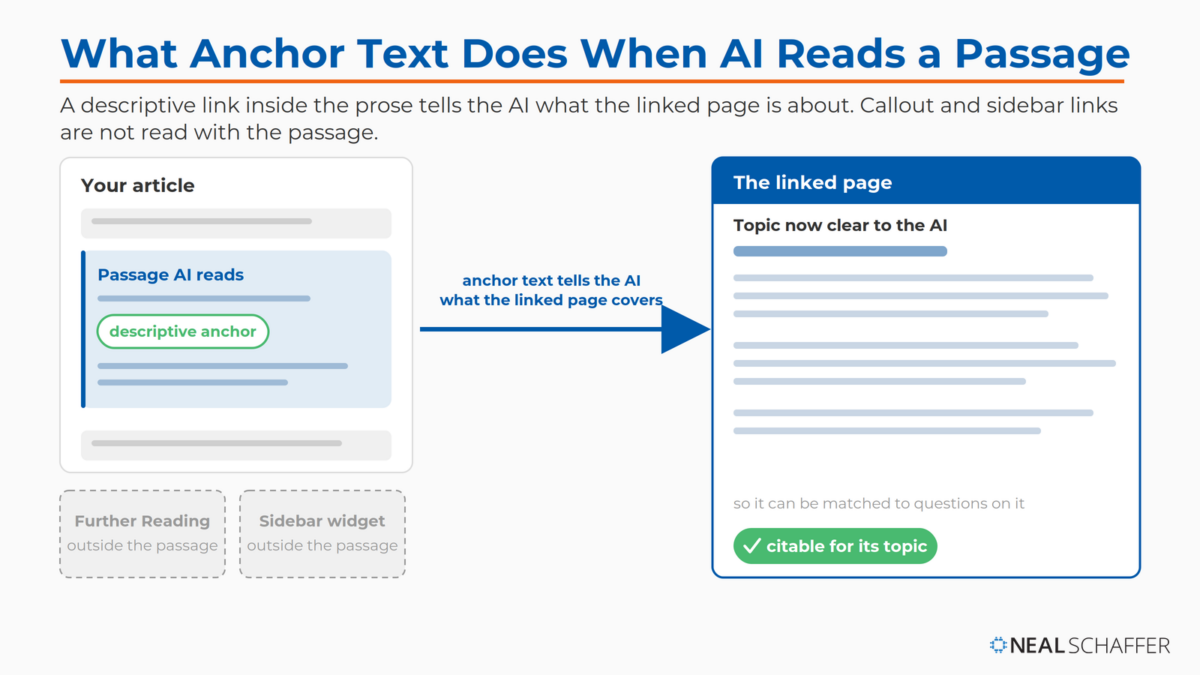 A descriptive internal link inside your prose tells an AI what the linked page is about, which helps that page get cited for its own topic. Links in callouts and sidebars sit outside the passage the AI reads.
Internal linking did not turn into a new discipline. The job just got bigger.
How Is Internal Linking for AI Overviews Different from Traditional SEO?
Internal linking for AI Overviews differs from traditional SEO in three structural ways:
- it works at the section level rather than the page level,
- it treats anchor text as semantic context rather than a ranking signal alone,
- and it rewards entity reinforcement over raw link count.
The old playbook optimized the page. AI search optimizes the passage.
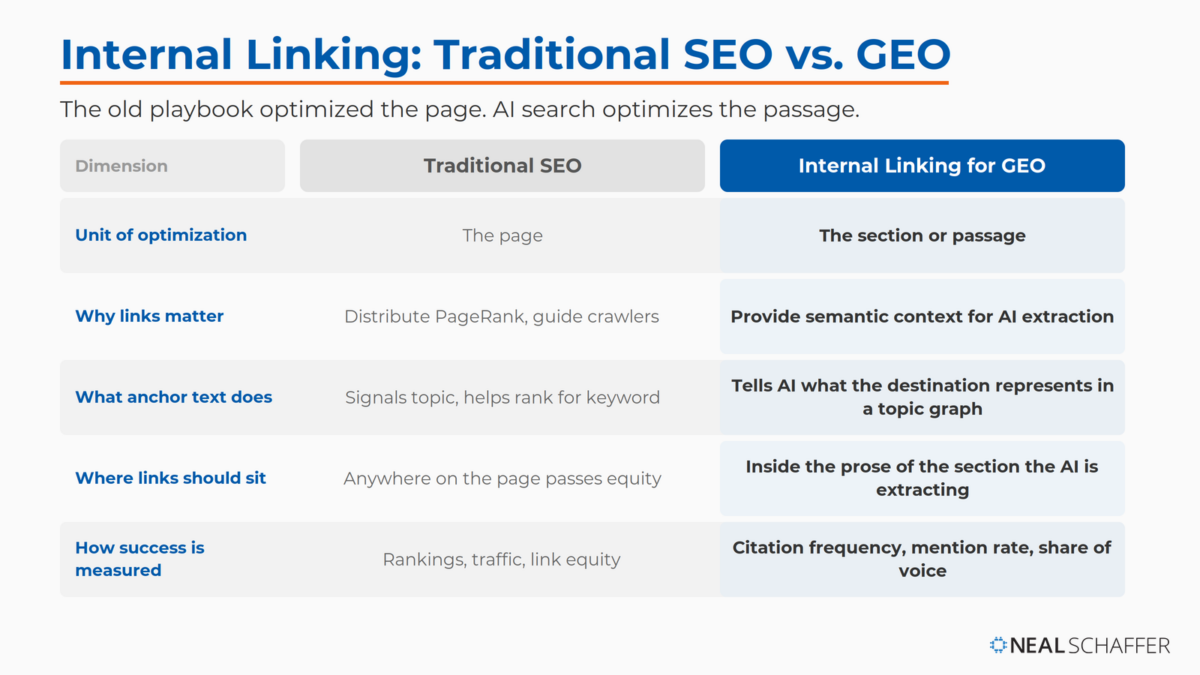 The same dimensions, two playbooks: traditional SEO optimizes the page, while internal linking for GEO optimizes the passage an AI extracts.
Aleyda Solis, founder of Orainti and one of the most respected voices on AI search, put it directly in an AirOps webinar covered in their AEO audit checklist:
“With AI search this happens at a passage or chunk level of relevance.”
That one shift reorganizes how you think about linking. A page can rank fine and still get skipped for citation because the specific section that answers the question is structurally weak. BrightEdge research found that only about 17% of the sources cited in AI Overviews also rank in the organic top 10 for that query, with most citations pulled from pages outside the first page of results. Authority and visibility get a page into the pool AI pulls from. Which page in that pool gets cited comes down to the passage, not its rank position.
The table below shows how the mental model has changed:
| Dimension | Traditional SEO Approach | Internal Linking for GEO |
|---|
| Unit of optimization | The page | The section or passage |
| Why links matter | Distribute PageRank, guide crawlers | Provide semantic context for AI extraction |
| What anchor text does | Signals topic, helps rank for keyword | Tells AI what the destination represents in a topic graph |
| Where links should sit | Anywhere on the page passes equity | Inside the prose of the section the AI is extracting |
| How success is measured | Rankings, traffic, link equity | Citation frequency, mention rate, share of voice |
None of this makes the old playbook wrong. Crawlability still matters. PageRank still flows through internal links. Google’s John Mueller has called internal linking “super critical for SEO”, describing it as one of the biggest things you can do to point both crawlers and readers at the pages you consider important. That was true before AI search and it is still true now. The AI layer just adds new requirements on top, and the legacy advice often skips them. Some practitioners now call this broader practice relevance engineering rather than GEO. Either way, you are engineering the semantic context that makes an AI confident enough to use your content as a source.
If you are still working out the fundamentals underneath all this, my primer on on-page SEO covers where internal linking sits in the broader picture, the technical SEO side explains how crawlers actually follow those links, and SEO strategy is where all of it fits into a plan.
Trying to Keep Up with Digital Marketing?
Just released: my new book to help small businesses, entrepreneurs, and marketers master digital marketing in today’s digital-first world.
Drawing on my Fractional CMO experience, Digital Threads simplifies complex strategies into clear, actionable steps for success.
Transform your business today—grab your copy! Click the cover or button below to buy on Amazon.
Why Do Pillar Pages Matter More for AI Citation Than Traditional SEO?
Pillar pages matter more for AI citation because they concentrate the topical-authority signal search systems use to decide who owns a subject. SEO has held for years that a strong hub page anchors topical authority, and that principle carries into AI citation: when systems pick who to cite, clear topical ownership is what they reward.
My social media marketing statistics page is the clearest example, but not in the way you might think. A statistics page is a link magnet. It has earned links from high-authority marketing publications over the years because people cite data, and that is the whole job of a page like that. The mistake is treating the link magnet as the destination. Its real value is the authority it has earned, which I route through internal links to the pages I actually want found and cited: my in-depth guides and the pages closest to what I sell. AI does not read those backlinks the way Google’s crawler does, but, consistent with Google’s framing that optimizing for AI features is still SEO, it draws what it cites from the search results it already pulls, and the authority and visibility those backlinks produce are what put a page in that pool.
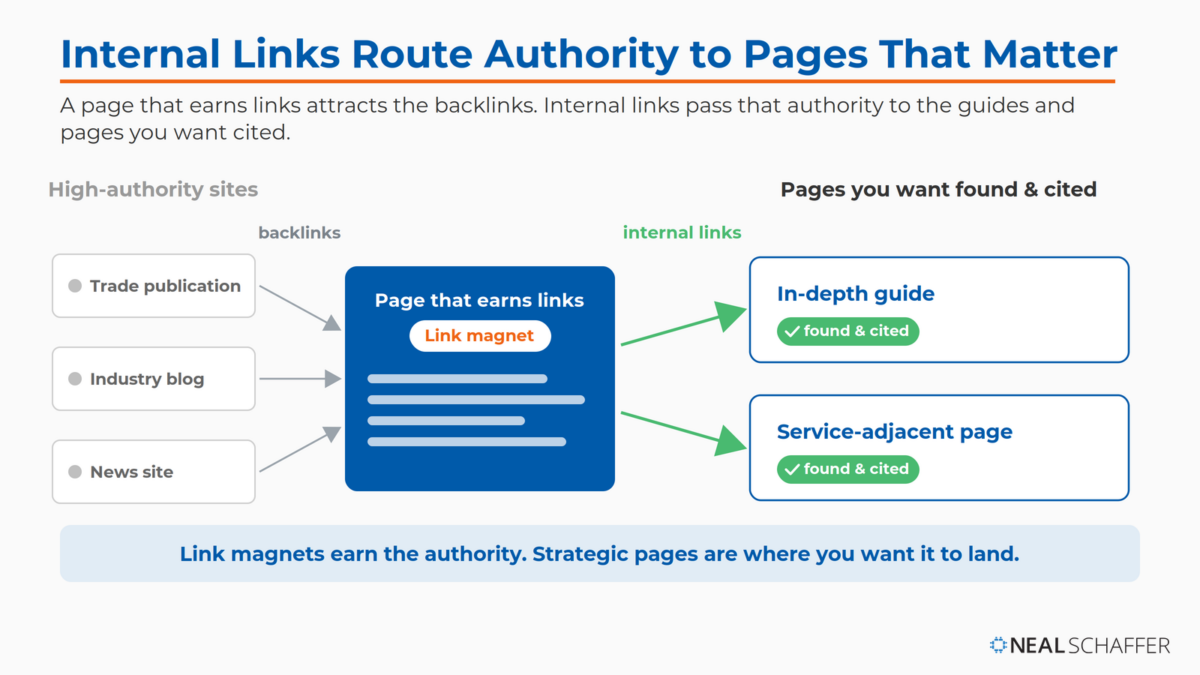 One of your pages earns links from high-authority sites. Internal links then route that earned authority to the guides and service-adjacent pages you actually want found and cited.
This is the topic cluster model applied to AI citation. HubSpot popularized the pillar-and-cluster approach years ago, where linking cluster content back to a central pillar page signals to search engines that the pillar is an authority on the topic. The model did not change. The stakes did. Being cited in AI Overviews now pays off directly: an analysis from Seer Interactive found that brands cited inside an AI Overview earn roughly 120% more organic clicks per impression than uncited brands on the same query. The downside is just as concrete. Pew Research tracked nearly 69,000 Google searches and found users click a traditional result only 8% of the time when an AI summary appears, versus 15% without one. The old payoff was an incremental ranking bump.
Three rules I follow for pillar linking:
- New posts link to the page I want to own a topic, the best guide on it or the page closest to what I sell, not to whichever page happens to have the most backlinks. The link magnets earn the authority; the strategic pages are where I want it to land.
- The pillar link sits inside the prose where a statistic or data point is introduced, never in a callout box or a footer. The whole point is for its anchor text to be read as part of that passage, where it signals what the pillar page covers.
- The anchor text describes the destination in plain language. Not “click here,” not “my ultimate guide,” not “the data.” Something like “the latest research on SEO performance” works because it tells the AI exactly what the link represents.
How Should Anchor Text and Link Placement Work for AI Parsing?
Anchor text for AI parsing should describe the topic at the destination in natural language, and the link should sit inside the prose of the section the AI extracts, never in a callout box or sidebar widget. The anchor text acts as a semantic label telling the AI what the linked page represents.
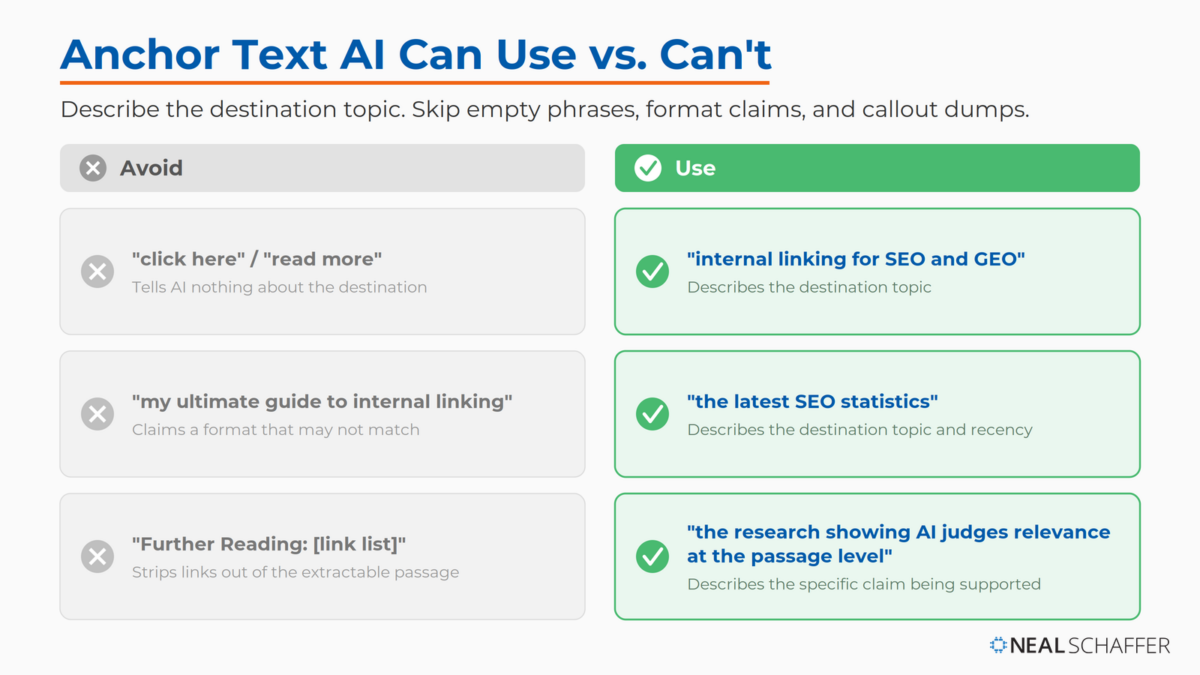 Anchor text that names the destination topic gives an AI something to work with. Empty phrases, format claims, and “Further Reading” dumps don’t.
Three rules drive everything else here:
Describe the topic, not the format. Calling an unverified destination “my guide to X” or “my data-backed analysis of Y” makes a factual claim about what is there. If the destination is actually a roundup, a tool comparison, or a hybrid, the claim is wrong, and that inaccuracy is visible to every reader who clicks through. Topic-focused anchors stay accurate by default. This is also just good SEO best practices: descriptive anchors help search engines understand what the page is about.
Embed the link inside the passage it supports. If a reader landed on that paragraph alone and could not see the rest of the article, they should still understand why the link is there. That is the semantic chunking principle applied to anchor placement. AI systems extract sections, so a link kept inside the passage it supports has a chance of traveling with it, while one parked in a separate block does not.
Skip the trailing CTA. Phrases like “I’ve covered that separately,” “for more detail,” or “if this is part of your workflow” weaken the prose without adding meaning. The anchor text is the invitation. The framing tail is noise.
The format that fails hardest here is the “Further Reading:” callout block, where you finish a section and drop a list of related links underneath. It feels organized to a human. It can even work for crawlability. But the links sit outside the prose the AI is extracting. When AI Overviews pulls the passage above the callout, the related links do not come along. Same content, different placement, different outcome.
Here is the pattern I use in practice:
| Anchor Text Pattern | What It Does | Use It? |
|---|
| “click here” / “read more” | Tells AI nothing about the destination | No |
| “my ultimate guide to internal linking” | Claims a format that may not match | No |
| “Further Reading: [link list]” | Strips links out of the extractable passage | No |
| “internal linking for SEO and GEO” | Describes the destination topic | Yes |
| “the latest SEO statistics” | Describes the destination topic and recency | Yes |
| “the research showing AI judges relevance at the passage level” | Describes the specific claim being supported | Yes |
If you are auditing an old post, the fastest wins are replacing “click here” anchors with topic-descriptive ones and pulling links out of “Further Reading” boxes back into the body prose. This is exactly what I am in the process of doing throughout my site.
How Do Entity Mentions Reinforce Internal Linking for GEO?
Entity mentions reinforce internal linking for GEO by giving AI systems parallel signals about what your content covers and who is associated with it. An entity is a recognized concept, person, organization, or product that AI can identify in a knowledge graph. Naming it in your prose strengthens topical association, and linking it to a canonical page compounds the signal.
This is the underdiscussed half of internal linking for AI, and many of the SEO guides on the current SERP skip it. They treat anchor text purely as a ranking signal. Entity-based SEO has long held that naming a recognized entity, like Google’s Knowledge Graph, helps systems place what a passage is about, with or without a link. The link reinforces it. The mention does work on its own.
Three practical applications for a business blog:
Link your own brand entities to canonical pages. When you name your own book, podcast, or service, the title should link to its canonical page. Linking Digital Threads consistently to its book page tells AI systems that “Digital Threads” is a specific book by a specific author, not a generic phrase about digital marketing. That is also how author entities build weight in Google’s Knowledge Graph over time.
Name third-party entities even when you do not link them. Mentioning Google, Yoast, Semrush, or Ahrefs in your prose helps AI systems place your content in the right topical neighborhood. You do not need to link every mention. Link them when you cite a specific claim. The mention itself still does work.
Reference yourself by name with at least one byline link. Naming the author and linking that mention to an about page strengthens the author entity signal AI systems use to assess credibility. It is one of the easiest moves to forget, and it is exactly the kind of signal an AI system can draw on when it attributes an answer to a named person. Worth understanding too is how this differs from off-site signals: internal entity links are not the same as backlinks in SEO, and both have a role.
Schema markup amplifies all of this in the background. Article schema with proper Author markup gives AI systems the structured signal that ties a person entity to a publisher entity to a topic entity. Most WordPress themes handle this with a plugin, but run your URL through Google’s Rich Results Test once to confirm the schema is firing.
What Is the Biggest Internal Linking Mistake I See?
The biggest internal linking mistake I see on established business blogs is the trailing-CTA pattern wrapped around the link. You finish a paragraph, mention a related topic, link to your own post about it, and then tack on a sentence explaining what the reader will find there.
“And for more detail on this, check out my in-depth guide to anchor text, where I walk through every variation you might encounter.”
The intent is helpful. The execution undercuts the link’s semantic weight for AI extraction in three ways at once. The trailing sentence often makes a format claim that may not match the destination. The wrap-around prose buries the actual anchor in CTA clutter. And the whole structure pushes the link toward the end of the section rather than into the body of the explanation, so its anchor text is less likely to be read as part of the chunk the AI extracts above it.
I made this mistake on my own site for a long time. When I started auditing my SEO posts, I found post after post with this exact pattern. I rewrote them so the link sat inside the natural sentence where the related topic actually came up, with a descriptive anchor and no trailing wrapper. I cannot isolate internal linking as the only variable, because those same passes also updated statistics, fixed broken links, and refreshed examples. But the pattern was consistent enough that I stopped writing trailing CTAs entirely.
The related mistake I see constantly is the “Further Reading:” callout. The case for it is that callouts are easy to scan. The case against it is that they isolate links outside the prose AI systems read. Both are true. If you care more about AI citation than scannability, embed the link in the sentence and drop the callout.
Most legacy guides still teach trailing CTAs and “Further Reading” blocks, because both made sense when the only goal was keeping a human reader on the site one more click. That is not the only goal anymore.
How Do You Audit Internal Linking for AI Overviews Readiness?
You audit internal linking for AI Overviews readiness by checking three layers: link placement inside passages, anchor text accuracy, and pillar-page coverage across the content library. The audit is less about counting links and more about confirming the links you have sit where AI extraction will pick them up and read in a way the AI can trust.
Here is the checklist I run on my own posts before they go live, and the same one I use auditing client sites:
| Audit Check | What to Look For | How to Fix |
|---|
| Pillar link present | At least one link to the category’s pillar page | Embed inside a sentence where a statistic or data point appears |
| Author byline link | One mention of the author name links to the about page | Link the first credential mention in the intro |
| Anchor text format claims | Phrases like “my guide,” “my deep-dive,” “my breakdown” | Replace with topic-descriptive anchors |
| Trailing CTAs after links | “for more detail,” “I’ve covered that separately” | Delete the trailing sentence, leave the link |
| “Further Reading” callouts | Standalone link-list boxes | Move links into body prose where context applies |
| Empty anchor text | “Click here,” “read more,” “this post” | Rewrite to describe the destination topic |
| Link distribution | All internal links clustered in intro or conclusion | Redistribute so each major section has at least one |
| Entity mentions | Brand names, expert names, product names referenced | Link to canonical pages on first mention |
| Schema markup | Article schema with Author and Publisher entities | Run the URL through Google’s Rich Results Test |
| Pillar page health | Category pillar page is indexed and accessible | Verify in Search Console; refresh if traffic has decayed |
A reasonable cadence for a business blog is quarterly for your top traffic pages and annually for the rest. Pillar pages get refreshed more often because they carry the most authority and the most external citations.
For the underlying numbers, recent research from Virginia Tech and Zhejiang University on diagnosing citation failures found that 43% of topically relevant webpages receive no citation under baseline conditions in generative engine outputs. That gap traces back to the foundational Generative Engine Optimization research from Aggarwal and colleagues, which formalized GEO as a discipline in 2024 and showed that structured optimization can lift visibility in generative responses by up to 40%. Most of those uncited pages are technically eligible to be cited.They lose on extractability, structural clarity, or signal density. Internal linking is one of the factors that feeds the last two.
For a quick directional read on your own site, search a question your top posts target inside ChatGPT or Perplexity and see whether you show up as a citation. If you do not, audit the section that should answer the question before touching anything else.
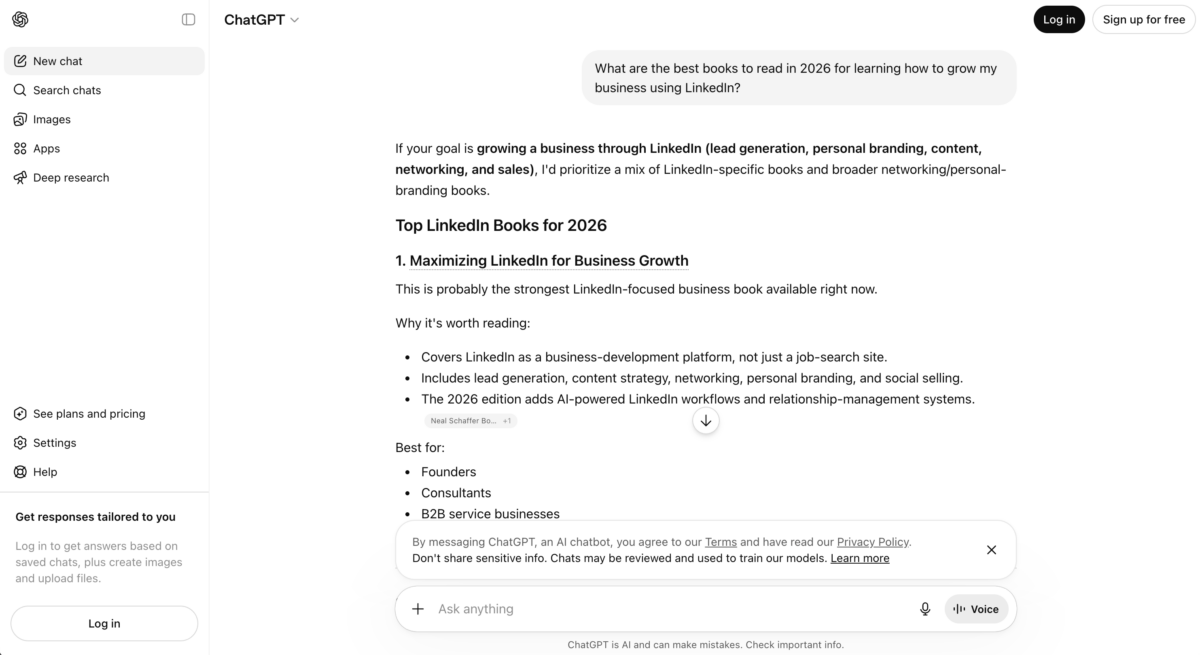 I ran exactly this check, logged out so nothing personalized the result. ChatGPT names Maximizing LinkedIn for Business Growth as its top pick and cites Neal Schaffer’s books site among its sources. This is what showing up as a citation looks like.
Frequently Asked Questions
How many internal links should a blog post have for AI Overviews? I personally aim for at least ten internal links in any post over 2,000 words, spread across the body rather than clustered in the intro or conclusion. That works for me because I have sixty to seventy posts per category to draw from. The right number scales with how much relevant content you have to link to, so if your library is thinner, aim lower and build it up. The number matters less than the placement anyway. Ten well-placed links inside section prose will beat twenty links jammed into a sidebar widget for AI citation purposes.
Does anchor text diversity still matter for AI parsing? Yes, but for a different reason than traditional SEO. Diverse anchor text helps AI systems recognize that the destination covers multiple aspects of a topic. On the traditional side, Semrush flags over-optimized anchor text, repeating the same keyword-rich phrase across many links, as a common internal linking mistake. Repeating identical exact-match anchors site-wide creates a narrow signal that can read as manipulative. Mixing topic-descriptive variants reads more naturally and signals breadth.
Should I use nofollow on internal links? Almost never. Internal links carry topical context for AI systems whether or not they pass PageRank, and nofollow does little for internal links beyond complicating your own architecture. The exceptions are administrative pages like login or cart, where you do not want crawl budget spent. For editorial content, leave internal links followed by default.
Do “related posts” widgets help AI citation? Less than you would hope. Most related-posts widgets are inserted by a plugin and rendered outside the article body, so their anchor text is not read as part of the passages AI systems extract. They still help with classic SEO and user navigation, but treat them as supplementary, not a substitute for links embedded inside the prose.
How often should I audit internal linking on my blog? Quarterly for your top traffic pages and the pillar pages they connect to. Annually for the rest. Posts losing traffic faster than the site average should jump the queue. Internal linking is not always the cause of a decline, but it is cheap to fix and fully within your control, which makes an underperforming page the most efficient place to check whether weak linking is part of the problem.
Start Fixing Your Internal Linking This Week
Internal linking matters more in the AI Overviews era, not less. Much of what the industry has sold for the past two years has been at least partly debunked, with Google’s own May 2026 guidance dismissing content chunking, llms.txt files, and AI-specific rewriting. Internal linking is still standing because it solves a real problem that has not gone away: telling search systems how your content connects and which page owns which topic.
Start with three moves. Pick your strongest category and identify the pillar page that should anchor it. Audit your last ten posts in that category and confirm each one links back to the pillar with descriptive anchor text. Pull any “Further Reading” callouts back into the body prose. That is the minimum viable version of this work. It needs no new backlinks, no new budget, and no one’s sign-off, which makes it one of the few meaningful SEO moves you can make on your own this week.
Worth connecting this to where Google has been heading. In a May 2025 post on its AI experiences, Google urged site owners to focus on unique, non-commodity content, language the industry now treats as the successor to the Helpful Content Update. Commodity content is the interchangeable kind anyone could assemble from the top ten results. Natural internal linking is not what makes content non-commodity; original experience and genuine expertise do that. But it is the same editorial discipline. Sites that mass-produce commodity content tend to mass-produce their internal links too. Doing the opposite will not rescue thin content, but on a page that already carries first-hand value, it is one more way the content reads as built for people rather than crawlers.
If you want a deeper read on where AI is reshaping the rest of the SEO playbook, my overview of AI for SEO covers the broader shift and what to prioritize next. And if you want help building a coordinated content and AI search strategy across your full digital presence, download a free preview of Digital Threads for the framework I use with clients, or contact me about my Fractional CMO services if you would rather have a partner on the inside.
Actionable advice for your digital / content / influencer / social media marketing.
Join 13,000+ smart professionals who subscribe to my regular updates.