Your slogan is working overtime whether you realize it or not. Those few words show up everywhere: your website header, social media profiles, email signatures, business cards, ads. And here’s the thing: most slogans don’t work nearly as hard as they should.
I’ve spent over 15 years helping businesses get their messaging right as a Fractional CMO, and I see the same challenges repeatedly. Companies either overthink it, ending up with something forgettable and generic, or they rush the process and wonder why their slogan doesn’t stick.
Think about it: Nike’s “Just Do It” is only three words. Apple’s “Think Different” is two. Yet these slogans have become inseparable from the brands themselves. Research from Exploding Topics shows that brand consistency (which includes your slogan) can increase revenue by 10-20%. That’s not a small number.
This isn’t about finding clever wordplay. It’s about creating a phrase that captures your brand’s essence and sticks in your audience’s mind long enough to influence their decisions.
Key Takeaways
? The most effective slogans average 3-5 words. Shorter is almost always better for recall.
? Brand consistency with your slogan can increase revenue by 10-20%.
? 81% of consumers need to trust a brand before buying, and clear messaging builds that trust.
? Test multiple variations (at least 10-15) before settling on your final slogan.
? Your slogan should work across all channels: digital, print, and internal communications.
? Avoid including your brand name in the slogan itself, as this can feel overly promotional.
What Makes a Slogan Effective?
A great slogan does three things: it’s memorable, it communicates your value, and it connects emotionally with your audience. That’s it. But getting all three right in just a few words? That’s where most businesses struggle.
According to Huddle Creative’s branding research, 81% of consumers need to trust a brand before they’ll consider buying from it. Your slogan is often one of the first touchpoints that begins building (or breaking) that trust.
The psychology here is straightforward. Shorter phrases are easier to remember. Common words increase likeability. Concrete terms improve recall while abstract concepts boost emotional connection. The trick is balancing all three.
| Slogan Element | Impact on Memorability | Impact on Likeability |
|---|
| Short length (3-5 words) | High | High |
| Common vocabulary | Medium | High |
| Unique word combinations | High | Medium |
| Concrete imagery | High | Medium |
| Emotional triggers | Medium | High |
David Ogilvy, widely considered the father of advertising, put it simply: “What you say in advertising is more important than how you say it.” Your slogan isn’t the place for fancy language. It’s the place for clarity.
What’s the Difference Between a Slogan and a Tagline?
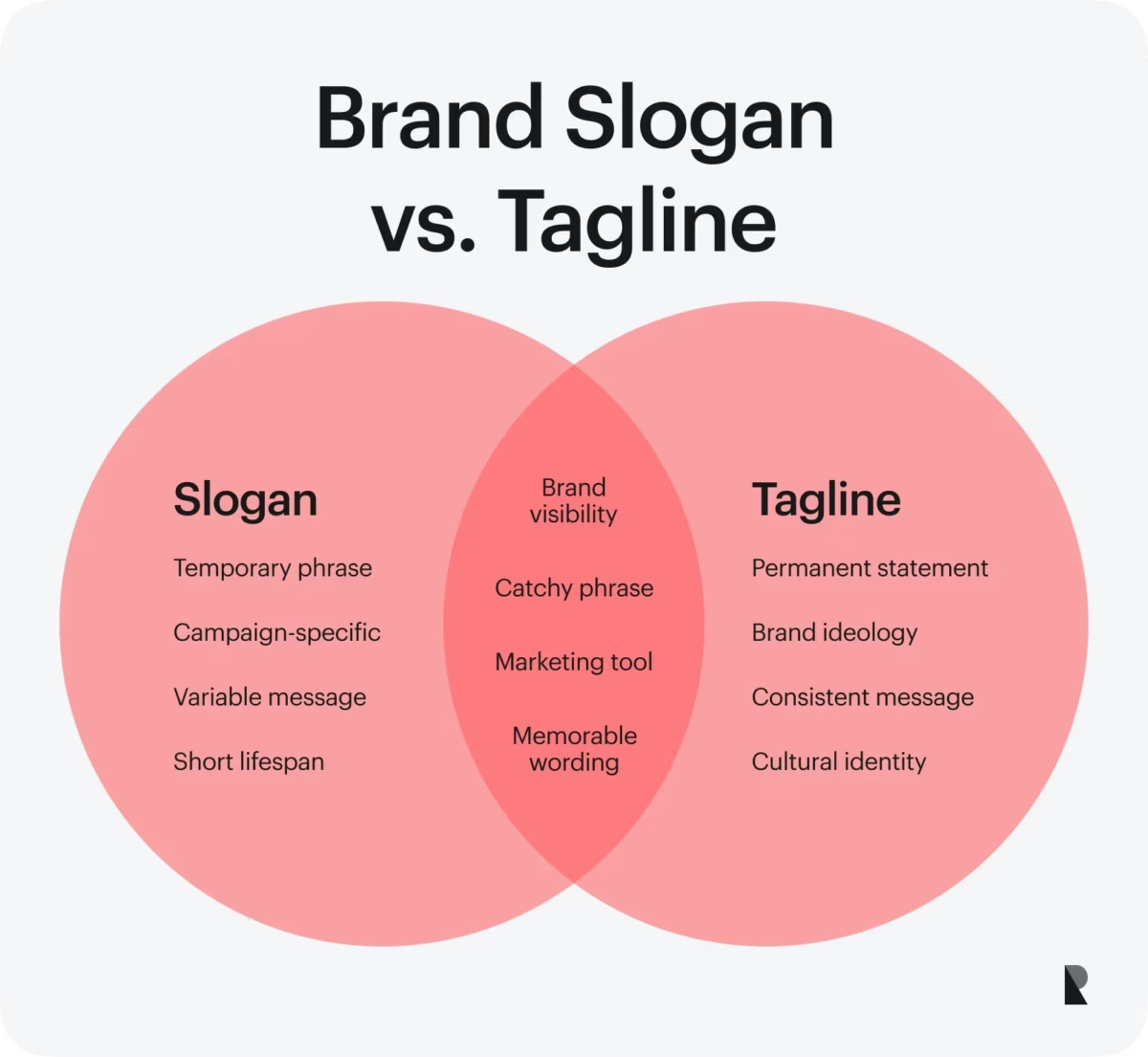 Source
Before we get into formulas, let’s clear up a common confusion. Slogans and taglines are related but serve different purposes.
A tagline is your brand’s permanent identifier. It represents your overall brand promise and rarely changes. Think McDonald’s “I’m Lovin’ It” or BMW’s “The Ultimate Driving Machine.” These stay consistent for years, sometimes decades.
A slogan is more flexible. It can change with campaigns, products, or seasons. Slogans are marketing-focused and often tied to specific initiatives. According to Indeed’s career advice, slogans focus on marketing activities while taglines focus on branding activities.
| Feature | Tagline | Slogan |
|---|
| Duration | Long-term, rarely changes | Can change with campaigns |
| Focus | Brand identity | Product or campaign |
| Purpose | Brand recognition | Marketing action |
| Examples | “Just Do It” (Nike) | Campaign-specific phrases |
For this article, I’m using “slogan” broadly to cover both. The formulas work either way.
How Long Should a Slogan Be?
The data is clear on this: shorter is better. The most recalled slogans average about 3-5 words. Any longer, and you’re asking too much of your audience’s memory.
InkBot Design’s research recommends keeping slogans between 3 and 7 words maximum. But the sweet spot depends on your goal:
Is Your LinkedIn Working?
Just released: my new book to help professionals, entrepreneurs, and business owners maximize LinkedIn for real growth.
With years of LinkedIn expertise, Maximizing LinkedIn for Business Growth offers actionable steps to build your brand, expand your network, and drive results.
Start leveraging LinkedIn like never before—grab your copy now! Click the cover or button below to buy on Amazon.
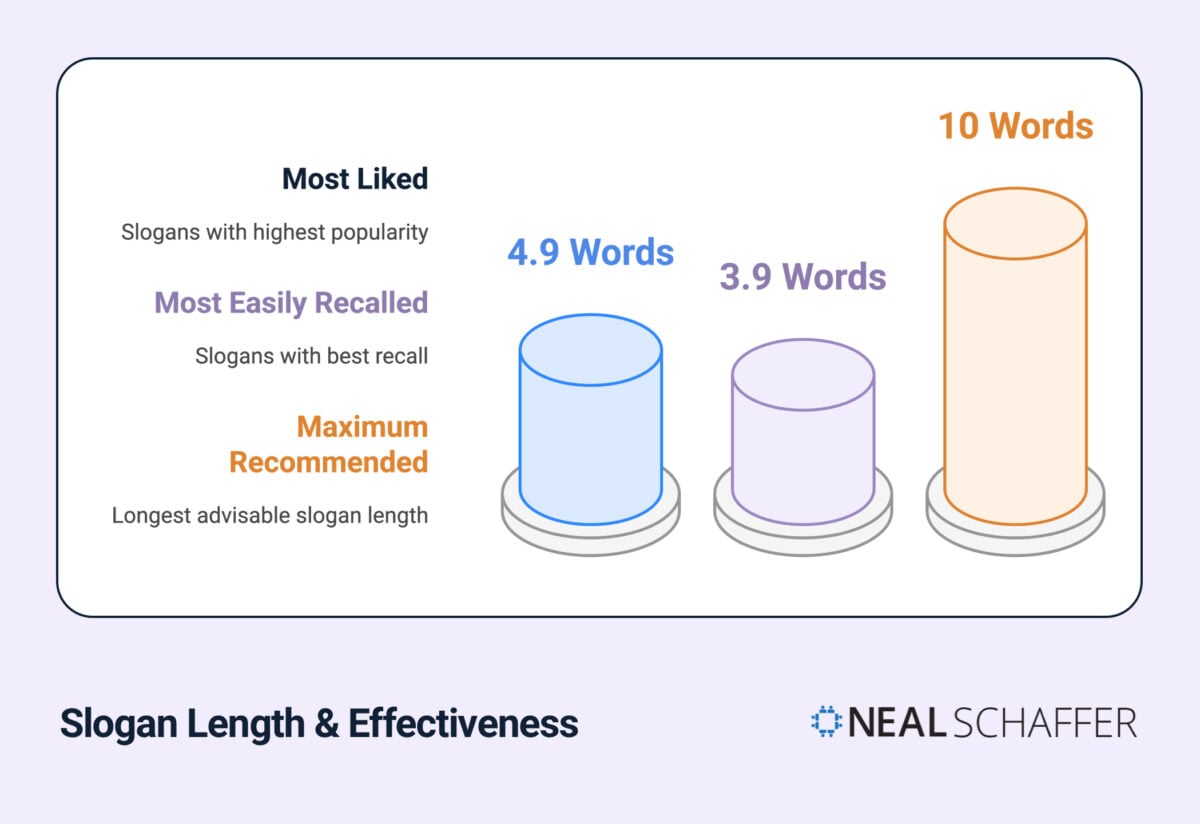
Notice the tradeoff? The slogans people like most (4.9 words) are slightly longer than the ones they remember best (3.9 words). If recall is your priority, go shorter. If emotional connection matters more, you have a bit more room to work with. But never exceed 10 words.
Look at the most iconic examples:
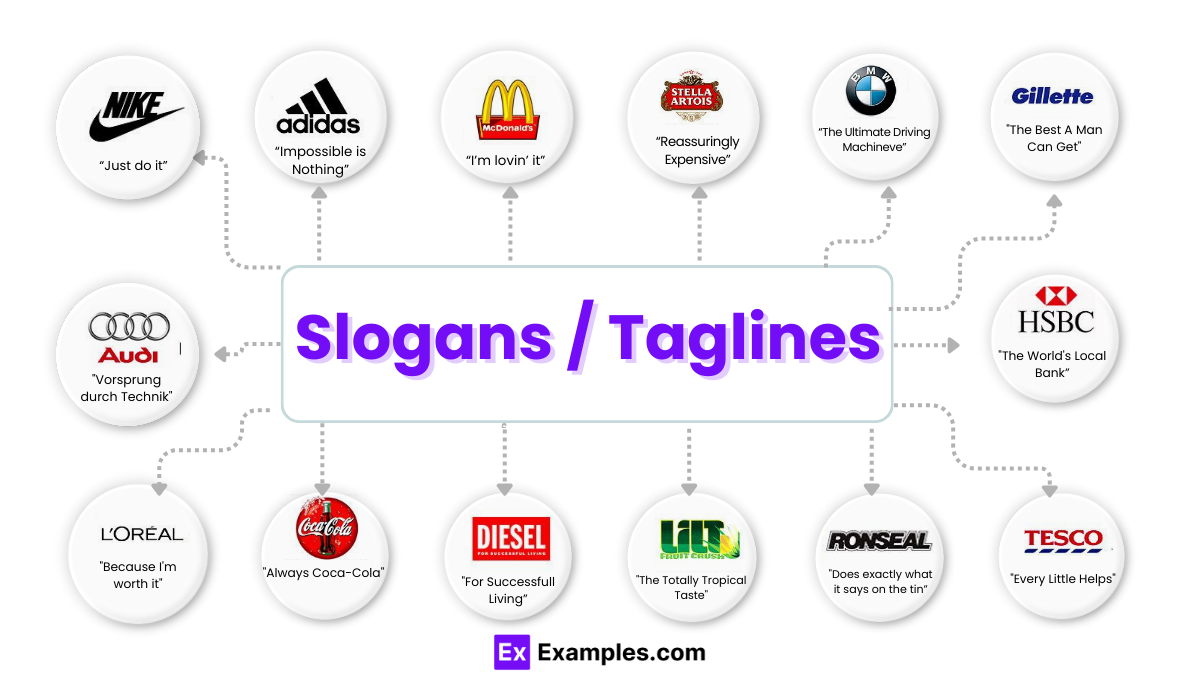 Source
- “Just Do It” (3 words)
- “Think Different” (2 words)
- “I’m Lovin’ It” (3 words)
- “Because You’re Worth It” (4 words)
- “Eat Fresh” (2 words)
Every word in your slogan needs to earn its place. If you can remove a word without losing meaning, remove it.
7 Proven Slogan Formulas That Convert
Through my consulting work and teaching digital marketing at universities, I’ve studied what makes brand messaging stick. These seven formulas consistently produce results. They’re not magic, but they give you a solid starting point instead of staring at a blank page.
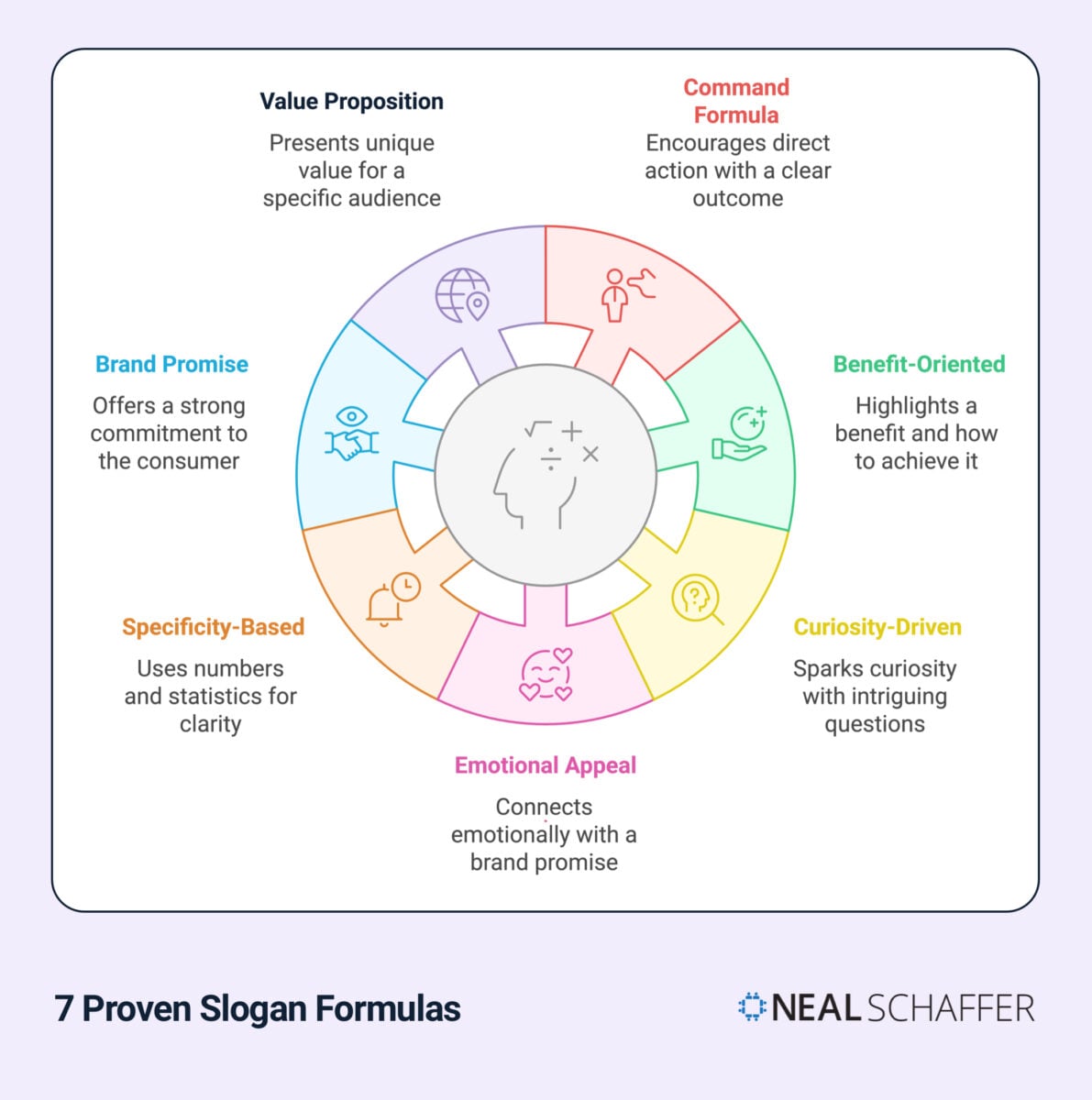
Let’s break down each formula with examples you can apply immediately.
Formula 1: The Command Formula
Structure: [Action Verb] + [Desired Outcome]
This formula works because it tells people exactly what to do. It’s direct, clear, and action-oriented. No guessing required.
Examples:
- “Just Do It” (Nike)
- “Think Different” (Apple)
- “Eat Fresh” (Subway)
- “Have a Break” (Kit Kat)
The command formula works best for brands focused on empowerment, motivation, or transformation. If your product helps people take action or change behavior, start here.
Formula 2: The Benefit-Focused Formula
Structure: [Primary Benefit] + [How You Deliver It]
Don’t make your audience guess what’s in it for them. Tell them directly.
Examples:
- “Melts in Your Mouth, Not in Your Hands” (M&Ms)
- “Save Money. Live Better.” (Walmart)
- “The Ultimate Driving Machine” (BMW)
This formula is ideal for products where the benefit isn’t immediately obvious, or where you want to differentiate from competitors who offer similar features. I’ve talked about the importance of clear value propositions in my content marketing examples post.
Formula 3: The Curiosity Formula
Structure: “What if [Possibility]?” or “The Secret to [Desired Outcome]”
Curiosity is one of the most powerful psychological triggers. When you create an open loop, people want to close it.
Examples:
- “What’s in Your Wallet?” (Capital One)
- “Where’s the Beef?” (Wendy’s)
- “Maybe She’s Born With It, Maybe It’s Maybelline”
The Maybelline example is brilliant because it creates mystery around the product’s effectiveness. You can’t tell if it’s natural or the makeup. That curiosity drives engagement.
Formula 4: The Emotional Appeal Formula
Structure: [Emotional Trigger] + [Brand Promise]
Emotions drive decisions. According to Harvard research on neuromarketing, emotional responses significantly influence buying behavior. A slogan that makes people feel something will outperform one that just informs.
Examples:
- “Because You’re Worth It” (L’Oréal)
- “Open Happiness” (Coca-Cola)
- “I’m Lovin’ It” (McDonald’s)
The L’Oréal slogan taps into self-worth. It’s not about the product features; it’s about how buying the product makes you feel about yourself. This connects directly to brand voice development, which I’ve written about extensively.
Formula 5: The Specificity Formula
Structure: [Number/Statistic] + [Result] in [Timeframe]
Specific numbers create credibility. They’re concrete, measurable, and feel trustworthy.
Examples:
- “15 Minutes Could Save You 15% or More” (GEICO)
- “Two Scoops of Raisins in Every Package” (Kellogg’s Raisin Bran)
- “Finger Lickin’ Good” (KFC, implies the specific action)
GEICO’s slogan is a masterclass in specificity. The time commitment is clear (15 minutes). The potential outcome is clear (15% savings). There’s nothing vague about it.
Formula 6: The Brand Promise Formula
Structure: We [Promise] + [Benefit]
Make a commitment. Put yourself on the hook. This builds trust because you’re being explicit about what you’ll deliver.
Examples:
- “When It Absolutely, Positively Has to Be There Overnight” (FedEx)
- “The Fresh Food People” (Woolworths)
- “Quality Never Goes Out of Style” (Levi’s)
FedEx’s slogan is essentially a guarantee. It sets clear expectations and positions reliability as their core differentiator. This approach works well when trust and dependability are your competitive advantages.
Formula 7: The Value Proposition Formula
Structure: [Unique Value] + [For Whom]
This formula clearly states what makes you different and who you serve. It’s positioning in a sentence.
Examples:
- “The World’s Local Bank” (HSBC)
- “Good Food, Good Life” (Nestlé)
- “Connecting People” (Nokia)
HSBC’s slogan solves a paradox: how can a global bank feel local? By stating it directly, they claim that positioning before anyone questions it.
| Formula | Best For | Key Strength |
|---|
| Command | Action-oriented brands | Direct and motivating |
| Benefit-Focused | Solution providers | Clear value communication |
| Curiosity | Engagement-driven brands | Creates interest and recall |
| Emotional Appeal | Lifestyle brands | Deep audience connection |
| Specificity | Service/product brands | Builds credibility |
| Brand Promise | Trust-dependent industries | Sets clear expectations |
| Value Proposition | Differentiation needs | Clarifies positioning |
How to Apply These Formulas to Your Brand
Having formulas is one thing. Using them effectively is another. Here’s the process I use with clients.
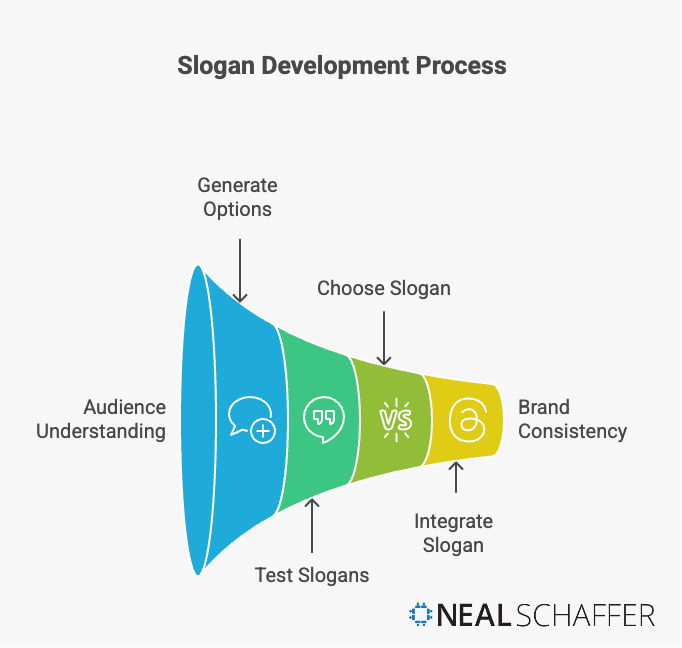
Step 1: Know Your Audience First
You can’t write a slogan in a vacuum. Who are you talking to? What do they care about? What language do they use?
Review your customer demographics and psychographics. Look at the language in customer reviews and feedback. What words do they use to describe your product or their problems? That’s often where your slogan lives.
I’ve written about understanding your target audience in the context of user-generated content, and the same principles apply here. Your slogan should sound like something your customers would say, not something a marketing committee created.
Step 2: Generate Multiple Options
Don’t fall in love with your first idea. Create at least 10-15 options using different formulas. Mix and match. Try command versions, benefit versions, emotional versions.
This is where AI writer tools can actually help. Not to write your final slogan, but to generate variations quickly. Use them as a brainstorming partner, not a replacement for your judgment.
Step 3: Test Before You Commit
Here’s where most businesses skip ahead. They pick what sounds good internally and roll with it. That’s a mistake.
Get feedback from actual customers or people in your target audience. Ask:
- What does this slogan make you think about?
- What company do you think would use this slogan?
- Can you remember this tomorrow?
The answers might surprise you. A/B testing on ads or landing pages can also reveal which slogans actually drive action versus which ones just sound clever.
Step 4: Integrate Consistently
Once you’ve chosen your slogan, use it everywhere. And I mean everywhere.
Digital presence:
- Website header and footer
- Social media profiles
- Email signatures
- Digital advertising
Traditional marketing:
- Business cards
- Packaging
- Signage
- Print materials
Internal communications:
- Training materials
- Company documents
- Internal presentations
Remember that brand consistency statistic about 10-20% revenue increases? That only happens with consistent application.
Common Slogan Mistakes to Avoid
I’ve seen these mistakes hundreds of times. Don’t make them.
Being Too Generic
“Quality You Can Trust” could be any company. “Excellence in Service” says nothing. If your competitor could use the same slogan, it’s not working.
Including Your Brand Name
Research suggests that including your brand name in the slogan can make it feel overly promotional and trigger consumer skepticism. Let the slogan stand on its own.
Making It Too Long
If you can’t say it in one breath, it’s too long. Every word you add reduces memorability.
Changing It Too Often
Consistency builds recognition. Changing your slogan every year means you’re constantly starting from zero. Nike has used “Just Do It” since 1988 for a reason.
Skipping Trademark Research
Before you fall in love with a slogan, check if someone else already owns it. The USPTO trademark database is your friend here. Rebranding because of a trademark dispute is expensive and embarrassing.
| Mistake | Why It Fails | Solution |
|---|
| Generic messaging | Not memorable or differentiating | Focus on unique value |
| Including brand name | Feels promotional | Let slogan stand alone |
| Too long | Hard to remember | Keep to 3-7 words |
| Frequent changes | No consistency | Commit for the long term |
| No trademark check | Legal risks | Search USPTO database |
Testing and Optimizing Your Slogan
Your slogan isn’t “set it and forget it.” You should track how it’s performing.
Metrics to monitor:
- Brand recall rates (can people remember your slogan?)
- Social media engagement when using the slogan
- Ad performance with and without the slogan
- Customer sentiment when the slogan is mentioned
If something isn’t working, investigate why. Maybe the slogan is fine but the placement is wrong. Maybe it resonates with one audience segment but not another.
The goal is continuous improvement, not perfection out of the gate.
Should You Use a Slogan Generator?
Tools like Shopify’s Slogan Maker, Canva’s Slogan Generator, and others can help with brainstorming. But treat them as starting points, not endpoints.
These tools work by combining common patterns and keywords. They can give you dozens of options quickly, which is useful for breaking through writer’s block. But they don’t know your brand, your audience, or your competitive positioning.
Use them in Step 2 (generating options), not Step 3 (making decisions).
Frequently Asked Questions
How do I know if my slogan is working? Track brand recall through customer surveys, monitor social media mentions, and analyze ad performance. If people can’t remember your slogan after seeing it multiple times, it’s not working. Also watch for organic use: are customers or employees using it naturally?
Can I trademark my slogan? Yes. Slogans can be trademarked if they serve as a source identifier for your goods or services. Check the USPTO database for existing trademarks before committing, and consult with an intellectual property attorney for protection.
How often should I change my slogan? Rarely, if ever. The most successful slogans remain consistent for years or decades. Nike’s “Just Do It” has been used since 1988. Changing too frequently prevents brand recognition from building. Only consider changing if your brand positioning fundamentally shifts.
What’s the ideal length for a slogan? Three to five words is the sweet spot for memorability. The most recalled slogans average about 3.9 words. Longer slogans are harder to remember and repeat. If you can’t remove any words without losing meaning, you’re in good shape.
Should my slogan include my company name? Generally, no. Research indicates that including your brand name can make the slogan feel too promotional and may trigger consumer skepticism. Let your slogan communicate value or emotion, and let your brand name live separately.

Take the Next Step
Coming up with an effective slogan takes more than creativity. It requires understanding your audience, applying proven formulas, testing rigorously, and committing to consistent use.
Start with the formula that best fits your brand positioning. Generate multiple options. Test with real people. And once you’ve found the right one, use it everywhere.
If you’re struggling to nail your brand messaging or want a second opinion on your slogan strategy, check out my consulting services. Sometimes an outside perspective is exactly what you need to see what you’ve been missing.
Actionable advice for your digital / content / influencer / social media marketing.
Join 13,000+ smart professionals who subscribe to my regular updates.