Thursday, April 16, 2026
It’s an understatement to say that GLP-1s are a disruptive force.
This novel powerhouse category of drugs are disrupting restaurants, snack makers, convenience stores, and airlines.
Retail and fashion are not immune either.
Destination XL, the big-and-tall men’s retailer, told investors that GLP-1 usage is causing customers to “move around in size” creating what they called business volatility.
But GLP-1s aren’t exactly introducing something new. They’re accelerating something that was already there, at a magnitude and pace the industry has never had to plan around.
I call this Fit Volatility: the condition where a meaningful portion of your customer base is changing size, shape, or fit expectation faster than your planning, merchandising, and inventory systems can accommodate.
The volatility doesn’t come from one source.
A customer on GLP-1 is simultaneously affected by diet habits, exercise routines, lifestyle changes, cosmetic surgery trends, and predictable life events like aging and hormonal shifts. Even more interesting to consider is if that customer discontinues GLP-1, data suggests 60–70% weight rebound within a year. That’s a second wave of volatility from the same cohort.
What throws another wrench into the mix is that new pill forms of the drug have been approved. Also, genetic testing can possibly help determine the extent to which an individual patient will lose weight.
GLP-1s are indeed a force multiplier of Fit Volatility!
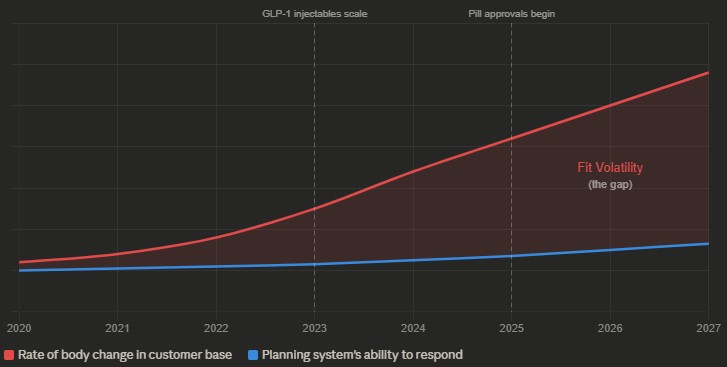
Clearly, this is a structural disruption, not just a singular event.
And it magnifies what is already flawed: an industry that plans a year out, works on multiple seasons simultaneously, and has no efficient mechanism to loop real-time market feedback into product creation.
Therefore, Fit Volatility is overwhelming a system that is already fragile. Any standard fit block or size curve in use today is a bet that tomorrow’s body looks like today’s. In an increasing number of markets, that bet is losing.
As such, here is one thing you can do right now: Pull your fit-related return data from the last two seasons and map it against the size curve you planned to. Then look at the excess that’s accumulated on those same styles. If the gap between what you planned and what came back has widened in core replenishment, you’re already inside the Fit Volatility window.
Because the future is smarter fit systems and the organizational capability to support them.
About Retail Strategy Group
Founded in 2020, Retail Strategy Group works with market-leading brands to help them improve profitability and increase organizational effectiveness. The firm produces a weekly newsletter, The Merchant Life, where retail executives find the best retail insights and new, provocative ideas. For more information, visit www.retailstrategygroup.com.