Most businesses I talk to are still doing Facebook marketing the way they did it in 2017. Post to the Page. Hope someone sees it. Boost the occasional update when reach drops. Then they wonder why Facebook “doesn’t work anymore.”
Facebook works. Your approach is what’s out of date.
I’m Neal Schaffer. I’ve spent more than fifteen years helping businesses with social media, I teach this material to executives at Rutgers Business School, and I’ve written six books on digital and social media marketing. I also still run my own Pages and ad campaigns, so this isn’t theory pulled from someone else’s blog. This guide is for the business owner, marketer, or entrepreneur who wants Facebook to do real work instead of just sitting in your footer as a logo. If you want the honest version of what moves the needle in 2026, keep reading.
Key Takeaways
? Facebook is still the widest-reach platform a business can use, so writing it off is a mistake even when the cool kids have moved on.
? Organic reach is thin. Plan to pair good organic content with a modest, well-targeted ad budget rather than expecting free posts to carry you.
? Video, and Reels in particular, get the most algorithmic favor right now. If your content plan is all static images, you’re fighting the current.
? Facebook ads are still some of the cheapest attention in digital marketing, which is the real reason small budgets can compete here.
? Facebook works best as one thread in a connected strategy alongside search, email, and your other channels, not as an island.
What is Facebook marketing?
Facebook marketing is the practice of using a Facebook Page, organic content, Groups, messaging, and paid ads to reach an audience, build relationships, and drive measurable business results. It spans free tactics (posting, community, replies) and paid ones (boosted posts and full ad campaigns), and most businesses get the best results by combining the two.
The scale is the reason it stays on the table. Meta reported an average of 3.58 billion daily active people across its Family of Apps in December 2025, up 7% year over year. Facebook is the largest single property inside that family. In the United States, about 71% of adults use Facebook according to Pew Research Center, and roughly 37% of all U.S. adults visit it several times a day. No other platform a small business can realistically use puts that many people in one place.
There’s also a behavior shift worth naming. Pew also found that 38% of U.S. adults regularly get news on Facebook, more than on any other social platform. Globally, Facebook is still the most widely used social platform, with 56.3% of adult internet users reporting they used it in the past month in DataReportal’s Digital 2026 analysis. People don’t just scroll Facebook to see their cousin’s vacation photos. They research businesses, read reviews, join communities, and increasingly treat it as a discovery engine. That’s your opening.
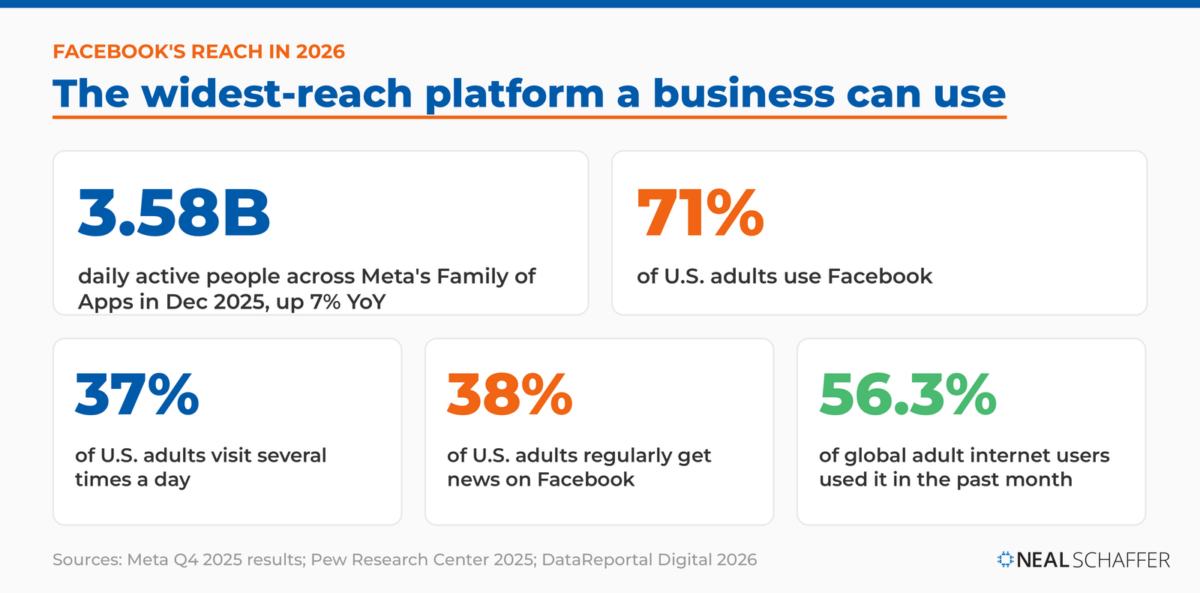 Five Facebook reach stats for 2026: 3.58 billion daily active users across Meta’s Family of Apps, 71 percent of U.S. adults, 37 percent daily visitors, 38 percent getting news there, and 56.3 percent of global adult internet users.
Is Facebook still worth it for marketing in 2026?
Yes, Facebook is still worth it in 2026, but not in the form most people picture. The audience is enormous and active, and ad costs remain low. What’s changed is where attention lives inside the app. Static Page posts get little organic reach. Video and Reels get pushed hard. Treating Facebook like a 2017 bulletin board is what makes it feel dead.
I went to a Meta Boost Small Business Studios event in Detroit a while back, and the takeaway was almost comical in how clear it was. In an entire day of presentations from Meta’s own team, there was barely a mention of the Facebook feed. It was all Instagram, and inside Instagram it was all Reels. On an episode of my podcast Your Digital Marketing Coach, I summed it up like this:
“the future of Facebook is Instagram and the future of Instagram is Instagram reels.”
Years later, that call has only gotten more true. Meta keeps prioritizing Reels in the feed for one reason: short video is where attention and watch time are growing fastest.
So the question isn’t whether to be on Facebook. It’s whether your content matches how people actually consume the platform now. I’ve watched this play out on my own accounts: photo posts that used to collect likes for a full day now go quiet within hours, while short video gets meaningfully more reach. If you adjust, Facebook rewards you. If you don’t, you’ll keep blaming the platform for a content problem.
How do you set up a Facebook Page built to market?
A marketing-ready Facebook Page is one that’s fully staged before you spend a cent on ads: complete business info, a recognizable profile and cover image, a clear call-to-action button, pinned content that shows what you do, and the newer Page features Meta keeps adding. Most Pages are missing something basic, and that quietly undercuts every campaign you run.
Stage the Page first. Walk through it as a stranger would. Is it obvious what you sell, who you help, and how to contact or buy from you within a few seconds? Add the action button (Book Now, Shop Now, Send Message, whatever fits). Fill in hours, location, and the about section with the words your customers actually use. Then build out the assets you’ll reuse in ads and posts. If you need a starting point for the visual side, look at real Facebook ad examples to see what a polished, on-brand presence looks like before you publish your own.
Community is part of setup too, not an afterthought. A well-run group can become the most engaged corner of your Facebook presence, which is why it’s worth learning how to create a group on Facebook and tying it to your Page. Groups are where conversation still happens organically, and conversation is what the algorithm rewards.
What should you actually post on Facebook?
Post a mix weighted toward video, with a clear job for each format: Reels for reach and discovery, feed posts for your existing audience, Stories for in-the-moment and interactive content, and the occasional live video for real-time connection. Lead with content that educates, entertains, or starts a conversation, and keep promotional posts a small slice of the total.
The main formats each do a different job.
| Format | Primary job | Best for |
|---|
| Reels (short video) | Reach and new-audience discovery | Getting found by people who don’t follow you yet |
| Feed posts (image/link/text) | Reaching existing followers | Announcements, offers, blog and product links |
| Stories | In-the-moment, interactive updates | Polls, questions, behind-the-scenes, time-limited offers |
| Live video | Real-time engagement | Q&As, launches, demos, events |
| Groups | Community and conversation | Deepening loyalty, support, gathering feedback |
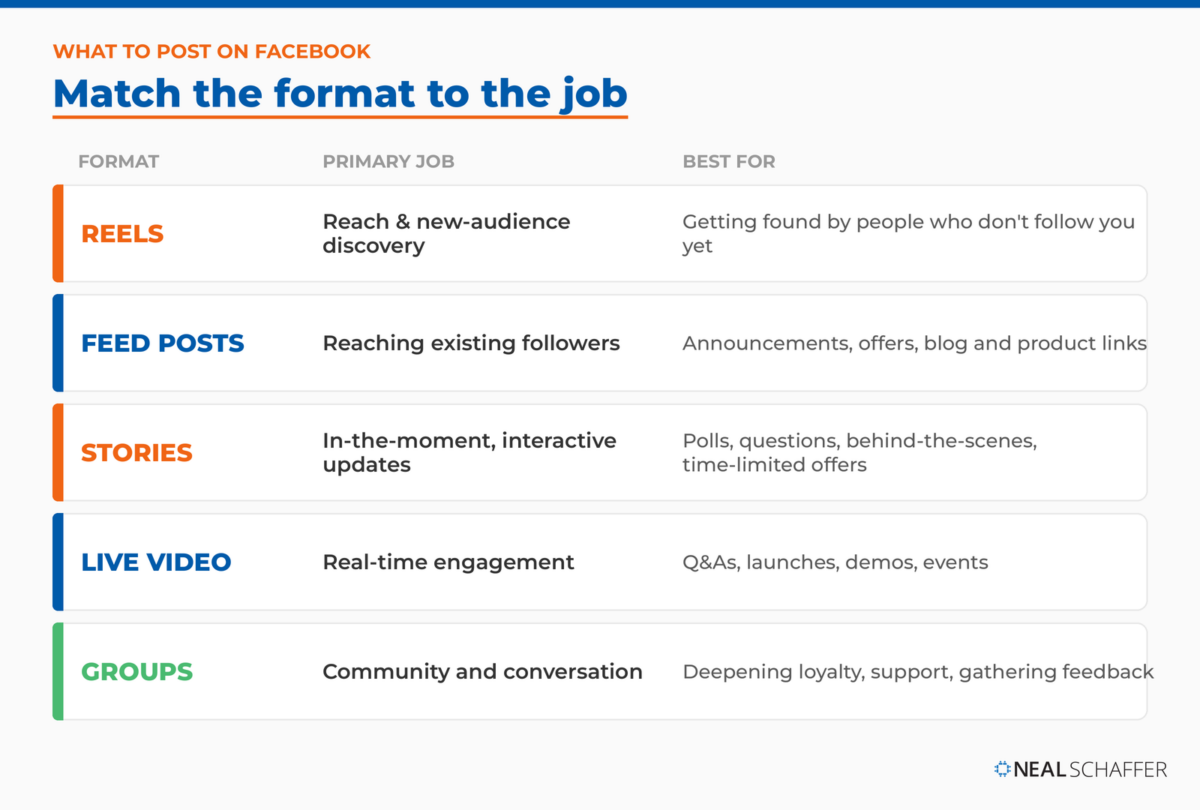 Each Facebook format does a different job. Reels pull in new audiences, feed posts reach existing followers, Stories drive in-the-moment interaction, live video creates real-time connection, and Groups build community. Weight the mix toward video.
If you’re staring at a blank scheduler, you don’t need a fancy strategy doc to start. You need ideas you can execute this week. Pulling from a set of Facebook post ideas is the fastest way to break the blank-page freeze, and content built specifically to spark comments and shares, like Facebook engagement posts, tends to outperform straight broadcasting. Video deserves special attention given where the algorithm is leaning, so it’s worth understanding how Facebook video ads and organic video both fit your plan.
Timing matters less than consistency, but it still matters. Rather than guess, post when your specific audience is online. The data on the best time to post on Facebook is a reasonable default, but your own Page insights always beat any general benchmark.
One practical note on creating the content itself. As an Adobe Express ambassador, I lean on Adobe Express to produce Page graphics, Reels, and quick video edits, and I find it more intuitive than Canva for a lot of small-business tasks. Either tool works. The point is to remove friction so you actually publish, because the businesses that win on Facebook are the ones that show up consistently, not the ones with the prettiest single post.
How does the Facebook algorithm decide who sees your content?
The Facebook algorithm ranks each piece of content for each user based on predicted engagement: how likely you are to comment, share, react, or watch. It weighs your past behavior, the content type, recency, and the signals a post is already collecting. Meaningful interactions, especially comments and shares, carry more weight than passive likes.
Two implications follow from that. First, content that genuinely prompts a response beats content that just looks nice. Ask questions, take positions, invite replies. Second, video gets a structural advantage right now because watch time is exactly the kind of engagement Meta wants to grow. None of this is a secret formula, and chasing hacks is a waste of energy. If you want the deeper mechanics, the Facebook algorithm is worth understanding on its own, but the short version is simple: make content people react to, in the formats the platform is pushing, and post consistently.
Is Your Digital Marketing All Over the Place?
My latest book helps small businesses, entrepreneurs, and marketers bring search, email, and social together into one digital marketing strategy that actually compounds.
Drawing on my work as a Fractional CMO, Digital Threads turns complicated tactics into a clear, practical plan you can follow, whatever your budget or team size.
Grab your copy on Amazon and start weaving your own digital threads. Click the cover or the button below to get started.
How does Facebook advertising work, and what does it cost?
Facebook advertising lets you place ads across Facebook, Instagram, Messenger, and WhatsApp, targeting people by demographics, interests, behaviors, and custom audiences built from your own data. You can run a simple boosted post in two minutes or build a structured campaign in Ads Manager. Costs are low relative to other channels, which is why even small budgets can compete.
How cheap? WordStream’s 2025 analysis of more than a thousand campaigns put the average cost per click on Facebook lead-generation campaigns at $1.92, versus $5.26 on Google Ads. That gap is the whole argument for Facebook ads: you can buy a lot of qualified attention before you’ve spent what a single Google click might cost. Actual numbers vary widely by industry and objective, so treat benchmarks as a starting reference, not a promise.
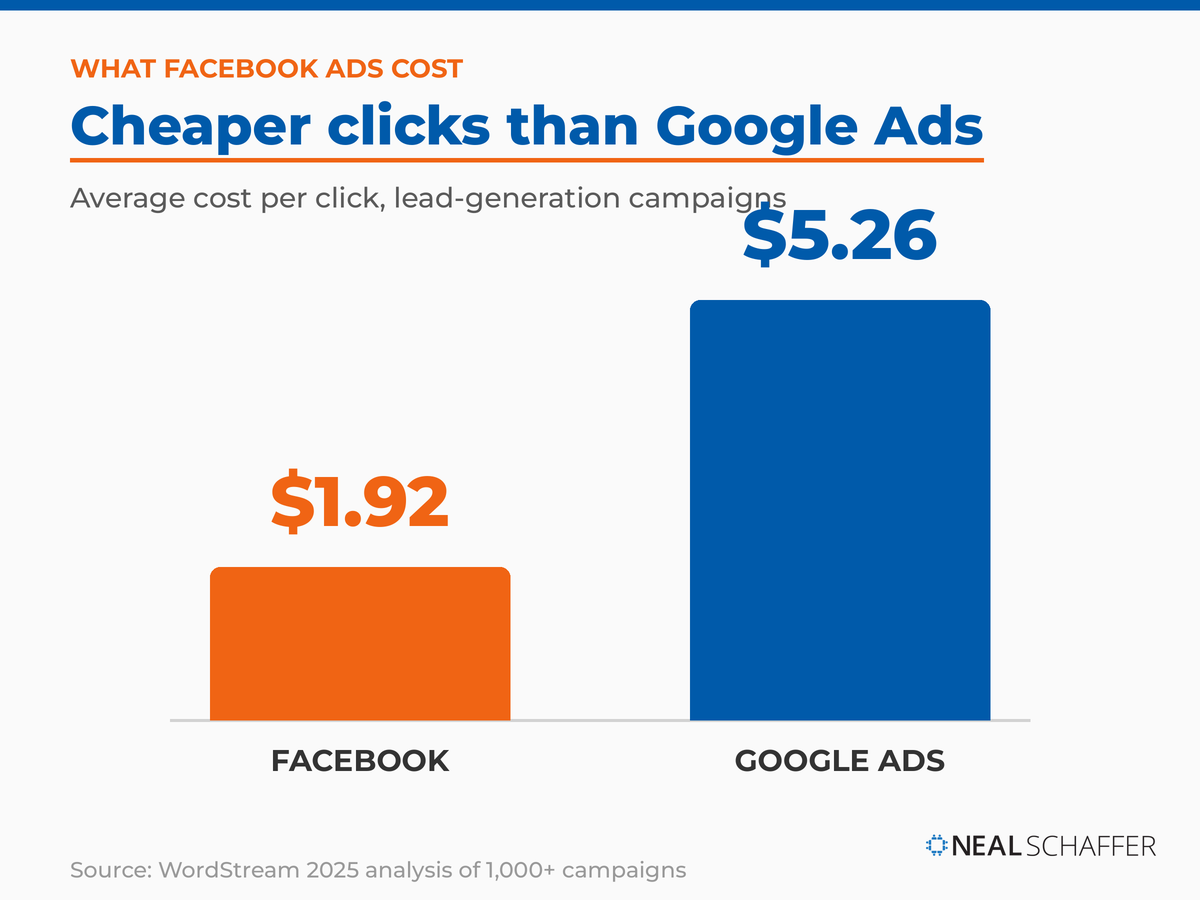 Facebook lead-generation clicks averaged $1.92 against $5.26 on Google Ads in WordStream’s 2025 analysis of more than a thousand campaigns. That gap is the core argument for putting a small budget into Facebook ads. Source
You have two real entry points, and choosing wrong wastes money.
| Approach | What it is | Best for |
|---|
| Boost Post | One-click promotion of an existing post | Beginners, simple reach goals, testing the water |
| Ads Manager | Full campaign builder with objectives and audiences | Lead gen, sales, retargeting, anything you want to scale |
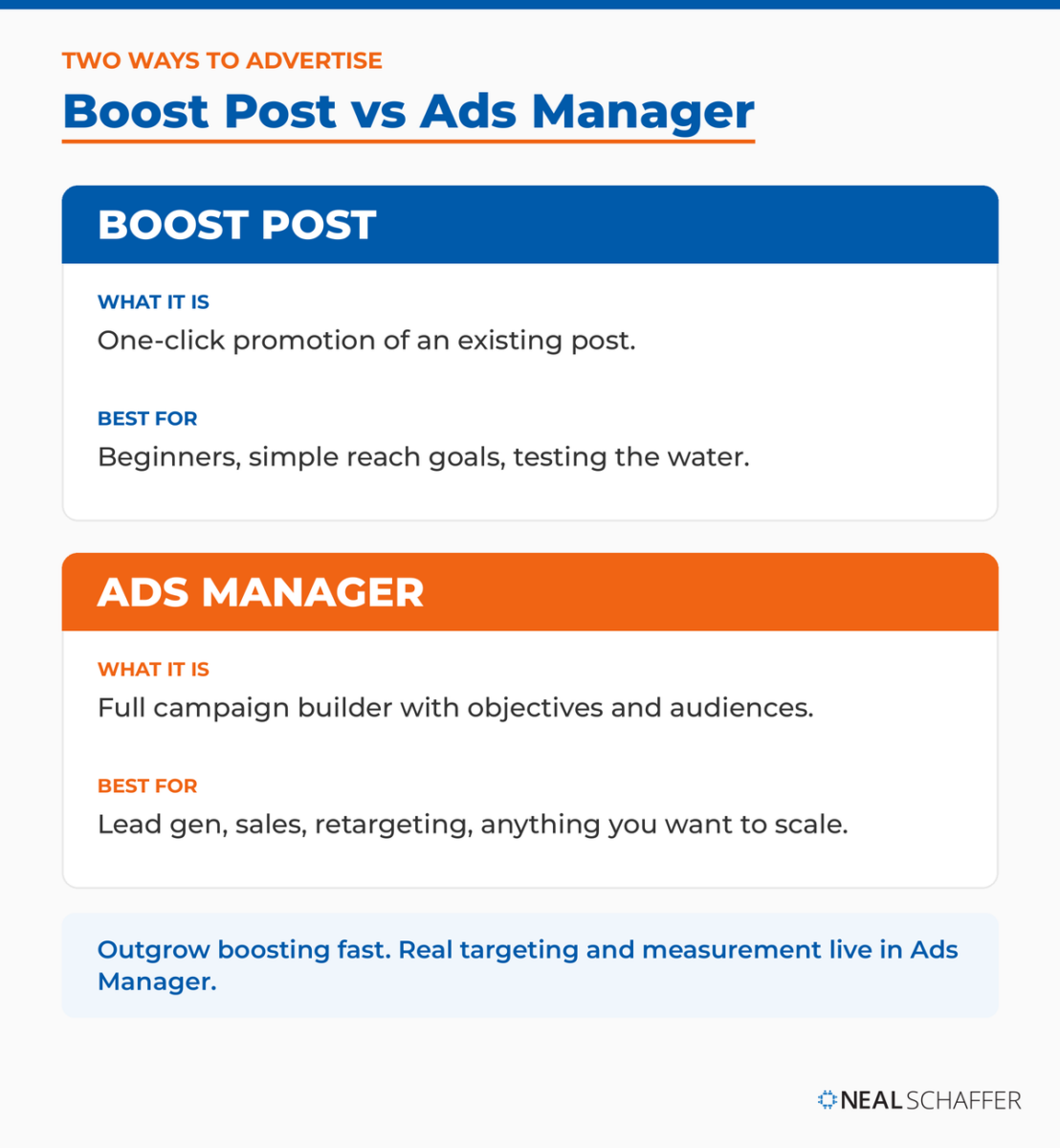 Boost Post is one-click promotion built for beginners and quick tests. Ads Manager is the full campaign builder for lead generation, sales, retargeting, and anything you want to scale. Most businesses outgrow boosting fast.
Boosting is fine for getting started or amplifying a post that’s already performing. But it’s a blunt instrument. If you’re serious about results, learn Ads Manager, because that’s where real targeting and measurement live. Start by understanding the different Facebook ad types so you match the format to the goal, then get specific about Facebook ads targeting, which is where Meta’s platform genuinely earns its reputation. Before you scale, set realistic expectations on how much Facebook advertising costs for your situation. And if you’re still deciding whether paid social is right for you at all, the question of whether Facebook advertising works is worth settling first.
One underused tactic: study what competitors are already running. The Facebook Ad Library shows you live ads across the platform, which is a free way to gather creative ideas and see what your market is paying to promote.
What’s the biggest mistake most Facebook marketing guides get wrong?
The biggest mistake is treating Facebook marketing as a self-contained project. Most guides hand you a checklist for the Page and stop there, as if Facebook lived in its own universe. It doesn’t. The businesses that get real return treat Facebook as one channel feeding a connected system, not a destination in itself.
I made this mistake early in my own marketing. I’d pour effort into a platform, build an audience there, and then have no plan for what happened next. The audience stayed stuck on the platform instead of moving toward something I owned, like my email list or my website. In my book Digital Threads, I lay out a framework built around search, email, and social working together, with each channel doing a specific job and handing the customer to the next. Facebook’s job in that system is usually discovery and relationship, not the final sale.
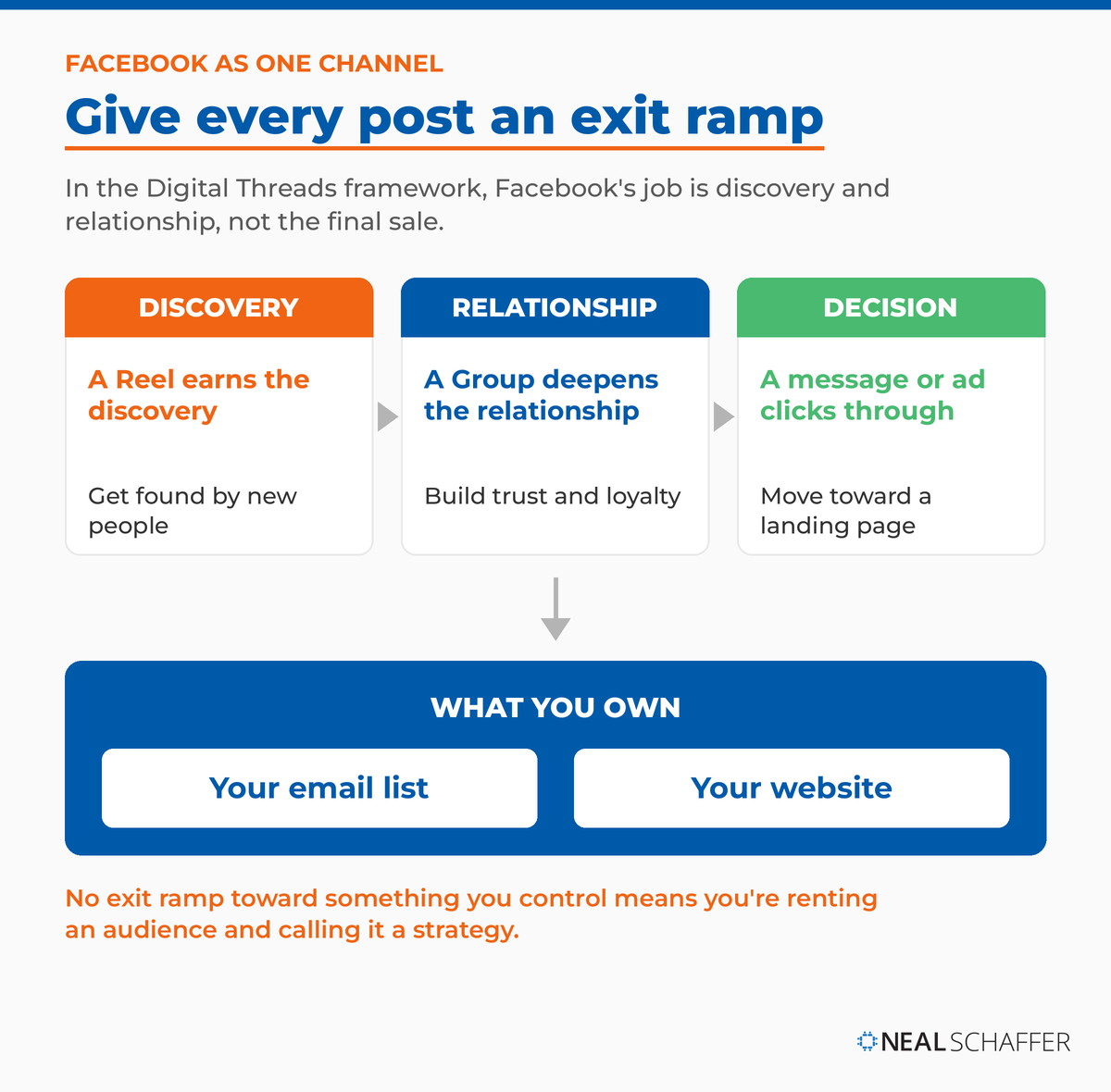 In the Digital Threads framework, Facebook handles discovery and relationship, then hands people to something you own. A Reel earns discovery, a Group deepens the relationship, and a message or ad moves toward a decision. No exit ramp means you are renting an audience.
So when you plan Facebook content, ask where each post sends people next. A Reel earns the discovery. A Group deepens the relationship. A messaging conversation or an ad that clicks to a landing page moves someone toward a decision. If your Facebook activity has no exit ramp toward something you control, you’re renting an audience and calling it a strategy. That single reframe changes how you measure success: not by likes, but by what those likes eventually turn into.
How do you build a Facebook marketing strategy?
A Facebook marketing strategy is a documented plan that connects specific business goals to your content, community, and ad activity on the platform, with a way to measure results. At minimum it answers four questions: who you’re reaching, what you’ll post and how often, how much you’ll spend on ads, and how Facebook feeds the rest of your marketing.
Build it in this order:
- Set a goal you can measure. “More awareness” is not a goal. “200 email signups a month from Facebook” is. Tie the goal to something downstream, not to vanity metrics.
- Define your audience. Get specific about who you serve, then mirror that in both your organic content and your ad targeting. Inviting “anyone and everyone” to like your Page actually hurts you, because it muddies the signals the algorithm uses.
- Plan your content mix. Decide your formats and cadence in advance, weighted toward video. Consistency beats intensity. Posting twice a week for a year outperforms posting daily for three weeks and then disappearing.
- Allocate a small ad budget. Even a modest spend, supported by good organic content and the right tools, lets you reach beyond your existing followers. A handful of solid Facebook tools can help you schedule, measure, and stay consistent without living inside the app.
- Connect it to everything else. Decide how Facebook feeds your email list, your site, and your other channels, and how you’ll track that flow.
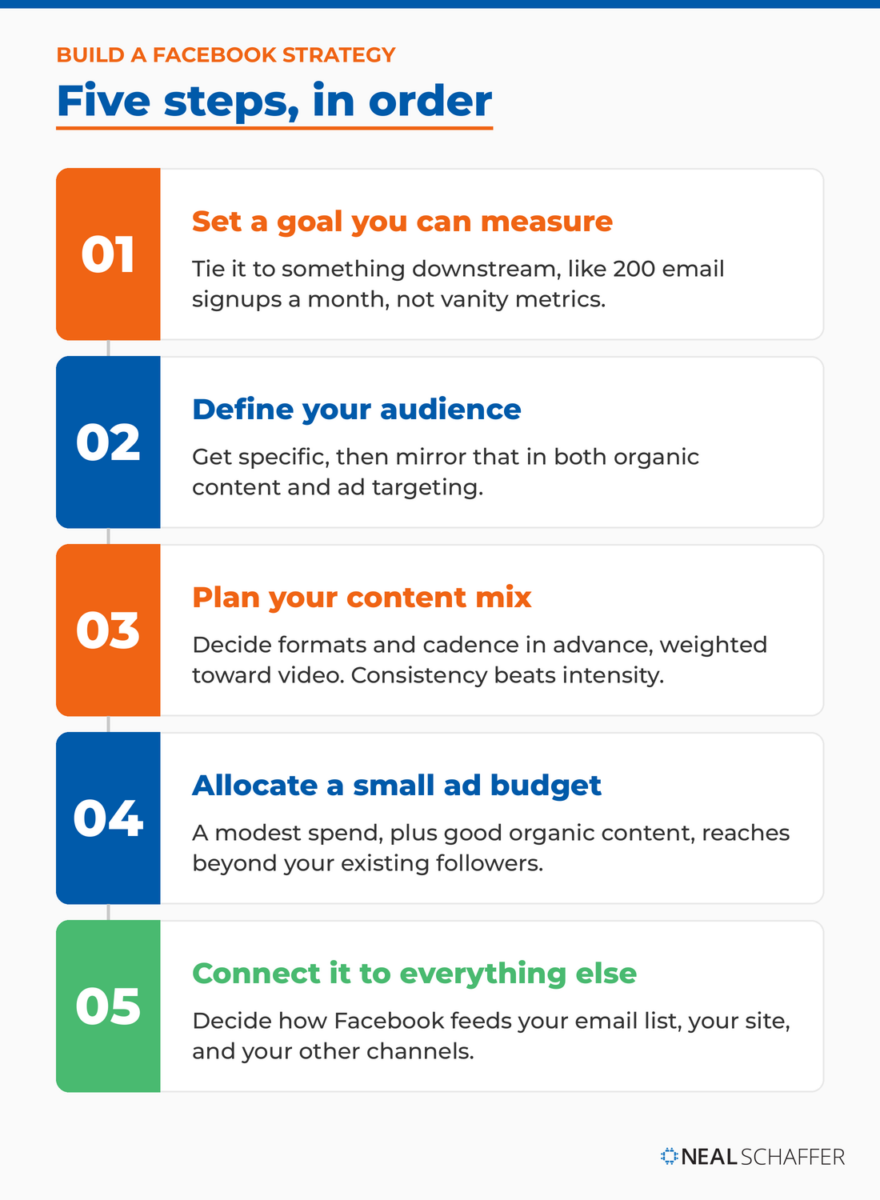 A workable Facebook strategy runs in order: set a goal you can measure, define your audience, plan a video-weighted content mix, allocate a small ad budget, then connect it all to your email list, site, and other channels.
For the data behind these decisions, the latest Facebook statistics are worth keeping bookmarked, since usage and ad behavior shift every year and a strategy built on stale numbers ages fast. Revisit them each time you plan, because Facebook’s role in your mix should be set by current data, not last year’s assumptions.
Frequently Asked Questions
Is Facebook marketing free? Facebook marketing can be free if you stick to organic tactics like posting, Groups, and replying to comments. But organic reach is limited in 2026, so most businesses see meaningfully better results by adding a modest ad budget. The smart approach is free content supported by targeted paid promotion, not one or the other.
Is Facebook still relevant for marketing in 2026? Yes. Facebook remains the widest-reach platform most businesses can use, with billions of active users and roughly 71% of U.S. adults on it. What’s changed is the content that gets distribution. Video and Reels are favored, and static-only Page posting underperforms. Adjust your content and Facebook is very much still relevant.
How much does Facebook advertising cost? It varies by industry, objective, and audience, but Facebook ads are among the cheapest in digital marketing. WordStream’s 2025 data showed lead-gen costs well below comparable Google Ads. You can start meaningful testing on a small daily budget, then scale what works. Treat published benchmarks as a reference, not a guarantee.
Should I use Boost Post or Ads Manager? Boost Post is fine for beginners or for amplifying a post that’s already doing well. For anything serious, lead generation, sales, or retargeting, use Ads Manager, where you get real targeting, multiple objectives, and proper measurement. Most businesses outgrow boosting quickly.
What’s the difference between Facebook marketing and a Facebook marketing strategy? Facebook marketing is the activity: posting, engaging, advertising. A Facebook marketing strategy is the plan that gives those activities direction, connecting them to measurable goals and to the rest of your marketing. Doing the activity without the strategy is how businesses stay busy on Facebook while getting little back.
Start Marketing on Facebook With a Real Plan
Facebook still has the audience. The businesses that win on it in 2026 are the ones that match modern content, mostly video, to a clear plan, support it with a small ad budget, and connect the whole thing to their broader marketing. Pick one goal, define who you’re reaching, commit to a consistent content mix, and decide where every post sends people next.
If you want to keep your decisions grounded in current data, bookmark the latest social media marketing statistics and revisit them each quarter. And if you’d like a hand building a coordinated plan that puts Facebook in its proper place alongside your other channels, that’s exactly the kind of work I do as a Fractional CMO, or you can join other owners and marketers working through this in my Digital First Mastermind community.
Actionable advice for your digital / content / influencer / social media marketing.
Join 13,000+ smart professionals who subscribe to my regular updates.