SEO. Content. Blogging. TikTok. LinkedIn. Email. Paid ads. Influencers. Podcasting. YouTube. AI. Every week someone tells you about one more thing you absolutely have to be doing, and the list never gets shorter. That is the real reason most digital marketing strategies stall. Not a lack of effort. There’s simply too many options and no way to decide between them.
I have spent more than fifteen years on the other side of that problem. I work with companies as a Fractional CMO, I teach digital marketing to executives at Rutgers Business School and UCLA Extension, and I host the Your Digital Marketing Coach podcast. When I sat down to write Digital Threads, my playbook for digital-first marketing, I had one goal: take the chaos above and turn it into something a business owner or entrepreneur can actually hold in their head.
What came out of that was a framework I call SES, which stands for Search, Email, Social. Three workhorses instead of a dozen disconnected tactics. This post walks through how to use it to build a digital marketing strategy that fits your business, whether you are a solo founder or running marketing for a larger team. I’m Neal Schaffer, and this is the same framework I use with my own clients.
Key Takeaways
? A strategy is a set of decisions, not a list of channels. Before you touch a single platform, you decide who you are trying to reach and which channels move them through your funnel. The channels come second.
? The SES framework keeps it simple: Search, Email, Social. These three cover how people find you, how you stay in touch, and how relationships turn into advocacy. Almost everything else fits inside them.
? Email is the only channel you truly own. Search visibility can change with an algorithm update and social reach is rented from the platform. Your email list is yours. Email returns roughly $36 for every $1 spent, higher than any other channel according to Litmus.
? Search is shifting under your feet, so don’t depend on it alone. When an AI summary appears in Google results, users click a traditional link only 8% of the time versus 15% without one, per Pew Research Center. That is the whole argument for building owned channels.
? Start with one strong action per pillar, then add. A small business does not need to be everywhere. It needs one search play, one email play, and one social play, executed consistently.
What is a digital marketing strategy?
A digital marketing strategy is a set of decisions about which online channels you will use, who you are trying to reach, and how those channels will move a stranger toward becoming a customer and then an advocate. It is the plan that comes before the posting, the ads, and the email sends. Tactics are the things you do. Strategy is why you do them.
That distinction matters more than it sounds. Most of what gets called a “strategy” online is really just a channel checklist: be on Instagram, start a newsletter, run some Google ads. A real strategy answers the harder questions first. Who is the customer? Where do they actually spend their attention? What do you want them to do next? Only then do you pick the tools. Get this order wrong and you end up busy without being effective, which describes a lot of marketing.
Why most digital marketing strategies fail
Most digital marketing strategies fail because the business tries to do everything at once. New platforms keep appearing, every one promises growth, and without a way to filter them, you spread thin across ten channels and do none of them well. The failure is rarely the channel. It is the absence of a decision about which channels matter for this business.
Maybe you’ve heard the advice from someone that you need to be on Discord and Telegram. Maybe you do. But those more niche channels only make more sense after you first nail the basics, the search presence, the email list, the social foundation. When everything feels equally urgent, nothing gets the attention it needs. My rule is blunt: if you can’t explain specifically how a channel drives your business forward, don’t worry about it yet. On an episode of my podcast Your Digital Marketing Coach about this exact problem, I put it this way:
“It’s not about Telegram or Discord. It’s about search, email, social.”
There’s a second failure mode, and it’s quieter. Businesses build their entire strategy on channels they don’t control. They rank well, then a Google update wipes out half their traffic (yes, it happened to a lot of us post-HCU and post-AI). They grow a following, then the platform throttles organic reach and asks them to pay to reach the audience they already built. A durable strategy assumes the rented channels will shift and puts real weight on the one channel you own.
The SES framework: a simpler way to build your strategy
The SES framework simplifies digital marketing into three channels that do the heaviest lifting: Search, Email, and Social. I introduced it in Digital Threads as the spine of a digital-first strategy because almost every tactic you can name (SEO, blogging, ads, newsletters, LinkedIn, influencer marketing) lives inside one of these three. Three workhorses are far easier to plan around than a dozen scattered tactics.
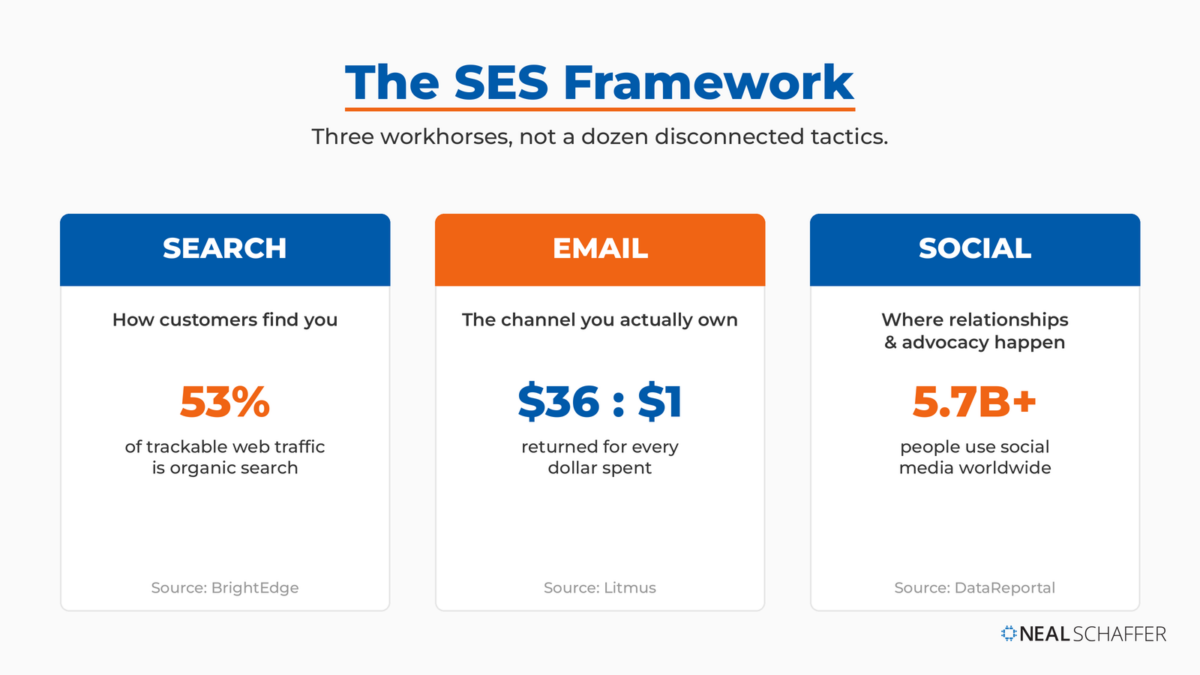 The SES framework replaces a dozen scattered tactics with three workhorses, Search, Email, and Social. Almost every digital marketing activity you can name lives inside one of them.
Here is the logic behind the order. People who don’t know you yet find you through search or social. Once they know you, you keep the relationship alive through email, the channel you own. And when customers turn into advocates, that mostly happens back in social, where word of mouth lives. I think of this as a funnel of digital relationships, and each stage has a channel that does the most work.
| Funnel stage | Who they are | Primary SES channel | Your goal |
|---|
| Discovery | The public, who don’t know you yet | Search and Social | Get found and build awareness |
| Consideration | People who now know you | Email and Social | Earn the opt-in, nurture the relationship |
| Conversion | Prospects becoming customers | Email and paid Social | Turn interest into a sale |
| Advocacy | Customers becoming advocates | Social | Turn happy customers into word of mouth |
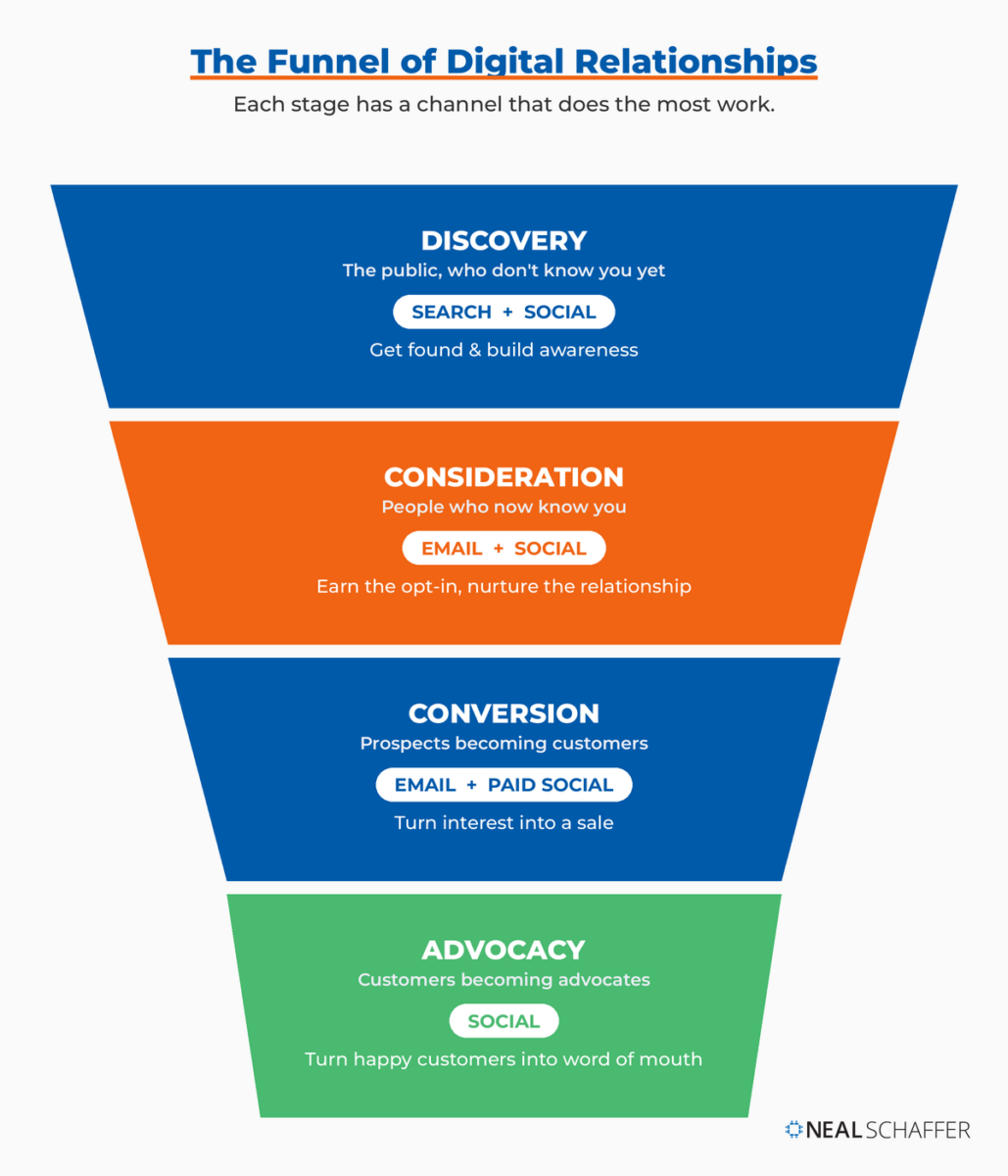 Each funnel stage has one channel doing the heaviest lifting: search and social drive discovery, email nurtures and converts, and social turns happy customers into word of mouth.
The point of the framework is not that other tactics don’t matter. Content marketing, for instance, fuels all three: a blog post helps your search ranking, gives you something to send in an email, and becomes social content. The point is that Search, Email, and Social give you three clear buckets to organize everything else around, so you can see at a glance where your strategy is strong and where it has a hole.
Search: how customers find you
Search is the discovery engine of your strategy, the way people who have a need but don’t know your name end up on your website. It covers SEO, the content you publish, and increasingly your visibility inside AI answers. Search still drives the majority of trackable web traffic, which is why it usually belongs at the front of any digital marketing strategy.
The numbers back this up. BrightEdge research found organic search drives 53% of all trackable website traffic, more than any other single channel. That is why a sound SEO strategy and a real commitment to SEO as a marketing discipline sit near the foundation of most plans. If you run a local business, the case is even stronger. Think with Google reports that “near me” mobile searches that include a variant of “can I buy” or “to buy” have grown more than 500% over two years, so local SEO can put you in front of someone who is ready to act today.
But search is shifting, and your strategy has to account for it. AI Overviews now sit at the top of many Google results and answer the question before the reader ever clicks. In one Pew Research Center analysis, about 18% of Google searches produced an AI summary, and when a summary appeared, clicks to a traditional result fell to 8% from 15%, close to half. The takeaway is not that search is dead. It’s that you cannot build your whole business on a channel that can change the rules overnight. Win at search, and treat every visitor it sends as someone to capture, not just count. Which brings us to the channel you own.
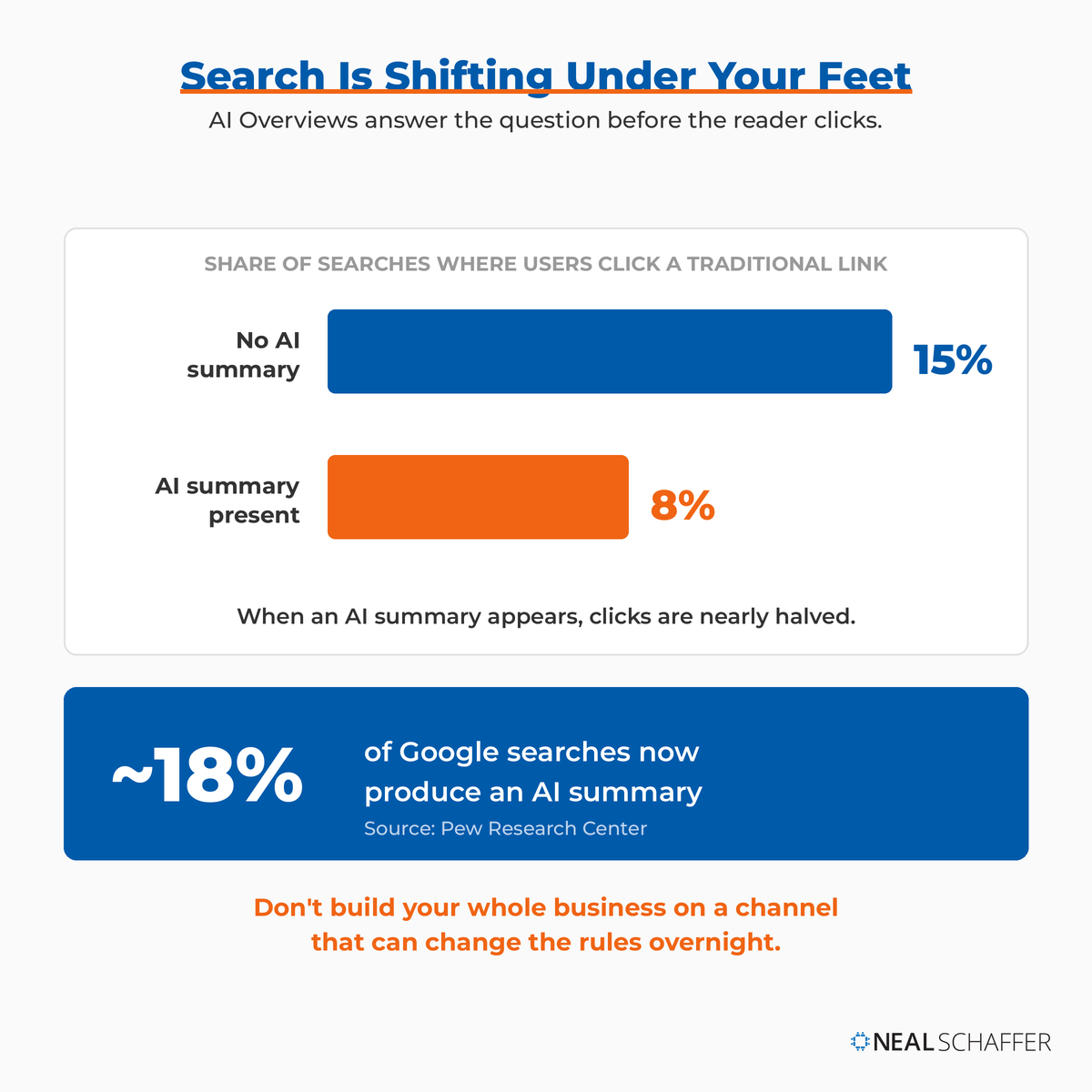 When Google shows an AI summary, clicks to a traditional result fall from 15% to 8%, nearly half, and about 18% of searches now trigger one. [Source]
Email: the channel you actually own
Email is the only channel in your digital marketing strategy that you genuinely own. Search rankings belong to Google’s algorithm and your social following belongs to the platform, but your email list is an asset no one can throttle or take away. That ownership is exactly why email keeps outperforming flashier channels on return, decade after decade.
The economics are hard to argue with. Email returns about $36 for every $1 spent, higher than any other channel, a return Litmus has tracked consistently for years. And the reach is direct in a way the other channels aren’t: when someone opts into your list, you can reach them on your schedule, without an algorithm deciding who sees you and without paying a gatekeeper for access to an audience you already built.
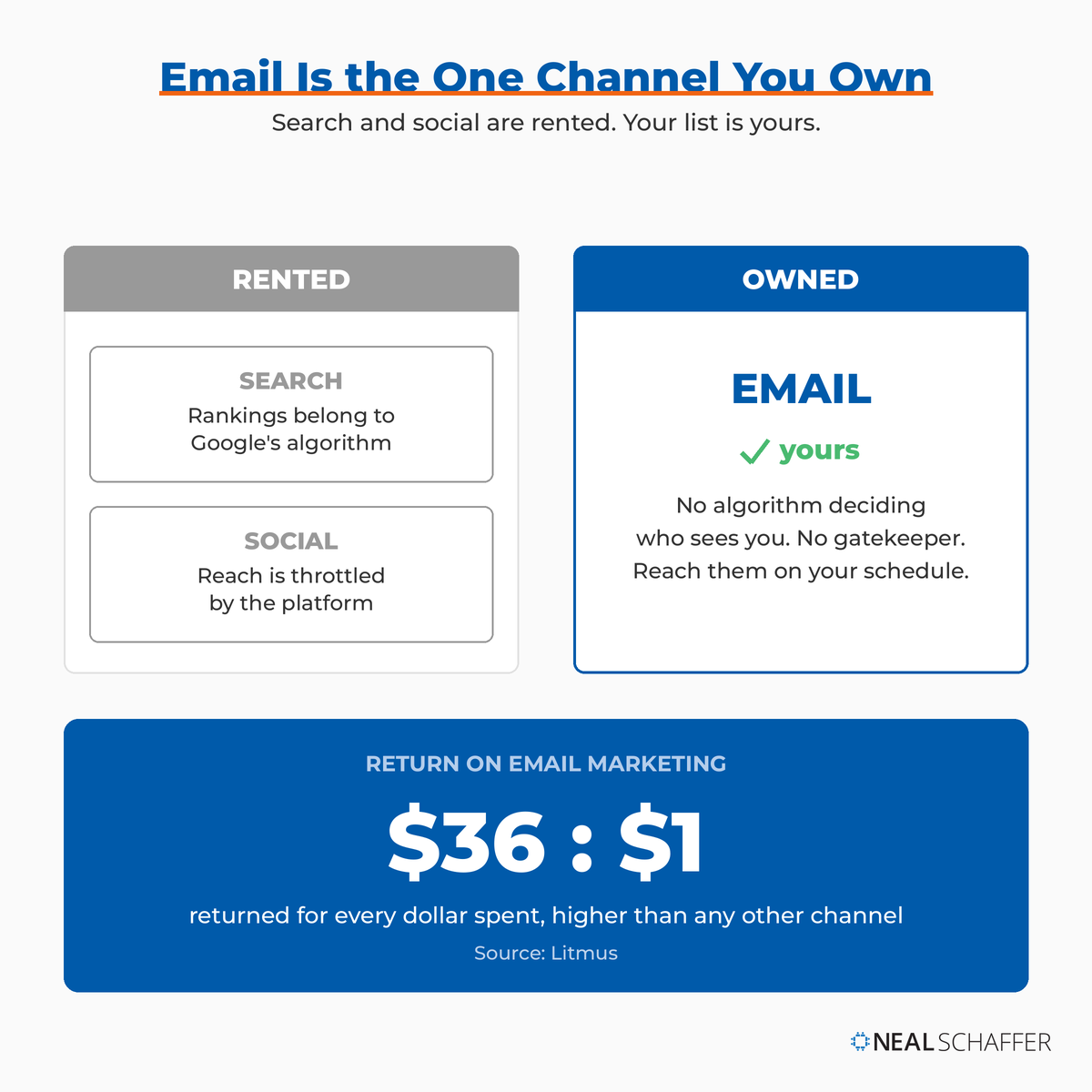 Search rankings and social reach are rented and can change overnight, but your email list is an asset no algorithm can throttle, returning about $36 for every $1 spent. [Source]
This is why list building deserves a place in every strategy, not as an afterthought but as a core goal of your search and social work. Every visitor and every follower is a candidate for your list. From there, a clear email marketing strategy does the patient work of turning a casual subscriber into a customer. The mechanics matter too: learning how to build an email list the right way and writing email subject lines that actually get opened are the difference between a list that converts and one that quietly ignores you. Treat email as the place where the relationship deepens, and the other two channels suddenly have a clear job: feed it.
Social: where relationships and advocacy happen
Social media is the relationship and advocacy engine of your strategy. It helps strangers discover you at the top of the funnel, and it’s where happy customers turn into the word of mouth that grows a business at the bottom. Unlike search and email, social touches every stage of the funnel, because at its core it is a relationship-building platform.
The audience is undeniable. More than 5.7 billion people use social media worldwide, according to DataReportal, close to seven in ten people on Earth. And they don’t just scroll there. They discover brands, vet them, and increasingly buy there too, which makes social both a discovery channel at the top of the funnel and a place where trust gets built or lost.
The mistake I see most often is treating social as a content treadmill, pumping out posts to feed the algorithm. A better lens is relationships. A clear social media strategy focuses less on volume and more on the connections that turn into customers and advocates. This is also where user-generated content and influencer partnerships earn their keep, because a recommendation from someone your audience already trusts moves people in a way your own posts can’t. If you’re a smaller operation, you don’t need to be on every platform. Focused social media marketing for a small business on the one or two networks where your customers actually are beats a thin presence spread across six. For a current read on where attention and engagement are heading, the latest social media marketing statistics are worth keeping bookmarked.
Make Your Marketing Finally Work Together
My latest book helps small businesses, entrepreneurs, and marketers bring search, email, and social together into one digital marketing strategy that actually compounds.
Drawing on my work as a Fractional CMO, Digital Threads turns complicated tactics into a clear, practical plan you can follow, whatever your budget or team size.
Grab your copy on Amazon and start weaving your own digital threads. Click the cover or the button below to get started.
How to build your digital marketing strategy step by step
Building a digital marketing strategy with SES means making a clear decision in each of the three buckets before you execute anything. You are not trying to win every channel. You are choosing one strong play per pillar that fits your audience and your capacity, then layering in more once those are running well.
Here is the sequence I walk clients through:
- Define your customer and your one goal. Who are you trying to reach, and what is the single most important action you want them to take? Everything downstream depends on this answer.
- Pick your Search play. Decide how people will find you. For most businesses that is SEO and content built around the questions your customers actually ask. For local businesses, it is your Google Business Profile and local search. There is always an organic way and a paid way; choose based on your timeline and budget.
- Pick your Email play. Choose one lead magnet or reason for someone to join your list, and one ongoing email (a newsletter, a welcome sequence) that keeps the relationship warm. This is the channel you own, so protect it.
- Pick your Social play. Choose the one or two platforms where your audience actually spends time, and commit to relationships over volume. Plan to repurpose, not to create from scratch on every channel.
- Connect the pieces. Make sure each channel feeds the next. Search and social send people to your site, your site captures them into email, email and social convert and then turn customers into advocates. A strategy with gaps between the stages leaks customers.
- Review and adjust. Set a cadence (quarterly works for most) to look at what’s driving results and what isn’t, and shift effort accordingly.
A useful way to pressure-test your plan is to fill in a simple table. If any cell is empty, that’s a hole in your strategy.
| Pillar | Your one starting play | The tool or asset it needs |
|---|
| Search | SEO content around customer questions, or local search | Website or blog, Google Business Profile |
| Email | A lead magnet plus a regular newsletter | Email platform and an opt-in form |
| Social | One or two platforms, relationship-focused | A content repurposing routine |
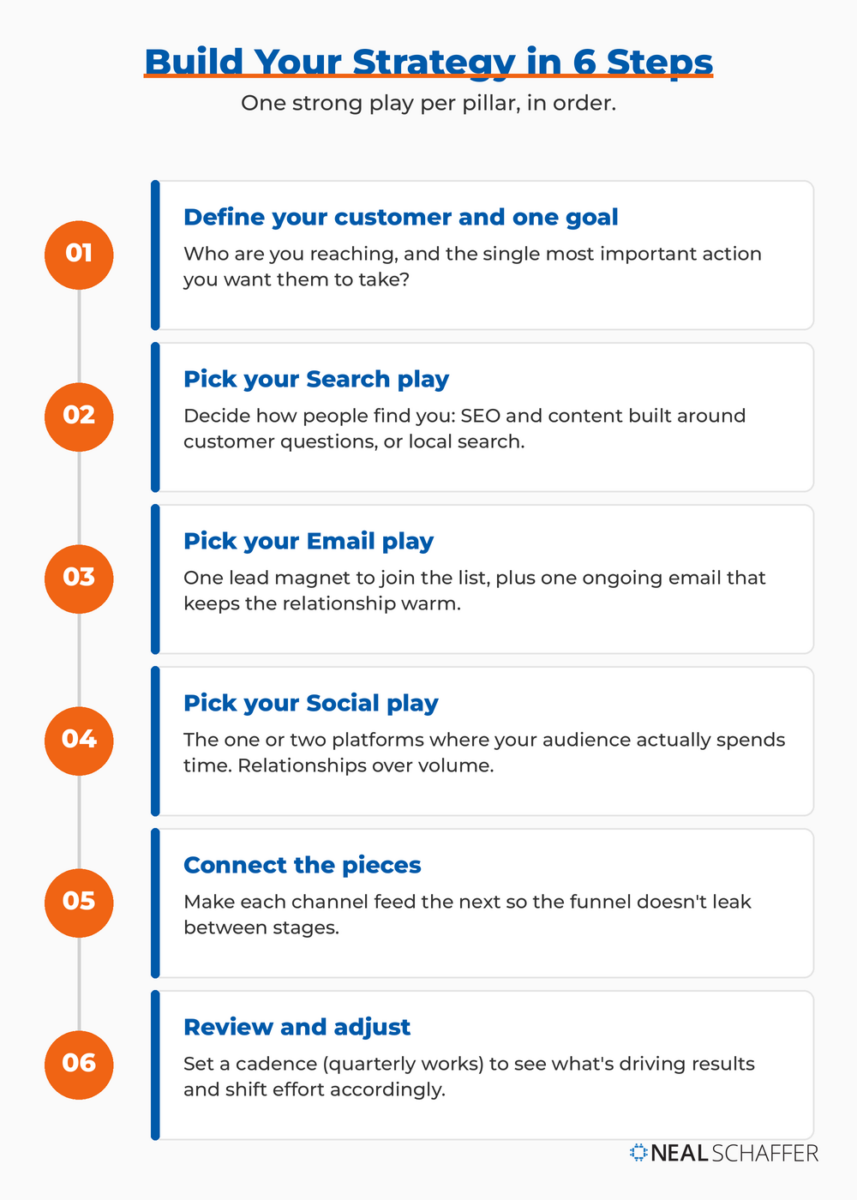 Build your strategy in order: define the customer, pick one play each for search, email, and social, then connect the pieces and review quarterly. One strong play per pillar beats ten half-efforts.
Two more decisions round out a modern strategy. First, AI in digital marketing now touches every pillar, from drafting content to analyzing performance, and ignoring it leaves efficiency on the table. Second, your digital marketing tools should follow your strategy, not lead it. Pick the framework first, then choose the tools that serve it.
Digital marketing strategy for a small business
For a small business, the right digital marketing strategy is a focused one. You don’t have the budget or the hours to be everywhere, and trying to be is the fastest way to burn out without results. SES works especially well here because it gives you permission to do three things well instead of ten things poorly.
In practice that usually means one search play (a Google Business Profile and a handful of pages targeting what your customers search for), one email play (a simple list and a regular note that keeps you top of mind), and one social play (the single platform where your specific audience hangs out). That’s it. As those three start working, you expand. The businesses that win at this scale are not the ones doing the most. They are the ones who picked the right three and stayed consistent. If you want to go deeper on how the channels relate, the difference between digital marketing and social media marketing clears up a confusion that trips up a lot of small business owners.
Frequently asked questions
What are the main components of a digital marketing strategy? The core components are your audience definition, your goals, your channels, and your plan for moving people through the funnel. Using the SES framework, the channel components simplify to three: search (how people find you), email (how you stay in touch), and social (how relationships and advocacy grow). Supporting elements like content and analytics run across all three.
What is the SES framework? SES stands for Search, Email, and Social, the three channels that do the most work in a digital-first strategy. I introduced it in Digital Threads as a way to simplify the overwhelming list of digital marketing tactics into three buckets that map to how a stranger becomes a customer and then an advocate.
How is a digital marketing strategy different from a marketing plan? A strategy is the set of decisions about who you target and which channels you’ll prioritize and why. A plan is the detailed schedule of what you’ll do and when. Strategy comes first and answers “why this approach.” The plan executes it. You need both, but a plan without a strategy is just busywork.
What’s the best digital marketing strategy for a small business? A focused one. Pick a single strong play in each SES pillar, search, email, and social, and execute those consistently before adding anything else. Trying to be on every platform is the most common small business mistake. Three channels done well beat ten done poorly.
How often should I review my digital marketing strategy? A quarterly review works for most businesses. Look at which channels are driving results, which aren’t, and where your funnel is leaking, then shift effort accordingly. The channels themselves change fast, especially search, so an annual-only review leaves you reacting too slowly.
Start Simple: Search, Email, Social
If your digital marketing feels scattered, adding more channels rarely fixes it. What fixes it is a decision. Choose your one search play, your one email play, and your one social play, connect them so each feeds the next, and commit to running them consistently. That is a real digital marketing strategy, and it will outperform a frantic presence on ten platforms every time.
If you want the full version of this approach, with the funnel of digital relationships and the systems behind each pillar, you can download a free preview of Digital Threads. And if you’d rather have help building and running the strategy for your business, that’s exactly what I do as a Fractional CMO, or you can join the entrepreneurs and small business owners in my Digital First group coaching community. Wherever you start, start with three. To see how the individual channels fit together before you build, the types of digital marketing make a useful next read.
Actionable advice for your digital / content / influencer / social media marketing.
Join 13,000+ smart professionals who subscribe to my regular updates.