You already use AI every day. The real question in 2026 is which one deserves to become the place where your actual work happens, because that decision compounds over time. For me, that meant moving from ChatGPT to Claude, and I have not looked back.
My own path did not start there. Like a lot of people, my AI journey began when ChatGPT launched in November 2022. I dabbled in 2023, used it more seriously in 2024, and it was my daily driver for content, research, and strategy. Then something shifted for me in late 2025, and by early 2026 I had moved most of my work over to Claude.
I am not coming at this as a tech reviewer. I approach it as a Fractional CMO and digital marketing consultant who works with real businesses, the author of six digital marketing books including Digital Threads, and the host of the Your Digital Marketing Coach podcast. I have taught social media at Rutgers Business School, and I run AI content workshops where marketers ask me this exact question constantly. So this is a working professional’s take, not a benchmark chart.
And it matters because AI is no longer optional in marketing. 91% of marketers now report actively using AI in their work, up from 63% the year before, according to Jasper’s State of AI in Marketing 2026 report. It is a shift I keep an eye on alongside the wider social media marketing statistics that shape where our work is heading. Nearly everyone is using something. Far fewer have picked the right something and gone deep. Let me walk you through how Claude and ChatGPT actually compare so you can make that call for yourself.
Key Takeaways
? ChatGPT (OpenAI) and Claude (Anthropic) are the two leading AI assistants for marketers, and they now match each other on price at the entry tier: both charge $20 a month for their main paid plan.
? Claude tends to produce more natural, less “AI-sounding” writing, which is why I shifted my content work over to it. ChatGPT is the broader all-rounder with more built-in tools.
? ChatGPT has native image generation, voice, and video (Sora). Claude does not generate photos natively, though its Claude Design product covers a lot of visual work.
? Both offer Projects for organizing ongoing work. Claude’s Projects, Skills, and Cowork became the backbone of my daily workflow after I switched.
? There is no universal winner. The right pick depends on your work. Test both on your own tasks for a week or two, then commit to one and go deep.
What Is the Difference Between Claude and ChatGPT?
Claude is an AI assistant built by Anthropic, and ChatGPT is an AI assistant built by OpenAI. Both let you chat, write, analyze files, and connect to your other tools. The practical difference is positioning: ChatGPT is the broad, feature-packed all-rounder with image, voice, and video built in, while Claude leans toward writing quality, long documents, and careful reasoning.
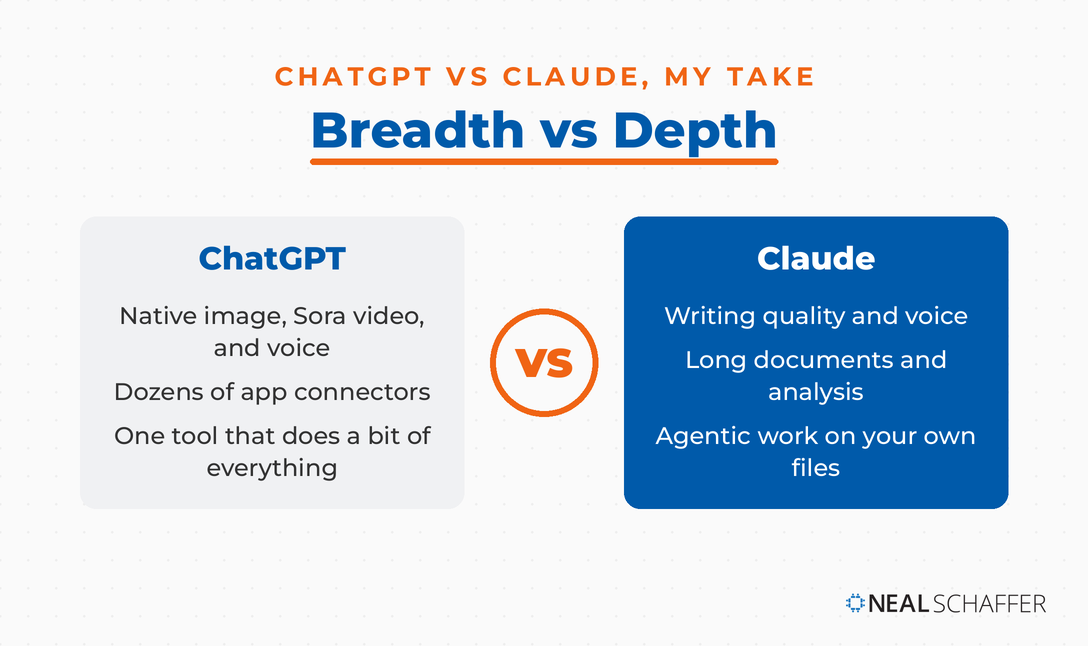 How I see the tradeoff: ChatGPT goes wide, Claude goes deep. That framing is what pushed me toward Claude for the writing and file work I do every day.
That framing shows up the moment you use them side by side. ChatGPT wants to be everything: a chatbot, an image studio, a voice assistant, a video generator with Sora, a coding agent, and a hub with dozens of app connectors. Claude is narrower on purpose. Anthropic has focused on writing, analysis, long-context work, and agentic tasks on your own files, and it deliberately does not do native image, audio, or video generation.
Neither company sits still. Claude runs on Anthropic’s Opus 4.8 as its most capable model, with a faster Sonnet model for everyday work. ChatGPT runs on GPT-5.5, its most advanced model, for paid users, with a lighter model on the free tier. Paid access on ChatGPT Plus also brings priority access and faster responses. Both are excellent. For most marketing tasks, you will not lose sleep over the raw model. You will feel the difference in the writing, the workflow, and the extras.
How Do Claude and ChatGPT Pricing Plans Compare?
Claude and ChatGPT cost the same at the entry point: both charge $20 a month for their main individual plan (Claude Pro and ChatGPT Plus). Both have a free tier and higher-priced power plans. ChatGPT adds an $8 Go tier and shows ads on its free and Go plans in the US, which Claude does not do.
Here is how the individual plans line up in 2026.
| Plan level | Claude (Anthropic) | ChatGPT (OpenAI) |
|---|
| Free | $0, Claude Free with usage limits, no ads | $0, ChatGPT Free with tight limits, shows ads in the US |
| Budget | Not offered | Go, $8/month (also shows ads) |
| Main paid | Pro, $20/month | Plus, $20/month |
| Power tier | Max 5x, $100/month | Pro, $100/month |
| Heaviest tier | Max 20x, $200/month | Pro, $200/month |
A few things worth knowing. Claude’s higher plans (Max) buy you more usage headroom, not different features. The $100 Max 5x plan gives roughly five times the usage of Pro, which is the one I pay for. ChatGPT’s tiers layer in more capability as you climb, and its two “Pro” plans confusingly share the same name at $100 and $200, so check the exact label before you buy.
Most marketers and small business owners should start with the $20 plan on either side. You only need the $100-plus tiers if you are living inside these tools for hours a day, which, full disclosure, I now am.
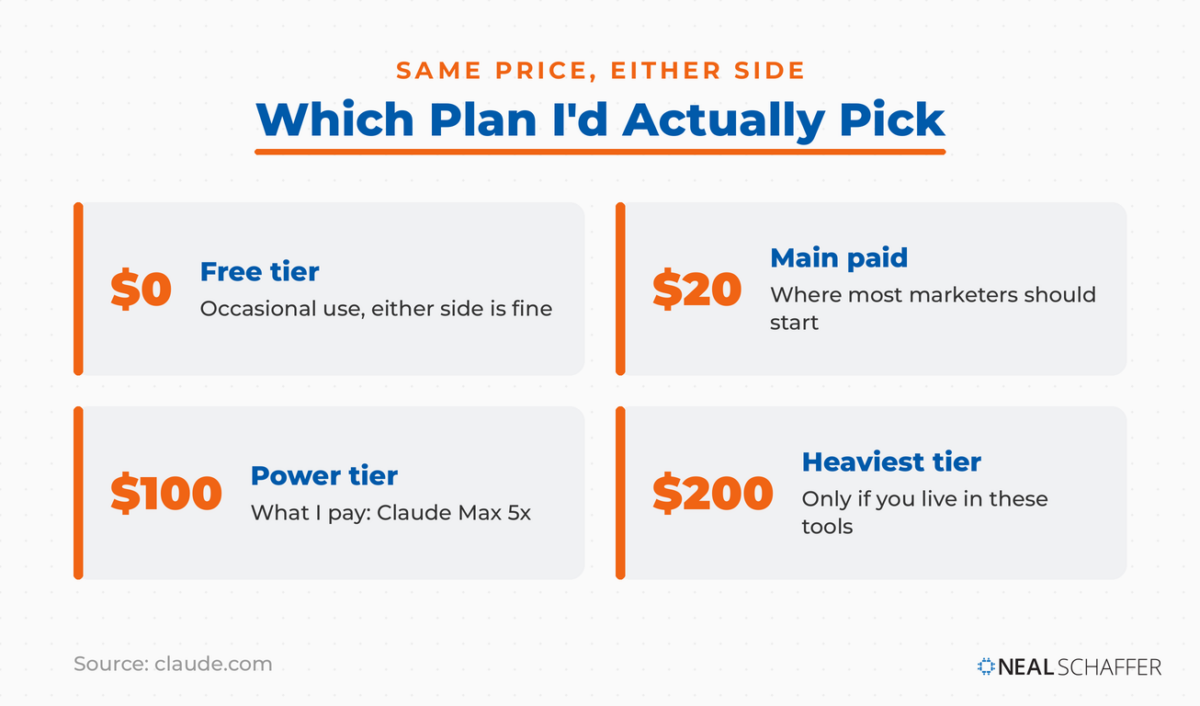 Both tools match on price, so the real question is which tier. Most people should start at $20. I run enough volume that I pay for the $100 Claude Max 5x plan. (Source)
Which Is Better for Writing and Content?
For writing and content, I give the edge to Claude. In my experience its output reads more like a human wrote it, with better rhythm and fewer of the tells that scream “a machine made this.” ChatGPT is perfectly capable, but its default voice often lands in a flat, generic register that needs heavy editing before I would publish it.
I will be blunt about why I switched. ChatGPT’s language, to my ear, reads very “tech bro.” It leans on the same puffed-up phrasing over and over, and it represents a lot of what most of us now recognize as AI-generated content. When I moved my content work to Claude in early 2026, the drafts came back closer to how I actually talk and write. That gap is the single biggest reason I made the switch.
This is not just a hunch. I put the same prompt through Claude, ChatGPT, Gemini, and Perplexity side by side and compared their answers head to head. Doing that repeatedly is how I saw each model’s real strengths. Some are stronger at data analysis. Some follow nuanced instructions better. For content creation, strategic thinking, and holding my voice across a long project, Claude was consistently the one producing the results I wanted to keep.
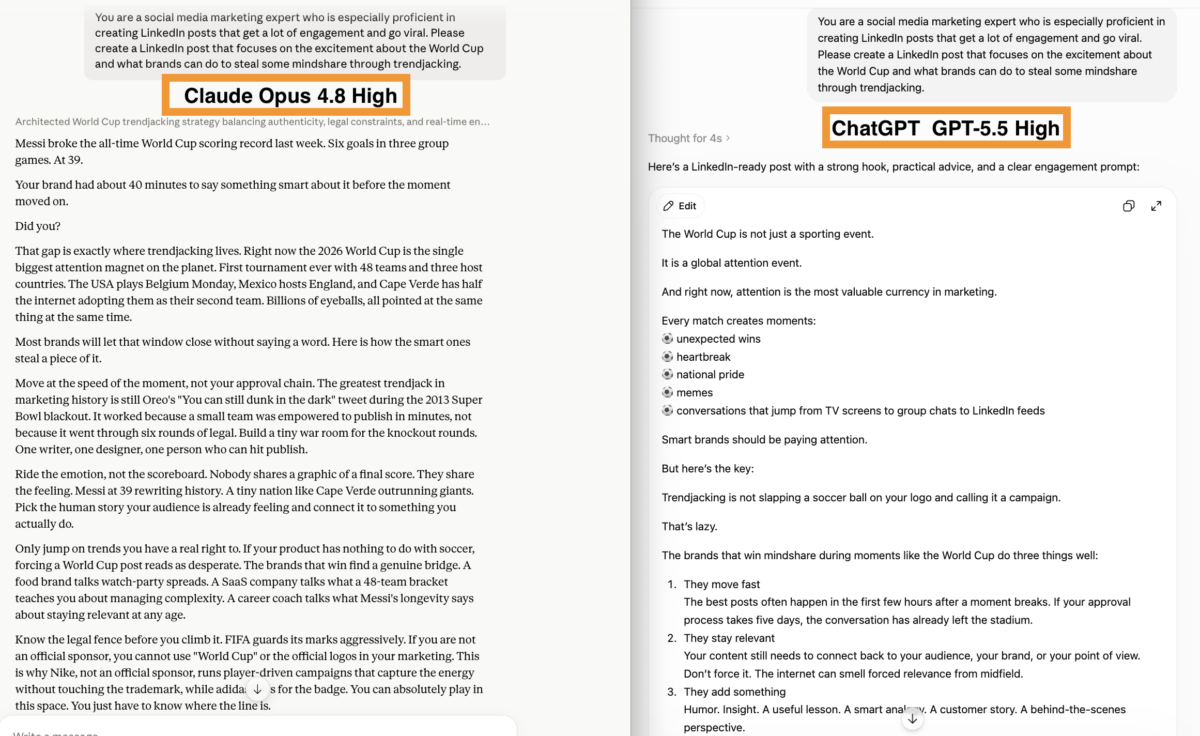 I gave Claude and ChatGPT the identical prompt: write a LinkedIn post about World Cup trendjacking. Claude (left) opened with a concrete Messi hook. ChatGPT (right) led with abstract “attention is the currency” phrasing. Same ask, very different voice.
To be fair, your mileage may vary. Both work well as a general-purpose AI writer. If your writing is short, transactional, or heavily templated, you may not notice much difference, and ChatGPT’s extra tools might tip the scale back its way. But if long-form quality and voice matter to you, spend a week comparing the two on your own content before you decide.
Which Handles Projects and Ongoing AI Workflows Better?
Both platforms offer Projects, which are workspaces where you set instructions once and upload reference files so the AI understands your world. In my experience, Claude does more with them. Its Projects, Skills, and Cowork became the hub of my daily work, while ChatGPT’s Projects and Custom GPTs never delivered the ongoing utility I hoped for.
I gave ChatGPT’s version a real shot. Custom GPTs never acted the way they were supposed to for me, and Projects there did not seem to add much once I got past the novelty. After moving to Claude, the picture changed. I started what I call my AI Workflow Flywheel, where each conversation builds on the last so the output keeps getting better and faster. Creating Skills (reusable instruction sets) and adapting my work to Claude Cowork, the agentic desktop assistant that handles multi-step tasks on your files, added even more value on top of that.
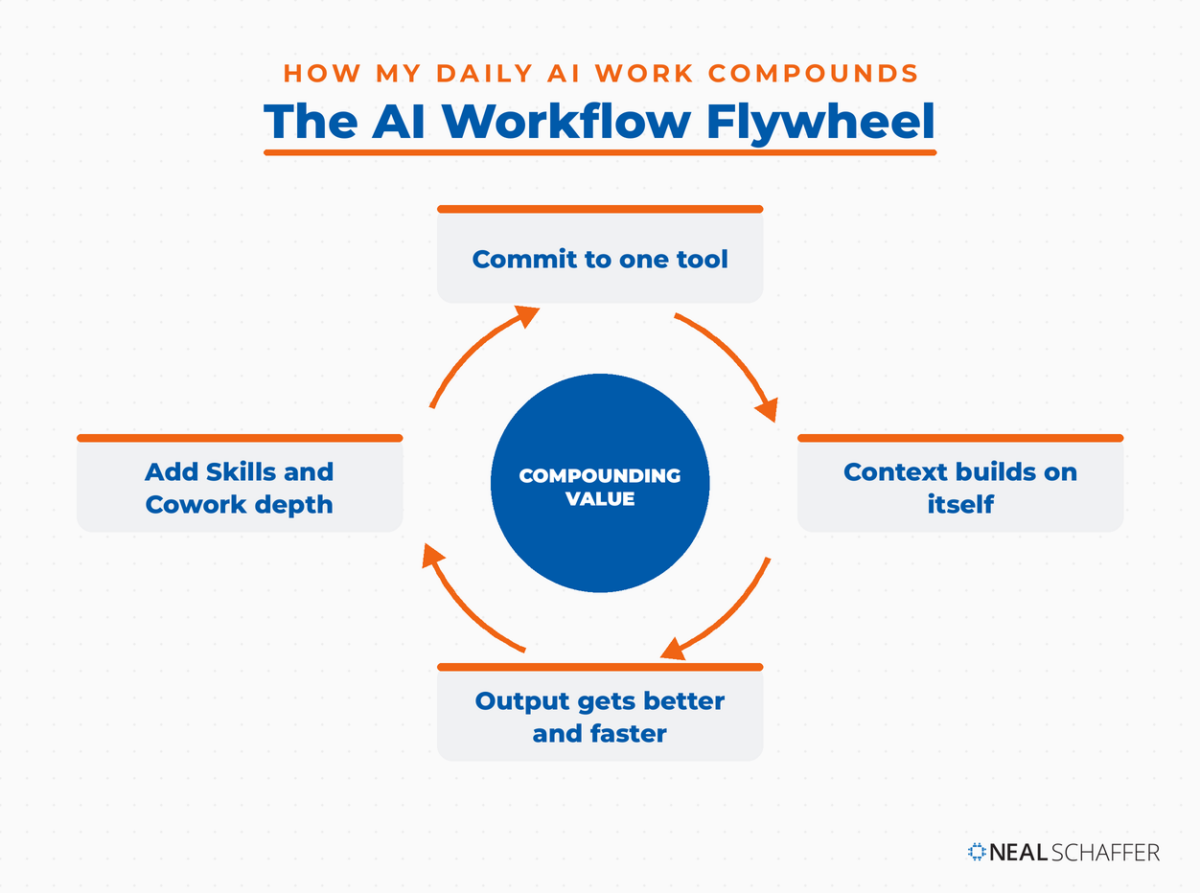 My AI Workflow Flywheel. Commit to one tool, let context build on itself, and each round returns better, faster output that pays for the next one.
The honest truth is that the tool matters less than the commitment. Both platforms handle a well-built prompt fine, and AI prompt generators can help you get started on either one, but the real payoff comes from staying in one place. If you keep bouncing between platforms for the same task, you never let one accumulate context about your business, and you start from zero every time. On my podcast Your Digital Marketing Coach, I put it this way: “You won’t know which one is best for you until you compare all of them. Experiment early, then commit.” Whichever you pick, stop treating it like an AI search engine and start treating it like the workspace where your projects live.
Which Is Better for Creating Images and Visuals?
For raw image generation, ChatGPT wins, and it is not close. ChatGPT creates images natively from a text prompt, and among people who do this daily its quality currently leads the pack. Claude does not generate photos at all. If AI image creation is central to your work, pick ChatGPT.
That said, “generate an image” and “create the visuals I actually need” are not the same job. For my blog featured images and interior graphics, Claude Design meets my needs. It builds designs, prototypes, one-pagers, and slides that I can refine by chatting, which is closer to how I think about marketing visuals than a one-shot photo generator.
Is Your Digital Marketing All Over the Place?
My latest book helps small businesses, entrepreneurs, and marketers bring search, email, and social together into one digital marketing strategy that actually compounds.
Drawing on my work as a Fractional CMO, Digital Threads turns complicated tactics into a clear, practical plan you can follow, whatever your budget or team size.
Grab your copy on Amazon and start weaving your own digital threads. Click the cover or the button below to get started.
So here is the split. Want photorealistic or illustrative AI images on demand? ChatGPT, plus its Sora video and voice features, gives you the fuller creative studio. Want on-brand layouts and design work you can iterate on? Claude Design handles a surprising amount of it. I use ChatGPT’s strength here as a reminder that no single tool is best at everything, which is exactly why I still keep an eye on both.
Which Has More Features and Integrations?
ChatGPT has more built-in features than Claude, full stop. Native image generation, Sora video, Advanced Voice, an agent mode, a coding agent, and dozens of app connectors make it the broader Swiss Army knife. Claude counters with depth in writing, long documents, and agentic file work. Breadth versus depth is the real tradeoff here.
Here is a side-by-side of where each one lands today.
| Capability | Claude (Anthropic) | ChatGPT (OpenAI) |
|---|
| Text writing and analysis | Excellent, my pick for voice | Strong, broad |
| Native image generation | No | Yes |
| Video generation | No | Yes (Sora) |
| Voice conversation | No | Yes (Advanced Voice) |
| Projects and memory | Yes | Yes |
| Reusable instruction sets | Yes (Skills) | Yes (Custom GPTs) |
| Agentic desktop work on your files | Yes (Cowork) | Yes (Agent mode) |
| Design and prototyping | Yes (Claude Design) | Partial (Canvas) |
| App connectors | Growing | Extensive |
If you want one tool that does a bit of everything and you value having voice and video in the box, ChatGPT’s breadth is genuinely useful. If your work is heavy on writing, analysis, and file-based tasks, Claude’s depth in those lanes is where the daily payoff shows up. Neither answer is wrong. They just serve different working styles, which is why comparing them against your own tasks and the rest of the best AI tools in your stack beats trusting anyone’s feature list, including mine.
Claude vs ChatGPT: Which Should You Choose?
Choose ChatGPT if you want the broadest all-in-one AI with native image, voice, and video, or if you are just getting started and want maximum built-in features for your $20. Choose Claude if writing quality, long-document work, and building deep, repeatable workflows matter most to you. Both are excellent, so the tiebreaker is which one fits how you actually work.
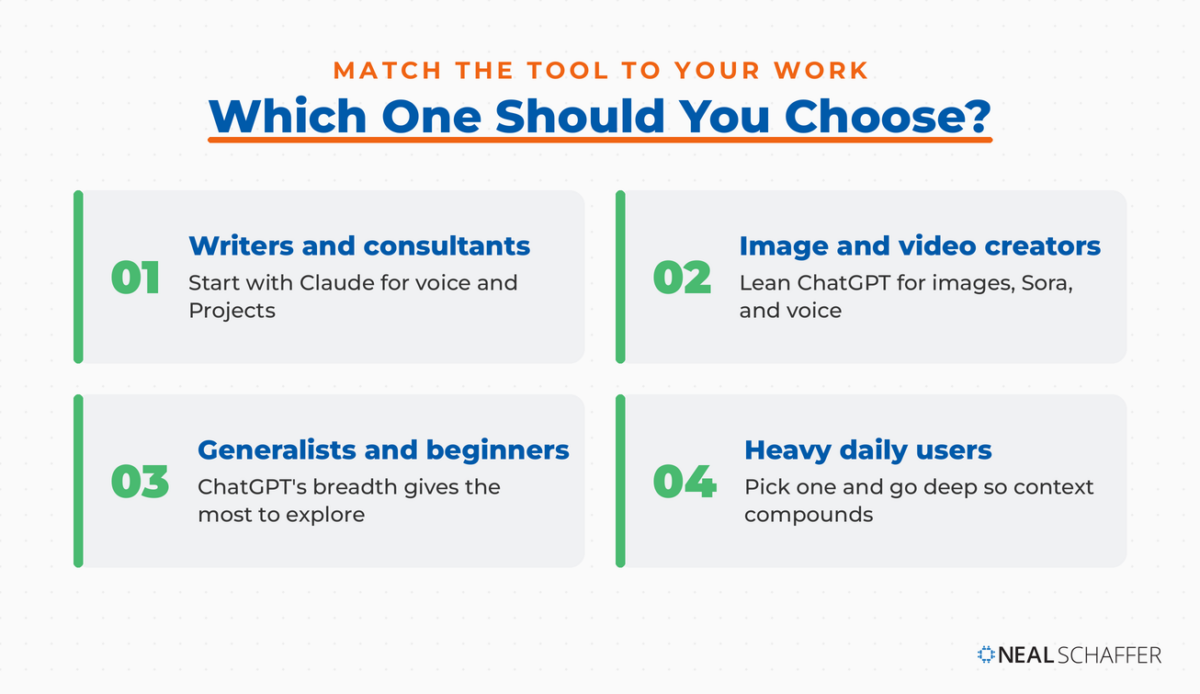 How I would route the choice. It comes down to the work you do most, and for heavy users the biggest win is going deep on one tool instead of splitting across both.
Some quick guidance based on how I see it play out:
– **Writers, content marketers, and consultants:** Start with Claude. The voice quality and Projects workflow are worth it, and it is where I do the bulk of my work. – **Creators who need images, video, and voice:** Lean ChatGPT. Its native creative tools and Sora video are a real advantage Claude does not match. – **Generalists and beginners:** ChatGPT’s breadth gives you the most to explore for $20, and you can always specialize later. – **Heavy daily users:** Whichever you choose, go deep on one before adding a second. The compounding context is the whole point.
Who is this decision not for? If you only touch AI a few times a month for quick questions, honestly, either free tier is fine and this comparison is more than you need. Do not overthink it. The stakes rise only when AI becomes core to your work.
For full transparency, I pay for Claude’s $100 Max 5x plan, and it is worth every cent for the volume of content and strategy work I run through it. But that is my workflow, not a prescription for yours. Your best tool is the one that fits your tasks, which you will only discover by testing both.
Frequently Asked Questions
Is Claude better than ChatGPT? On writing quality, long-document work, and holding a consistent voice, I find Claude better, which is why I switched. For breadth of features like image generation, video, and voice, ChatGPT is better. There is no single winner. It depends on which jobs matter most to you.
Is Claude or ChatGPT cheaper? They match at the entry level: both charge $20 a month for their main paid plan (Claude Pro and ChatGPT Plus). ChatGPT has a cheaper $8 Go tier, though it shows ads, and both offer free plans. At the power-user level both offer $100 and $200 tiers.
Can Claude generate images like ChatGPT? No. Claude does not generate images natively the way ChatGPT does. Claude’s separate Claude Design product creates layouts, prototypes, and slides you refine by chatting, which covers a lot of marketing visual work, but it is not a photo generator. If native image creation is your priority, choose ChatGPT.
Should I use both Claude and ChatGPT? You can, and testing both early is smart. But for any recurring task, commit to one so it accumulates context about your business and gets better over time. Splitting the same work across tools means starting from scratch each time and losing that momentum.
Ready to Pick the Right AI for Your Business?
Do not let the debate paralyze you. Pick the tool that fits your most important work, Claude for writing depth or ChatGPT for creative breadth, then commit for a few weeks and let it learn your business. The marketers pulling ahead are not the ones using the most AI tools. They went deep on one.
If you want to see which specific AI marketing tools I actually use alongside these platforms, that is a good next stop. And if you want a bigger-picture playbook for weaving AI into your search, social, and email strategy, grab a free preview of my book Digital Threads. Or get in touch about Fractional CMO services if you want hands-on help building it out.
Actionable advice for your digital / content / influencer / social media marketing.
Join 13,000+ smart professionals who subscribe to my regular updates.