Wednesday, May 13, 2026
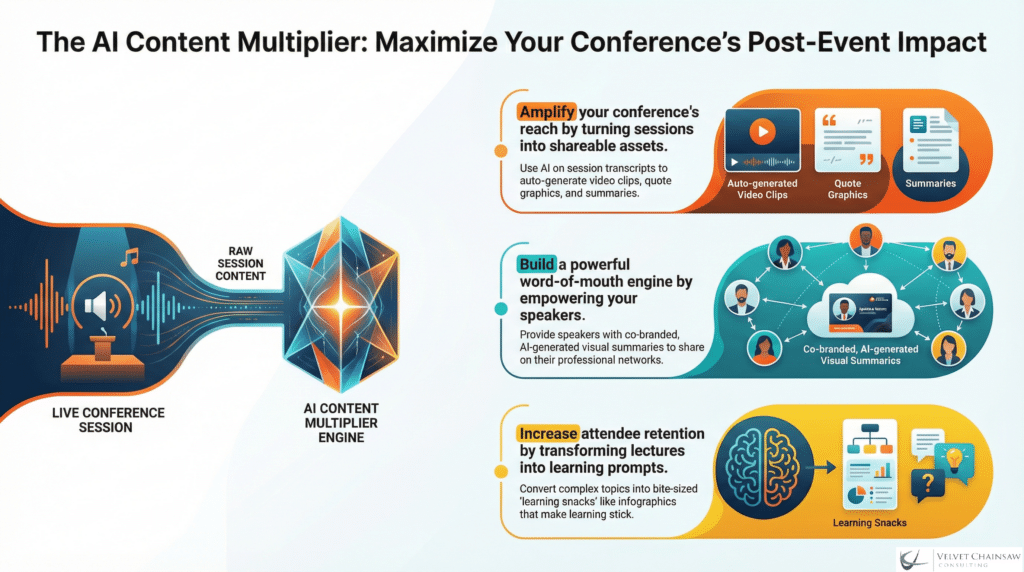
One of the greatest opportunities for leveraging AI in 2026 is not creating more content, but rather chunking session content into digestible, bite-sized snacks.
According to the
Content Marketing Institute, content marketing provides relevant and useful content to your prospects and customers to help them solve issues in their work (B2B content) or personal lives (B2C) content.
When it comes to marketing your conference to prospective attendees, it’s about focusing less on the “call to action” and more on demonstrating how the event will address their specific pain points.
For most, the Annual Conference is where the best and most thought-provoking content is shared. Before generative AI, executing on a content marketing strategy for your conference was too heavy of a lift for most. That’s all about to change in 2026.
Applying to Your Conference Marketing Plan
A number of years ago, Velvet Chainsaw developed a framework for
crafting your conference narrative. The framework aligns with a conference’s attendee journey and can be helpful for developing your content marketing plan:
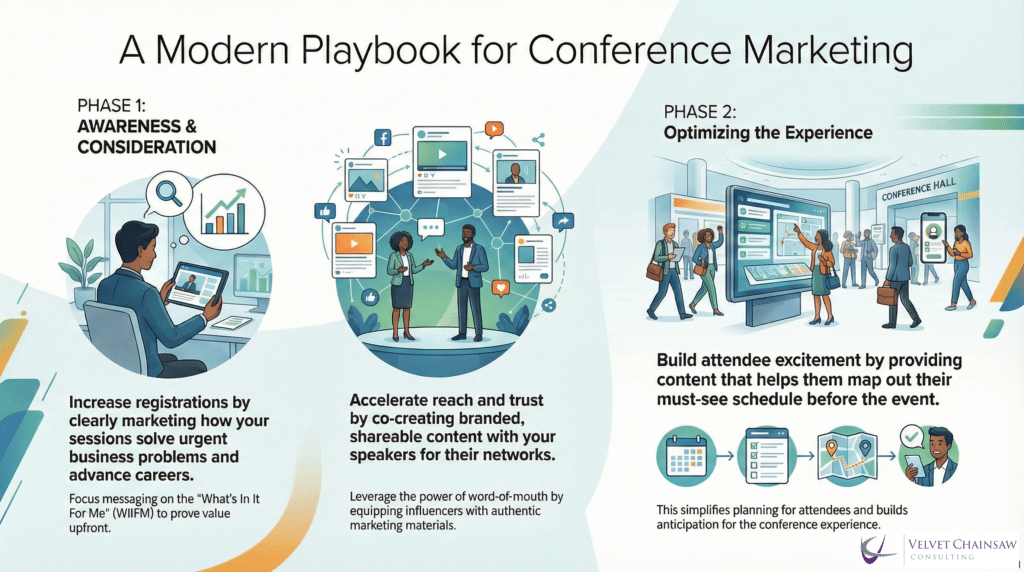
- Phase 1 – Awareness/consideration
- Phase 2 – Optimizing the experience
- Phase 3 – Capture/amplify
- Phase 4 – Memories/learning prompts
For the first two phases, awareness/consideration and optimizing the experience, focus a session’s content marketing on the WIIFM (what’s in it for me). The messaging should briefly and clearly articulate how a particular session is important, urgent, and helpful for improving business outcomes or an individual’s career. When properly executed, it can be used to encourage both registration and session attendance. It also provides tools that can be helpful for attendees to map out their schedule. Here’s an example AI prompt:
I am uploading a session outline for [Session Name]. Act as a conference marketing expert. Create three ‘bite-sized’ insights that clearly articulate how this session improves business outcomes or an individual’s career. Write these for a short LinkedIn post that targets prospective attendees who are facing [Specific Pain Point]. Ensure the tone is practical and urgent…no fluff.
For the last two phases — capture/amplify and memories/learning — leverage AI’s ability to help generate short session summaries and key learnings. Professional infographics and even short videos can be generated to help make learning stick and to share beyond those that attended the session. Create an AI prompt using instructions like this:
Upload your session transcript or slide deck into your generative AI tool and ask it to synthesize the three most compelling insights, organize them into clear headlines with supporting proof points, and format them for visual storytelling — optimized for a one-page infographic or a 60-second social video. Think: boardroom clarity meets social media speed.
Leverage Word-of-Mouth Marketing
Most marketers agree that word-of-mouth marketing is the most powerful means for conversion. Today, people trust other people more than brands. Content that is posted from a personal profile who is an influencer usually has higher engagement and trust than content posted by a conference organizer.
To leverage the power of word-of-mouth, consider helping your speakers co-create content marketing elements around one idea — the elements should include your conference brand along with their authentic voice and thought leadership. Encourage them to share with their network on LinkedIn. Visuals and graphics are easily digestible and most likely to be shared.
Visual Storytelling
Over the years, one of the most effective visual learning prompts comes from graphic facilitators. With the rapid advances of generative AI, similar visuals can be created and shared. Here’s two examples we created using the content in this article. Your AI prompt may look something like this:
- Act as a graphic facilitator. Review the attached session highlights and design a graphic recording-style visual.
- Requirements: Hand-drawn look and feel; Three main ideas connected with arrows; Simple icons (lightbulb, chart, people, checklist); Minimal text — short phrases only
- Layout: Title at the top; Ideas flow left to right like a storyboard
- Style: energetic, professional, conference-ready
- Goal: make someone who missed the session think, “I should have been in that room.”
Adapted from Dave’s Forward Thinking column in PCMA’s Convene. Reprinted with permission of Convene
, the magazine of the Professional Convention Management Association. ©2026.