Two years ago, 60% of consumers said they preferred AI-generated content. Today that number sits at 26%. The audience didn’t just stop loving AI content. They started rejecting it. And yet 91% of marketers are now using AI in their work, according to Jasper’s 2026 State of AI in Marketing report, up from 63% the year before. We’ve never had more adoption with worse audience reception.
That gap is the whole story of AI marketing in 2026.
The bottleneck has shifted. For a long time, the problem in marketing was execution. You knew what you wanted to do, you just couldn’t get it shipped fast enough. AI fixed that. The new problem is strategy, the layer above execution. When everyone has access to the same tools and the same generic prompts floating around on X, the output starts to look the same. Audiences are noticing. And the brands going all-in on AI without a system are getting burned.
I’ve been a Fractional CMO since 2010. I’ve written six books on digital and social media marketing, including Maximize Your Social, Digital Threads and Maximizing LinkedIn for Business Growth. I teach social media marketing at universities including UCLA Extension and Rutgers Business School, run AI content workshops, and help my clients build AI workflow flywheels. I use AI every single day, all day, in my own business. And I can tell you that what most marketers are doing right now is going to look really embarrassing in 18 months.
This is the practitioner’s playbook for actually doing AI marketing in a way that gets you results, doesn’t trash your brand, and positions you for an AI-first search era.
Key Takeaways
? The bottleneck in marketing has moved from execution to strategy. AI solved the creation problem, so what separates winners now is the system above the tools, not the tools themselves.
? Trust in AI-generated content is collapsing. Consumer preference fell from 60% in 2023 to 26% in 2025, which means volume without strategy is now actively brand-damaging.
? Search has fundamentally changed. Discovery now runs through ChatGPT, AI Overviews, and assistants alongside Google, and the new visibility game rewards depth, structure, and trust signals rather than keyword stuffing.
? Your AI tool works best as the workspace where your projects live, not as a one-off search engine. Context accumulates over time, and your output compounds with every conversation.
? People are the one thing AI cannot replicate. Your employees, customers, partners, and creators are your most durable competitive advantage, so the marketers who win are the ones who activate them.
What is AI marketing in 2026?
AI marketing is artificial intelligence applied across the whole marketing system: strategy, visibility, execution, voice, and the people who power it. Strategy decides what to make and why. Visibility structures it so AI engines surface it. Execution produces and distributes at scale. Voice keeps the output sounding like you. Used on any one part alone, AI is a tool, not a system.
Why most AI marketing is failing right now
91% of marketers now actively use AI in their work, up from 63% in 2025. That’s near-universal adoption. But adoption and integration are different things. The 35th edition of Duke University’s Fuqua School CMO Survey, conducted in January 2026 and co-sponsored by Deloitte and the American Marketing Association, found that generative AI now powers 22.4% of all marketing activities, up from just 7% in 2024, with companies projecting AI will reach the majority of marketing activities within three years. Yet the technology is racing ahead of the organizations using it. Across every marketing-technology capability the survey measured, none scored above a 5 on a 7-point performance scale, and performance has not improved in two years. And only 41% of marketers can prove AI is delivering measurable ROI, down from 49% the year before.
Way too many marketers still treat AI like a fancy search engine. Open a tab, ask a one-off question, copy the answer, close the tab. Frequency is not the same as integration. It is using a brilliant marketing consultant on retainer and only calling them once a month to proofread an email.
And while marketers have been busy prompting away, the audience has been making up its mind. Klaviyo’s 2026 AI Consumer Trends report found that only 13% of consumers completely trust AI. According to a 2026 Gartner survey referenced in that same Klaviyo analysis, half of US consumers would prefer to give their business to brands that don’t use generative AI in customer-facing messages, ads, or content. That’s the audience telling marketers, in clearly measurable numbers, that they can tell, and that they care.
We’ve all seen the cautionary tales. Lego used AI-generated images in an online Ninjago quiz in 2024, and fans spotted the distorted hands. Ninjago co-creator Tommy Andreasen called the move “completely unacceptable” and noted the company had guidelines against exactly that. In 2023, Levi’s announced a partnership with Lalaland.ai to use AI-generated models to increase the diversity of its product imagery, and critics accused it of “diversity washing” for generating diverse models rather than hiring diverse people. Intuit added its “Intuit Assist” chatbot to TurboTax, a product whose entire value proposition is built on accuracy. When the Washington Post’s Geoffrey Fowler tested it, the bot got more than half of his 16 questions wrong. The one thing customers trust the brand for, undermined by the tool meant to scale it. Brand-damaging AI is not a hypothetical. It is a portfolio of public case studies your customers have already seen.
I talked through all of this in my recent DigiMarCon West keynote, which I broke down in a podcast episode called People Not Prompts: The Marketing System AI Can’t Replicate. The core thesis: when everyone has access to the same AI tools, the output starts to look the same. The brands that win in 2026 are the ones with the system above the tools.
Layer one: the strategic foundation (the SES framework)
This is the framework I introduced in Digital Threads, published in October 2024. SES stands for Search, Email, and Social. Search captures demand. Email converts it. Social amplifies it. Six containers of digital marketing (your website, search engine marketing, email marketing, content marketing, social media marketing, and influencer marketing) all roll up into these three core functions. The fundamentals didn’t change with AI. AI just changed how fast you can execute on them.
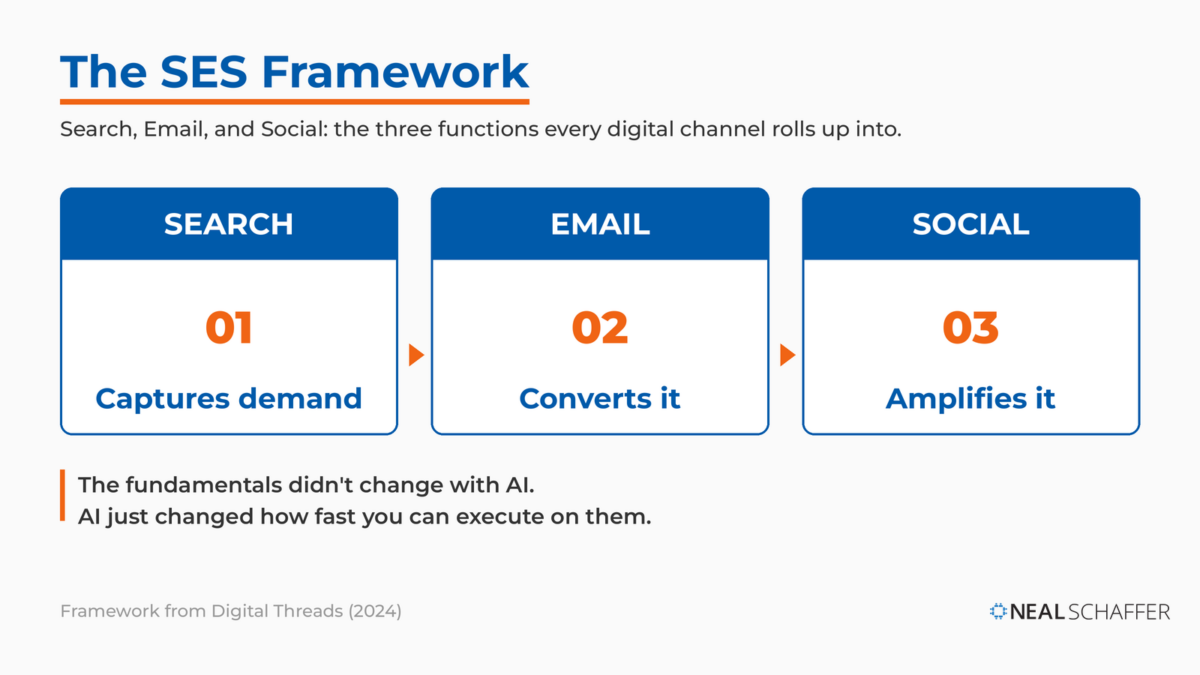 The SES framework from Digital Threads reduces all of digital marketing to three functions: Search captures demand, Email converts it, Social amplifies it. AI changed how fast you execute on them, not the fundamentals underneath.
Here’s how the three pillars map to what AI does and doesn’t change:
| Pillar | What it does | What AI changes | What AI doesn’t change |
|---|
| Search | Captures demand from people actively looking | Discovery has expanded from Google to ChatGPT, Perplexity, AI Overviews, voice, TikTok search | You still need substantive content that answers real questions |
| Email | Converts visitors into a relationship you own | AI can write sequences, segment, and personalize at scale | The list is still your only audience nobody can take from you |
| Social | Amplifies and humanizes the brand at scale | AI can produce volume across platforms in minutes | Algorithm-preferred formats still demand platform-authentic content |
The point of the SES framework is that no pillar works in isolation. A library of blog posts with no email capture is a leaky funnel. An email list with no social amplification grows slowly. Social without search foundation is rented attention. You need all three threads woven together.
Pillar 1: Search reimagined for the AI-first discovery layer
When I say search, I don’t just mean Google anymore. ChatGPT crossed 900 million weekly active users in early 2026, and the damage to the open web is already measurable. Pew Research found that when an AI summary appears at the top of Google, users click a traditional result just 8% of the time, compared to 15% when there is no summary, and only 1% click a link inside the summary itself. Publishers are living the fallout. Business Insider’s organic search traffic fell 55% in three years, HuffPost lost half its search referrals, and the New York Times watched search drop from 44% of its traffic to 37%, with some publishers reporting losses as high as 90%. Discovery now runs through ChatGPT, Perplexity, AI Overviews, and TikTok search alongside Google.
I broke this down in my People Not Prompts podcast episode. Across 15,000 prompts, Ahrefs found in September 2025 that only about 12% of URLs cited by ChatGPT, Gemini, and Copilot rank in Google’s top 10 for the same query. The gap is widening even on Google’s own surface: AI Overview citations that also rank in the top 10 fell from 76% in mid-2025 to 38% by early 2026, with one BrightEdge analysis putting the overlap as low as 17%. You can be invisible on Google’s first page and still show up in AI answers. That means you cannot just optimize for Google ranking anymore. You have to optimize for being cited by the AI engines too, which is a different game with different rules. I’ll get to that in Layer Two.
Pillar 2: Email as the conversion bridge
Nobody talks about email at digital marketing conferences anymore, so I keep stepping up as the one who reminds everyone it still works. 98 out of 100 visitors to your website will leave without converting. Without an email capture mechanism, they’re gone forever.
Email still generates about $36 for every $1 spent, higher than any other channel. And automation is where the real money hides. According to Omnisend’s 2026 report analyzing 27 billion emails, automated emails made up just 2% of sends but drove 30% of all email revenue, earning 16 times more per send than one-off campaigns. The email advantage has held for years, which is the point. The fundamentals didn’t change. AI just made it faster to build the welcome sequence and personalize the lead magnet.
If you want to go deep on AI’s specific impact here, I covered it in my guide to AI email marketing.
Social media spending keeps going up across the board and the results aren’t keeping pace. The answer is not more spend. It’s a fundamentally different approach.
Make Your Marketing Finally Work Together
My latest book helps small businesses, entrepreneurs, and marketers bring search, email, and social together into one digital marketing strategy that actually compounds.
Drawing on my work as a Fractional CMO, Digital Threads turns complicated tactics into a clear, practical plan you can follow, whatever your budget or team size.
Grab your copy on Amazon and start weaving your own digital threads. Click the cover or the button below to get started.
Three rules for the social pillar:
- Use algorithm-preferred formats. Short-form video, carousels, native posts. Every platform rewards content built for how it works, not content lazily repurposed from somewhere else.
- Keep people on platform. Algorithms deprioritize posts with external links. Use link-in-bio, comments, and DMs instead. This is the zero-click approach.
- Think like a content creator, not a brand. Social media was made for people, not businesses. The brands that win are the ones that feel human.
Duolingo’s “Death of Duo” campaign is the case study everyone should study. It generated a 25,000% increase in brand mentions according to Meltwater. Same brand, completely different content per platform: TikTok gets daily playful meme-driven content, Instagram gets weekly reels and carousels, LinkedIn gets a professional tone. That’s platform-authentic content at scale. For more on how AI fits specifically into the social pillar, see my guide to AI in social media.
Layer two: the visibility layer (AEO and GEO)
The acronyms are AEO (Answer Engine Optimization) and GEO (Generative Engine Optimization). A lot of so-called experts will tell you these are completely different things requiring completely different strategies. That’s not entirely true. AEO and GEO are two sides of the same coin. The underlying optimization principles overlap significantly. The goal for both is the same: make your content discoverable, trustworthy, and useful for AI engines, whether they’re large language models like ChatGPT and Claude or traditional search engines layering on AI like Google’s AI Overviews.
But there is an important distinction. I broke this down in my podcast episode on AEO vs GEO:
| Dimension | AEO (Answer Engine Optimization) | GEO (Generative Engine Optimization) |
|---|
| Core mechanic | Extraction | Synthesis |
| What it optimizes for | Direct concise answers pulled into a response | In-depth content cited as part of a synthesized answer |
| Where it shows up | Featured snippets, voice search results, knowledge panels | ChatGPT, Perplexity, Google AI Overviews, Claude, Gemini, Copilot |
| Content shape that wins | Short, structured, schema-marked answers right after the question | In-depth, original, well-sourced content that demonstrates expertise |
| Primary success metric | Featured-snippet wins, impressions in Google Search Console | Citation frequency in AI answers, brand mentions, sentiment |
The mistake is to pick one. You do both. The five foundational strategies that work for both AEO and GEO:
- Answer-focused content. Lead with clarity. Get to the point in the first 100 words. Don’t bury the answer in paragraph five. Use H2 and H3 questions with concise answers right after them.
- Structured formatting. Descriptive subheadings, bullet points, numbered lists, and tables. If a machine is going to read your content, make it easy for the machine to parse what each section is about.
- Credibility signals. Clear author bios with real credentials. Citations to reputable sources. Original research, case studies, or first-party data where you have it. AI is acting as a fact checker, and it’s looking for signals that you are a trustworthy source.
- Entity optimization. Consistently name your brand, products, and people. Help AI build a semantic network that includes you. This is part of why I link my own books, podcast, and consulting practice in my content. It’s not vanity, it’s entity reinforcement.
- Structured data (schema markup). FAQ schema, Article schema, How-To schema, Organization schema. The technical implementation that helps both traditional search engines and AI models understand exactly what you’re publishing.
If you want a deeper dive into the search-specific side of this, I’ve written separately about AI for SEO and the rise of the AI search engine as a category.
Layer three: the execution layer (the AI workflow flywheel)
This is where most marketers leave the most value on the table. They’ve adopted AI but they haven’t integrated it. Frequency is not the same as integration.
For 15-plus years, my inbox was mission control. Every project, every deliverable, every follow-up lived in email. Email tells you what other people need from you. That is a reactive posture. Then something shifted, and I don’t mean I found a better email app. The center of gravity for how I get work done literally moved into my conversations with AI. When I open Claude in the morning now, I’m not asking a quick question. I’m looking at my active projects. What am I working on? What have I forgotten about? What strategic initiatives should I be prioritizing? That is a proactive posture. And it changes everything about how the day plays out.
Then I take it one step further. After that proactive review, I have Claude lay out the actual work for the day: the specific tasks that move me toward whatever objective I’m chasing, in priority order. With that list in hand, I can drop back into reactive, heads-down execution and know I’m on track, because the plan came from my own goals instead of everyone else’s inbox demands. And through every part of this, the human stays in control. The AI proposes, I decide, and nothing goes out under my name without my own review. There is human oversight at every step, always. My name is on the work, so my hands are on it too.
The system behind all of this is what I call the AI Workflow Flywheel, and I broke it down in my podcast episode Stop Using AI Like a Search Engine, Build a Flywheel Instead. The flywheel has four stages:
- You start a conversation. Bring a real project into your AI tool. Maybe it’s a content calendar. Maybe it’s a keynote prep. Maybe it’s your LinkedIn strategy. You upload documents, explain your brand and audience, share your goals. This is the initial push, and it takes effort.
- The AI learns your context. Across conversations, the model accumulates an understanding of your business, your voice, and your preferences. You give it less information over time to get a better answer.
- You get better output faster. Because the AI already understands you, quality goes up and time-to-output drops. Insights from one project feed the next.
- You reinvest the time savings. You put the recovered hours into more strategic, creative, human work. Which generates more context for the flywheel. Each revolution is faster than the last.
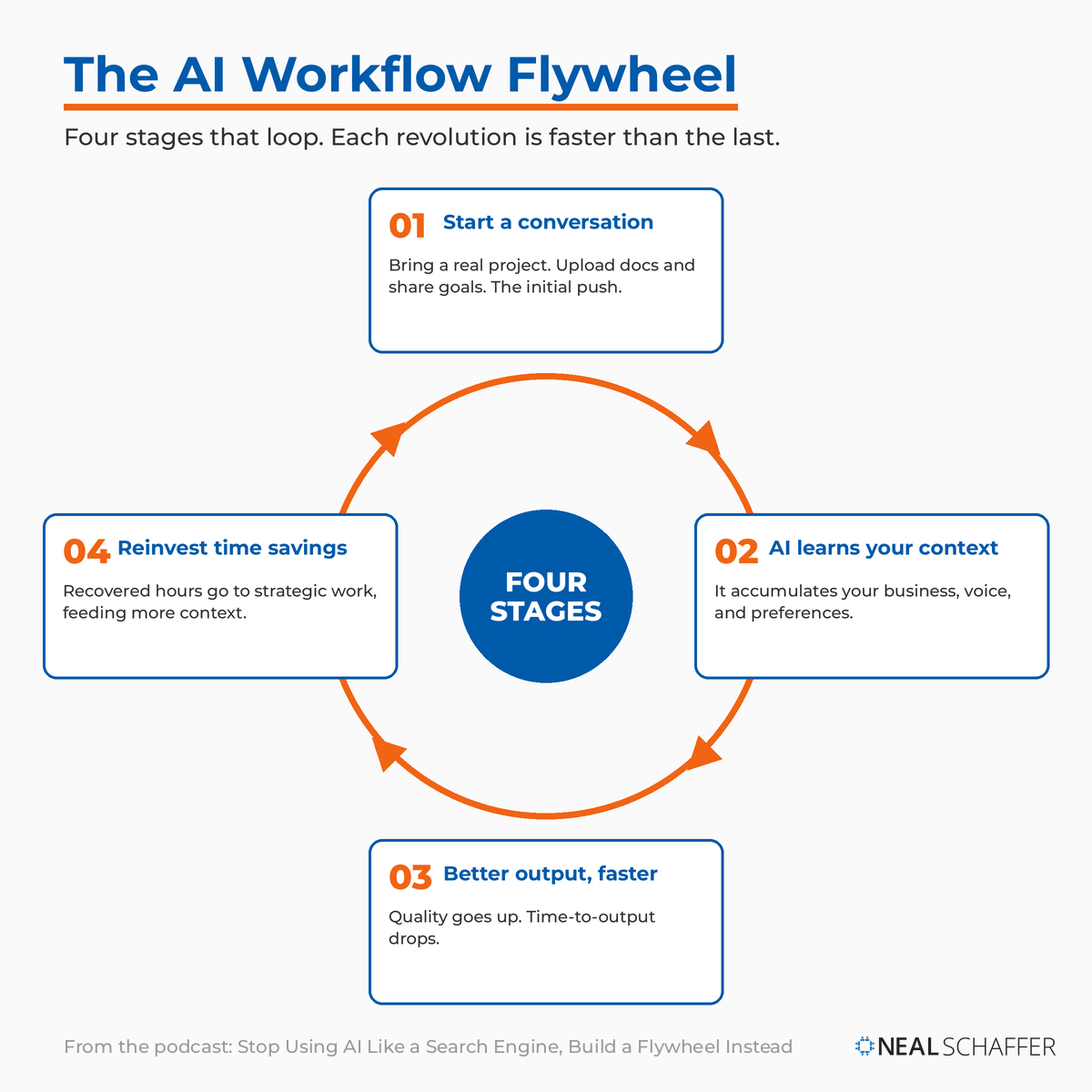 The AI Workflow Flywheel turns AI from a one-off tool into a system. Each loop, the model learns more of your context, output improves, and the time you save feeds the next revolution, which spins faster than the last.
The two mistakes that keep most marketers from experiencing this:
- Treating AI as a one-off tool instead of a system. Building projects, uploading files, evolving conversations over time is the move. Bouncing between blank prompts is not.
- Bouncing between platforms without committing. Experiment early to find the model that resonates with how you work. Then commit and let the flywheel build context.
I use Typing Mind to send the same prompt to multiple models side by side, which is how I figured out that for my specific workflows (content creation, strategic thinking, maintaining my voice across long projects), Claude was consistently producing better results than the alternatives. Then I committed to Claude as my workspace and stopped scattering my context across tools. The flywheel is only as powerful as the context you feed it consistently.
If you want practical entry points into the tools that sit inside this flywheel, my AI marketing tools roundup is the natural next read, along with the more general best AI tools and free AI tools lists.
Layer four: the content production system (long-long-tail and responsible AI volume)
Now we get to the part of AI marketing that gets people the most worked up. Critics call it AI slop. I think the conversation has lumped all AI-assisted content into one bucket, and that’s a mistake.
In my podcast episode AI Slop and the Long-Long-Tail: Your Biggest Missed Opportunity, I broke AI content into three tiers:
- Garbage slop. Hallucinated facts, plagiarism, clickbait, off-voice content nobody reviewed. Hard no, always.
- Neutral filler. The generic “10 tips for X” that any AI would produce. Technically fine, strategically meh.
- Structured AI-assisted content. Accurate, on-brand, designed to answer real questions your audience and the LLMs are actually asking. This is the only tier worth investing in.
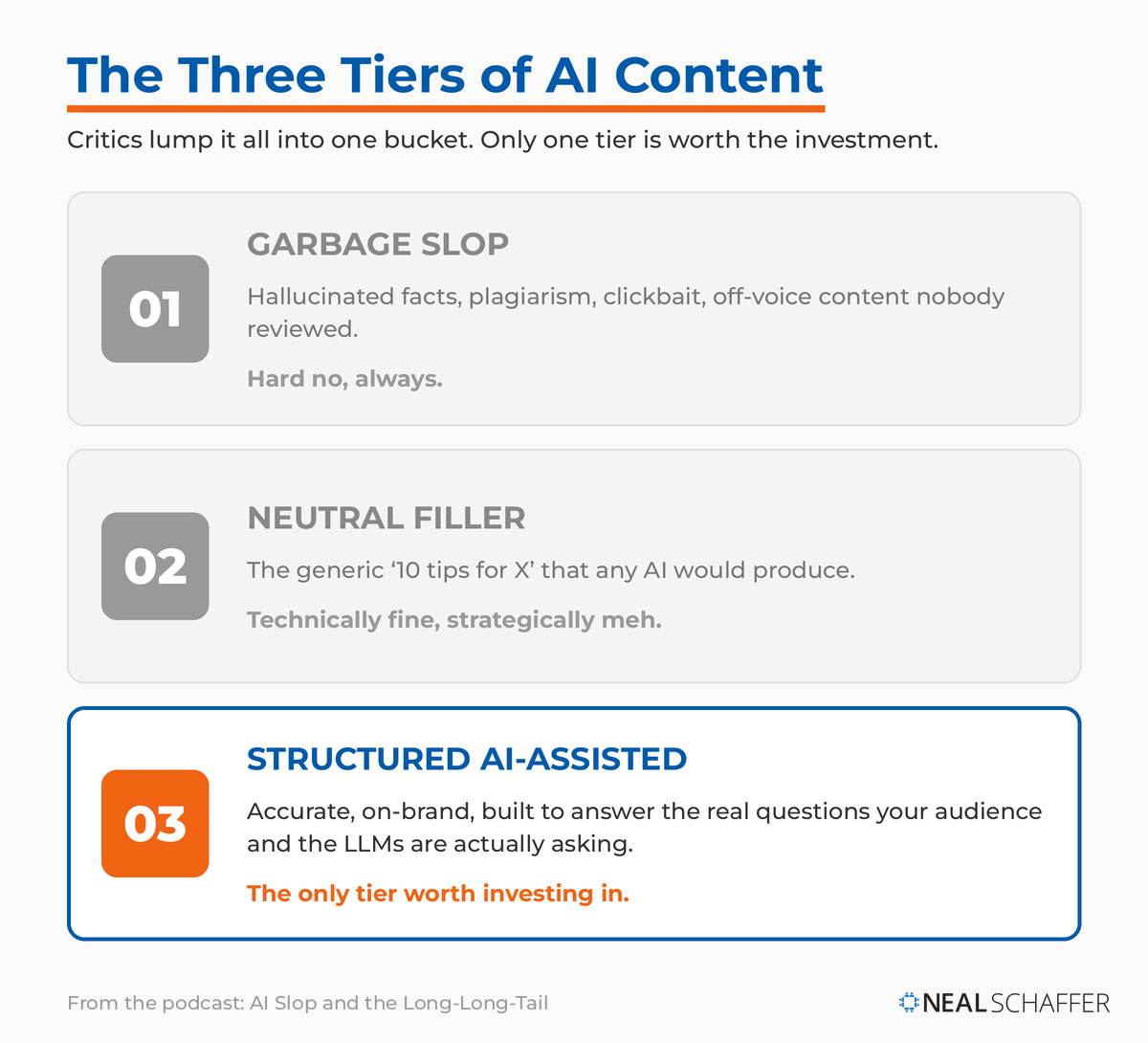 Not all AI content is the same. Garbage slop and neutral filler are easy to produce and not worth publishing. Structured AI-assisted content, accurate, on-brand, and built for the real questions people ask, is the only tier worth investing in.
The reason tier three matters is what I’m calling the long-long-tail. Traditional SEO was about ranking for a manageable set of keywords. Then we got the long tail. With ChatGPT, Perplexity, Claude, and AI Overviews, the questions look more like “what’s the best CRM for a freelance graphic designer in Ohio who hates subscriptions and needs client portals?” That is not a keyword. That is a full sentence with intent, preferences, and context baked in. And LLMs don’t just answer the one query. They fan out dozens of background searches across multiple sources to construct the answer. The addressable query space, the universe of ways someone could ask a question about your niche, has exploded.
My line in Digital Threads was “no content, no discoverability.” That’s even more true now. In 2015, maybe 50 high-quality blog posts were enough to be discovered. In 2026, you might need 500 or 1,000 pieces of content to cover the permutations of how people ask questions about what you do. Without that surface area, you’re a ghost to LLMs.
So how do you produce that volume without trashing your brand? Four guardrails:
| Guardrail | What it means in practice |
|---|
| Source | Start from your own material: blog posts, newsletters, webinars, decks, support tickets, recorded sales calls. AI restructures and rephrases your ideas. It doesn’t hallucinate expertise you don’t have. |
| Accuracy | Anytime you’re dealing with numbers, promises, regulated content, or product capabilities, a human fact-checks. Keep a list of non-negotiable truths the AI cannot mess with. |
| Brand voice | Build a style guide and prompt templates. Define what tone you use, what phrases you avoid, what words you reach for. AI is the keyboard, not the author. |
| Utility | If a piece doesn’t answer a real question, solve a real problem, or clarify a real confusion, it does not get published. Garbage slop is what happens when you forget this one. |
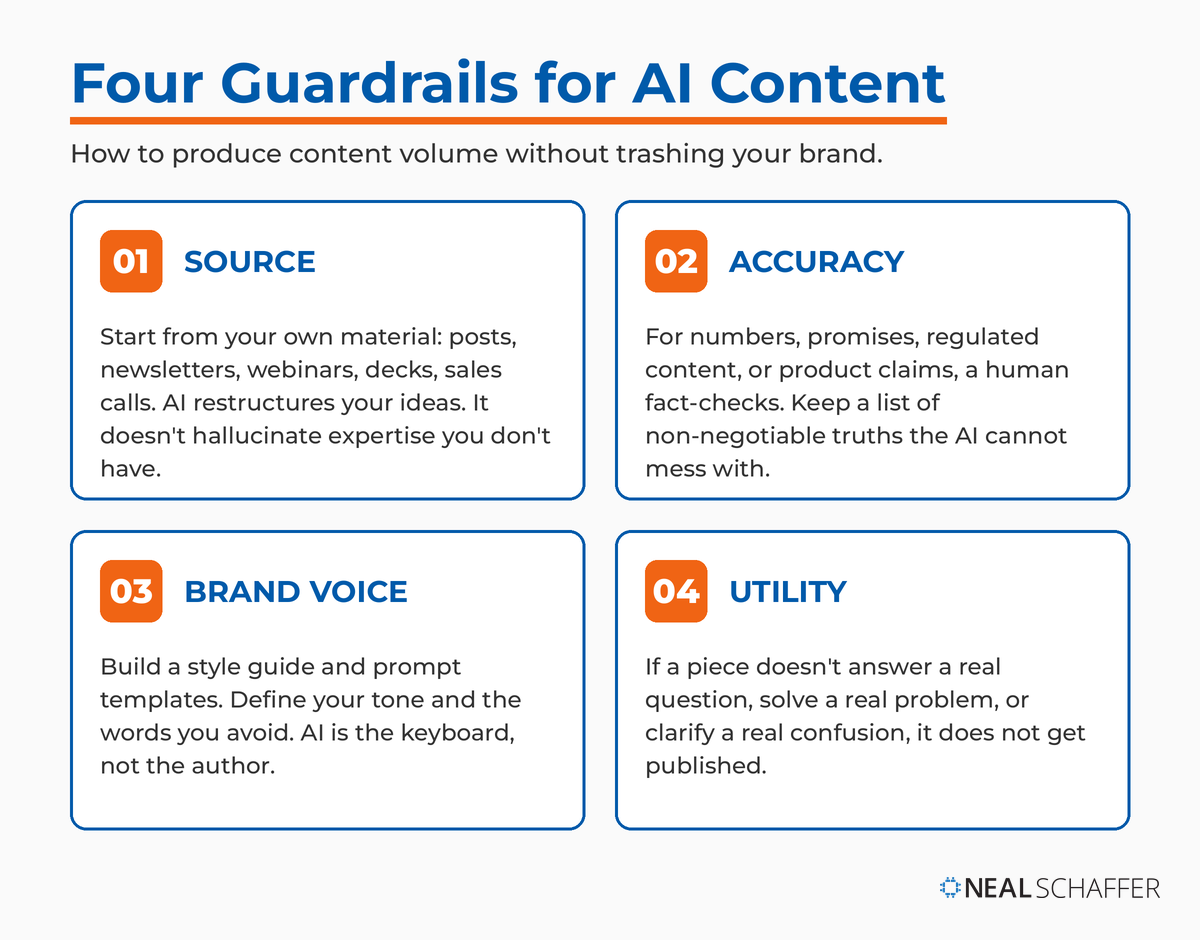 Four guardrails keep AI volume from wrecking your brand: start from your own source material, fact-check for accuracy, enforce your brand voice, and publish only what has real utility. AI is the keyboard, not the author.
My production workflow inside these guardrails is what I call fractal repurposing. Take one flagship asset (a podcast episode, a webinar, a long-form post). Transcribe it (I use Otter.ai). Ask AI to extract 20 to 30 specific questions, side comments, mini-frameworks, and examples buried in that asset. For each one, have AI draft a focused FAQ answer or a standalone short article that lines up with a real long-long-tail query. Then comes the part I never skip. AI produces a draft, never a finished piece. I review every single one, fact-check the claims, and add my own example, my screenshot, my proprietary framework, my brand stamp before anything publishes. Nothing goes out as raw AI output. The volume comes from AI handling structure and first drafts. The trust comes from a human reviewing and owning every piece that ships.
Result: instead of one big piece hoping to rank for a broad term, you have 20 very specific helpful pieces aligned with actual conversational queries. If you want practical tools for this stage of the workflow, my coverage of AI transcription, the AI writer category, and AI prompt generators are the natural deep dives. For visual content, the same fractal-repurposing logic applies through AI image generators and AI video generators.
Layer five: the voice layer (the ASKNEAL™ framework)
People keep asking me for the perfect ChatGPT prompt. There is no perfect prompt. The prompt is the easy part. The hard part is the context you build around it. After I started getting consistently better outputs than my peers running the same tools, I reverse-engineered what I was doing and built it into a 7-step framework called ASKNEAL, which I covered in detail in the ASKNEAL Framework podcast episode and walk through fully in the second edition of Maximizing LinkedIn for Business Growth. Yes, I named it after myself. Stay with me.
- A – Assign a role. Tell the AI exactly what kind of expert you need it to be. “You’re a direct response copywriter with 20 years of experience writing email campaigns that convert.” That single step taps the most relevant subset of the model’s training data and dramatically improves everything that follows.
- S – State your objective. Vague requests get vague results. Don’t say “help me with LinkedIn.” Say “I need five LinkedIn headline options that position me as a digital marketing consultant who helps small businesses scale through DIY strategies.”
- K – Kickstart context. Audience, tone, goal of the piece, industry, value proposition, where the audience hangs out, what language resonates. Context is the actual lever.
- N – Name your inspiration. Share your best-performing examples. Share peer content whose style you admire. This is training data for the conversation. You’re not copying anyone, you’re letting AI pattern-match to what’s worked.
- E – Expand on the idea. Anything else that didn’t fit anywhere else? Keywords, constraints, competitors to avoid, calls to action you want included.
- A – Ask for clarification. Before you press enter, ask the AI what it needs to know to do its best work. The questions it returns are often things you hadn’t thought to include.
- L – Lead the iteration. The first output is a draft, not the answer. Push for clarity. Adjust tone. Add specificity. Iterate five or six times if that’s what it takes. The magic is in the back and forth.
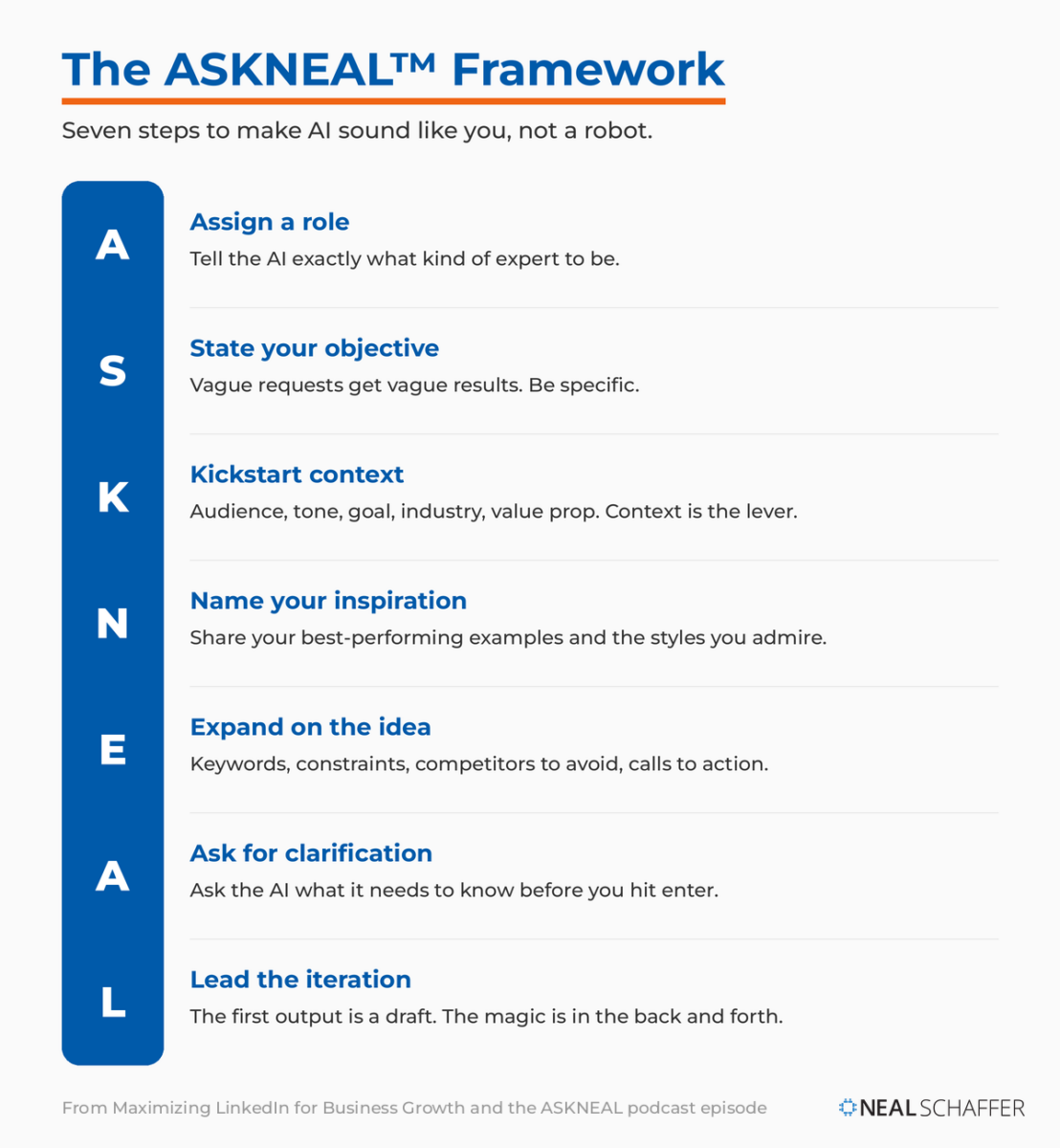 ASKNEAL is a seven-step framework for building the context AI needs to sound like you: assign a role, state your objective, kickstart context, name your inspiration, expand on the idea, ask for clarification, and lead the iteration.
ASKNEAL is also why I keep insisting that the answer to “my AI content sounds robotic” is not a better prompt template. It’s better context. If you’re consistently getting outputs that sound like everyone else’s, the issue is upstream of the prompt. For a deeper dive on cleaning up the output after the fact, my piece on how to humanize AI text and the related AI content detector guide are useful complements.
Layer six: the people layer (the one thing AI cannot replicate)
This is the part the technology can’t reach. Above everything else in the system sits the layer that makes the whole thing durable. Your people. Your employees, your customers, your partners, the content creators in your space. I call it your people ecosystem.
The data backs this up. According to Emplifi’s Q3 2025 social media benchmarks, posts featuring user-generated content converted at more than ten times the rate of posts without it. Peer and customer content earns a kind of trust that polished brand content cannot, and that advantage is widening in the AI era, because the alternative, synthetic content, is now actively losing trust. The Gartner data cited earlier confirms half of US consumers would prefer not to do business with brands using generative AI in customer-facing content.
The example that drove this home for me comes from Deloitte. Lara Sophie Bothur joined as a business analyst and became the firm’s first full-time corporate influencer in Germany.As Forbes reported, in a single year her LinkedIn content reached more than 400 million people and generated an estimated $13 million in advertising value, earned organically, along with more than 10,000 marketing leads for Deloitte. That is one employee, given room to show up as a human. A person was the marketing engine. AI couldn’t have built that.
Activating this layer is the move that separates good AI marketing from great AI marketing. Your employees are not in your office. They’re on LinkedIn. Your customers are reviewing you on Google and Reddit. Your partners are quoting you in podcasts. Your creators are publishing UGC about your category whether you ask them to or not. AI can amplify all of this. It cannot create it. That is the whole point.
A 90-day plan to start building this system
If your head is spinning, here’s where to actually begin. Don’t try to deploy all six layers at once. Pick one workflow this week, get the flywheel started, then extend.
Days 1 to 30: Foundation. Open one dedicated AI project (Claude project, ChatGPT project, whatever your tool of choice). Front-load it with your brand voice, your ICP, your top-performing content. Pick one recurring workflow (your weekly LinkedIn post, your newsletter draft, your podcast show notes) and move that workflow exclusively into the project. Come back to the same conversation each week. Let the context accumulate.
Days 31 to 60: Visibility. Audit your most important commercial pages for AEO and GEO. Front-load the direct answer. Add H2-question subheadings with concise answers right underneath. Add FAQ schema. Add real author bios with credentials. Cite primary sources. Pick three flagship pieces and start the fractal-repurposing workflow on each one, extracting 10 to 20 long-long-tail questions per asset.
Days 61 to 90: People. Identify the five employees, customers, or partners most willing to create. Equip them with the topic ideas your AI workflow has surfaced. Use Deloitte’s playbook in miniature. Track LinkedIn impressions and inbound conversations. Document what works. That becomes your year-two playbook.
That’s the whole system. Strategy, visibility, execution, voice, and the people who hold the whole thing up. The brands building this in 2026 are the ones that will still be in the conversation in 2028.
Frequently asked questions about AI marketing
Is AI marketing replacing human marketers? No. AI is solving the execution problem, which means the bottleneck has moved up the stack to strategy, judgment, and relationships. Only 41% of marketers can prove AI ROI today, down from 49% the year before, which tells you the value is not in the tools but in the marketers who can integrate the tools into a system. The marketers being replaced are the ones doing execution work without strategic context. The marketers thriving are the ones using AI to ship a year’s worth of work in a month and reinvesting the time saved into higher-judgment work.
What’s the difference between AEO and GEO? AEO (Answer Engine Optimization) is about extraction. You structure content so machines can pull a direct, concise answer in response to a query. Think featured snippets, voice search, knowledge panels. GEO (Generative Engine Optimization) is about synthesis. You optimize so your content gets cited as one of multiple sources in an AI-generated summary from ChatGPT, Perplexity, or Google’s AI Overviews. The best approach is a hybrid that does both, because the underlying foundations (clear answers, structured formatting, credibility signals, entity optimization, schema markup) overlap heavily.
Should I publish AI-generated blog posts? Yes, if you’re operating in tier three (structured AI-assisted content that’s accurate, on-brand, and useful) and you stay inside the four guardrails of source, accuracy, brand voice, and utility. No, if you’re publishing tier-one garbage slop or tier-two generic filler. The test is whether the piece answers a real question, sounds like you, and has been fact-checked by a human. Whether AI was involved doesn’t enter into it. Search engines have made clear they care about helpfulness, not how the content was produced. Content produced as a commodity, whether AI-generated or not, will not be favored by search engines.
What’s the best AI marketing tool to start with? There isn’t one. The right tool depends on your workflow. Test three or four with the same task using something like Typing Mind, see which one resonates with how you work, then commit to it long enough to build the flywheel. For most marketers I work with, Claude, ChatGPT, or Gemini is the right anchor tool, with specialized tools like Otter.ai for transcription, Clearscope for content optimization, and the broader stack of AI marketing tools layered in as workflows demand. The mistake is bouncing between everything without ever building accumulated context inside one.
How do I make AI-generated content sound like me, not a robot? Use the ASKNEAL framework: assign a role, state your objective, kickstart context, name your inspiration, expand on the idea, ask for clarification, lead the iteration. The real lever is providing examples of your best-performing past content as training data inside the conversation, not finding the perfect prompt. Then iterate the output five or six times rather than accepting the first draft. The first draft is NEVER the final draft.
Where to go from here
This was the strategic overview. If you want the full system as I teach it, Digital Threads lays out the SES framework and the modern digital marketing operating model in depth. The second edition of Maximizing LinkedIn for Business Growth covers the ASKNEAL framework and how to operate the entire stack on the single platform where search, email, social, and people all converge.
If you want the strategic pieces hand-walked with my eyes on your specific business, I run a Digital First Mastermind group coaching program and offer Fractional CMO consulting for companies serious about building the system rather than just buying more tools. And if you want everything I’m publishing as I publish it, my newsletter is where my earliest thinking lands before it makes it onto the podcast or into the books.
You can also download a free preview of Digital Threads if you want to see the SES framework laid out in chapter form before committing to the book.
The brands ignoring all of this are not going to wake up tomorrow with the problem solved. Build the system now. The compounding starts the day you commit.
Actionable advice for your digital / content / influencer / social media marketing.
Join 13,000+ smart professionals who subscribe to my regular updates.