Ask ten marketers what an AI agent is and you will get ten different answers. Some picture a robot running their whole funnel. Others assume you need a developer, a stack of connected apps, and a tool like n8n before you can touch one. So they wait. They keep using ChatGPT for a caption here and a subject line there, and they file “AI agents” under someday.
I want to save you that wait. The truth is simpler and a lot more useful. You are very likely already using AI agents. You just have not been calling them that.
The realization hit me while updating my own site. For months I had used Claude to create branded visuals for my posts. Then I wrote a handoff document for my VA with the alt text, captions, and placement for each image. One day I asked why I was handing that off at all. I opened Claude Cowork, gave it the images and that same document, and asked it to make the changes. It worked while I did other things. I came back to a perfectly updated site. That was the moment I knew I was using an agent, inside a tool I already pay for.
I have spent more than a decade helping companies figure out where new technology actually fits. I do that now as a fractional CMO and the author of Digital Threads, which includes a full chapter on AI and marketing. I also host the Your Digital Marketing Coach podcast and teach this material to graduate students at Rutgers Business School. So let me demystify AI agents the way I wish someone had done for me.
Key Takeaways
? An AI agent does more than answer a question. It plans and carries out a multi-step task using the tools you connect to it.
? You are probably already using semi-autonomous agents inside tools you have, even if nobody labeled them “agents.”
? Semi-autonomous agents pause for your review. Fully autonomous agents run a task from start to finish on their own, inside the guardrails you set.
? The best first use cases are repetitive, well-defined jobs: research, reporting, content drafts, and lead qualification.
? Start with one workflow, keep yourself in the loop, and widen an agent’s autonomy only after it earns your trust.
What is an AI agent, in plain English?
An AI agent is a software system that pursues a goal on its own. It plans and carries out a multi-step task with the tools you give it, not just replying to a single prompt. IBM describes an agent as a system that autonomously performs tasks by designing its own workflow with available tools. That loop is the whole difference.
Think about the AI you already use. A plain chatbot is reactive. You ask, it answers, you move on. An agent is proactive. You give it an objective, and it decides what steps to take, which tools to call, and when to come back to you. IBM draws the same line between an AI assistant, which works at your request, and an agent, which works toward a goal on its own.
It also helps to separate agents from ordinary automation. A Zapier or n8n recipe follows a fixed “if this, then that” path. It never deviates. An agent reasons about the goal, so if one path fails, it can try another. Traditional automation is a train on rails. An agent is a driver who knows the destination and picks the route.
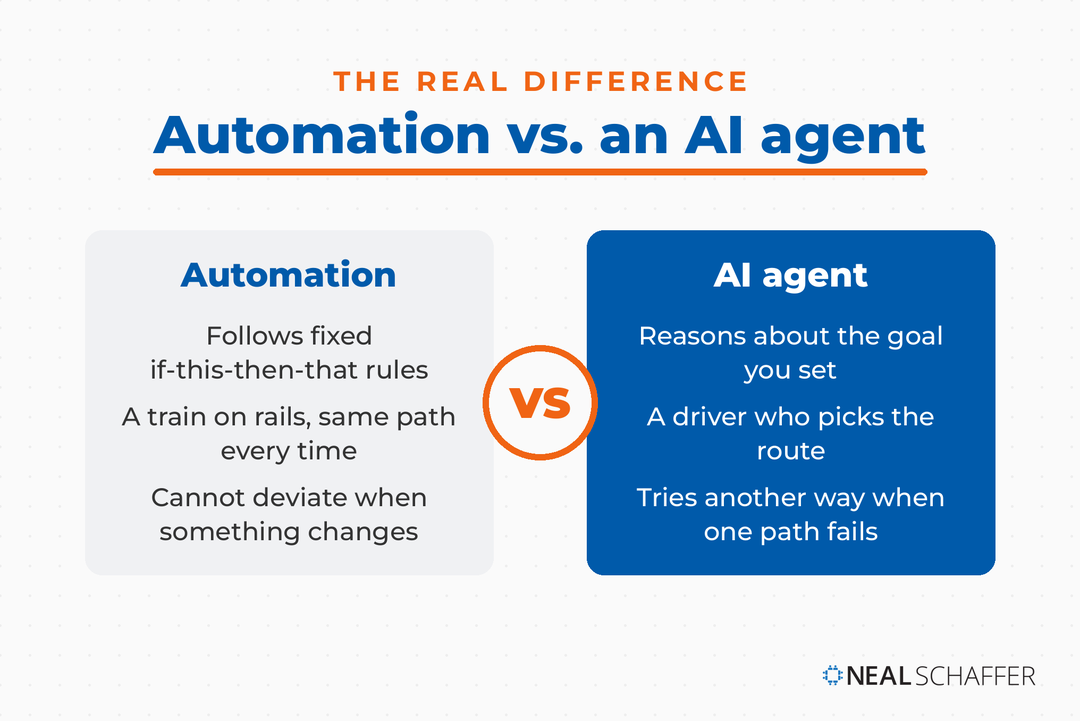 Traditional automation follows a fixed path and never deviates. An AI agent reasons about the goal you set, so when one route fails it can try another.
What is the difference between semi-autonomous and fully autonomous AI agents?
The difference is how much runs without you. A semi-autonomous agent does the work but pauses for your review or approval at key moments. A fully autonomous agent completes the whole task on its own, inside guardrails you set, and only pulls you in when something falls outside them. Same technology, different amount of trust.
Salesforce frames it cleanly on its own agent pages. It describes how AI agents are designed to work with a human involved, while autonomous agents are built to be self-sufficient with little to no human intervention. Neither is “better.” They sit on a spectrum, and where you land depends on the task and how much a mistake would cost you.
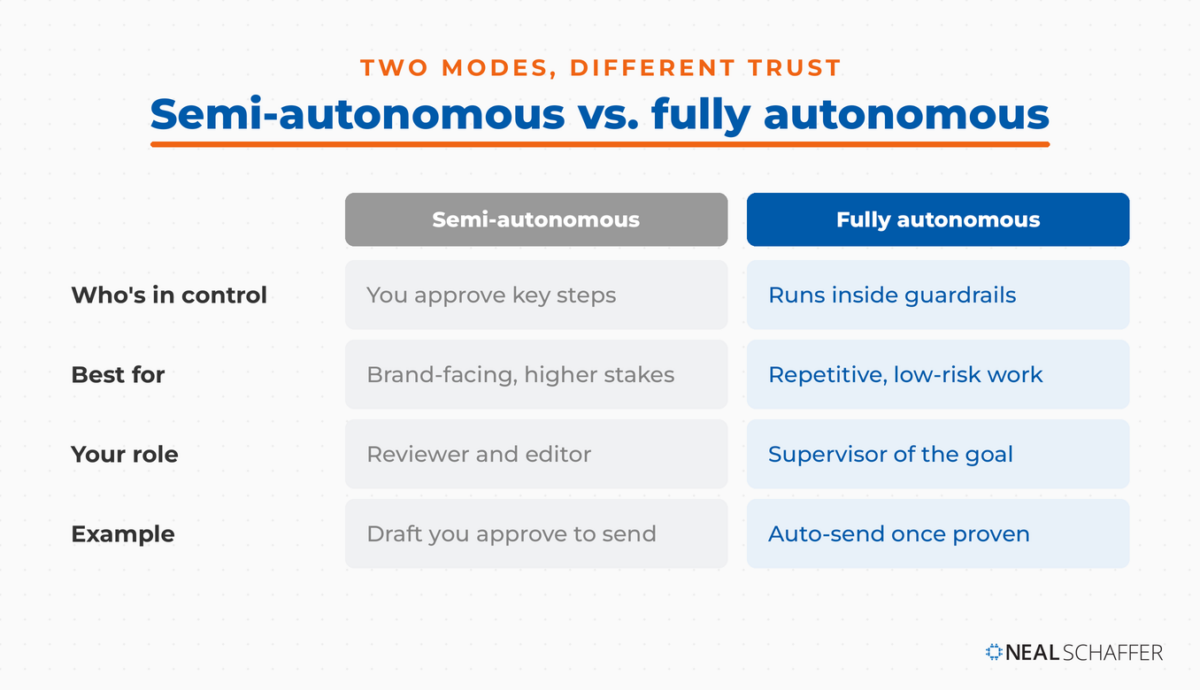 The difference is how much runs without you. A semi-autonomous agent pauses for your review; a fully autonomous one runs inside guardrails you set. Neither is better
 | Semi-autonomous agent | Fully autonomous agent |
|---|
| Who is in control | You approve the key steps | The agent runs inside preset guardrails |
| Best for | Higher-stakes or brand-facing work | Repetitive, well-scoped, low-risk tasks |
| Your role | Reviewer and editor | Supervisor who sets goals and limits |
| Example | Draft outreach you approve before it sends | Auto-send outreach once quality is proven |
You can watch that spectrum inside tools marketers already use. HubSpot’s prospecting agent lets you review each drafted email before it sends. Once you trust the quality, you can switch the same agent into a fully autonomous mode that sends without your review. That single toggle is the whole semi-versus-fully-autonomous question in miniature. You start with the human in the loop, then step back as confidence grows.
My advice: live in the semi-autonomous zone far longer than you think you need to. Full autonomy is where you end up, not where you begin.
Are you already using AI agents without realizing it?
Almost certainly, yes. Say you use AI to research a topic across sources, revise a piece over several steps, or work in a project that remembers your context. You are already directing a semi-autonomous agent. It plans, uses tools, and checks back with you. Most marketers simply never gave it that name.
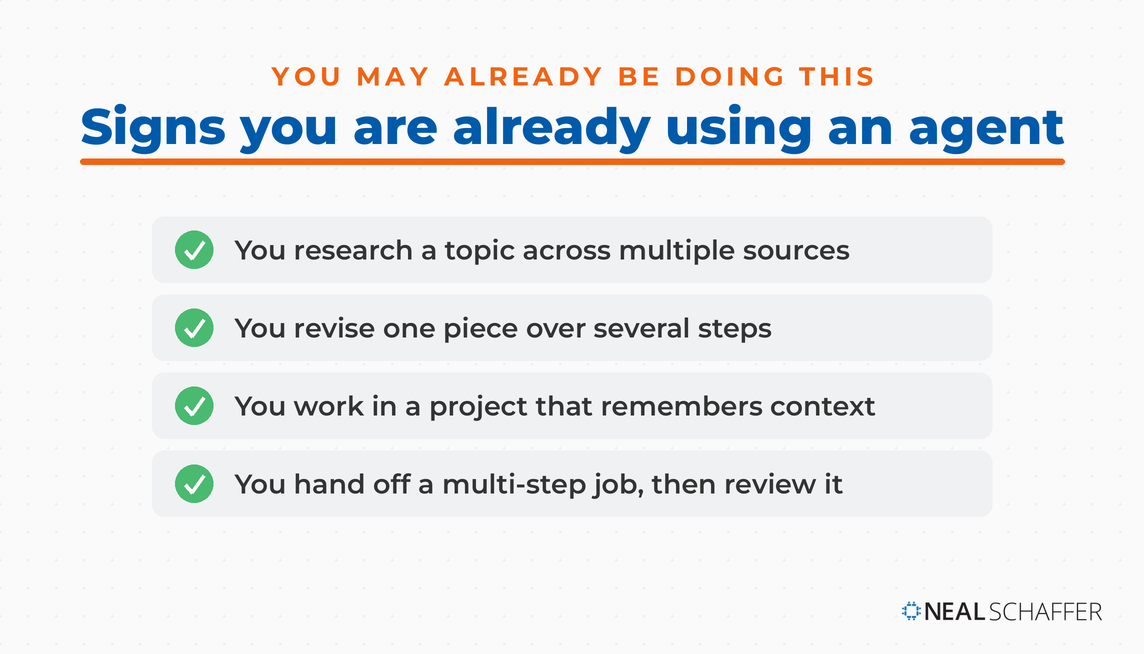 f you research across sources, revise over several steps, or hand a multi-step job to a tool and review the result, you are already directing an agent.
Consider how widespread this already is. According to Jasper’s 2026 State of AI in Marketing report, 91% of marketers now actively use AI in their work, up from 63% a year earlier. A large share of that daily use already involves agent-like behavior, even when people describe it as “using ChatGPT.” The label lags the reality.
For a long time I assumed agents meant building something in a workflow tool like n8n. It is genuinely useful, but also more involved, and that assumption keeps a lot of marketers on the sidelines. The site hand-off I described needed none of it. No integrations, no code. I had also moved most of my content work from ChatGPT to Claude by then, delegating multi-step jobs and reviewing the results. That is agent behavior. Most of us just call it “using an AI tool.”
AI is already reshaping the channels you work in every day. You can see the broader patterns in the latest social media marketing statistics. Agents are the next layer on top of all of it.
What can AI agents do for a marketing team?
For a marketing team, agents handle the repetitive, multi-step work that sits between your big creative decisions. Research, competitor monitoring, reporting, content drafting and repurposing, lead qualification, and campaign setup are the strongest starting points. Each is a defined job with clear inputs and outputs, which is exactly where agents perform best right now.
Here are the use cases I would try first, roughly in order of how safe they are to hand over:
- Research and analysis. Point an agent at a topic, a competitor set, or your own analytics and let it gather, summarize, and surface what matters. This pairs naturally with using AI for SEO work like keyword and SERP research.
- Content drafting and repurposing. An agent can turn one asset into channel-specific drafts, then you edit. If your drafts come back sounding robotic, spend your saved time making AI text sound human before publishing. Better starting prompts help too, which is where a good AI prompt generator earns its keep.
- Reporting. Weekly and monthly reports are ideal agent work: same inputs, same format, every time. Many teams that spend hours each Monday building dashboards get that time back first.
- Lead qualification and outreach. Agents can score leads against your criteria and draft personalized outreach for a human to approve.
- Customer support. AI chatbots have grown into support agents that resolve routine questions and hand off the hard ones.
- Social and campaign execution. From scheduling to first-draft campaign assets, agents are moving into AI in social media workflows across the stack.
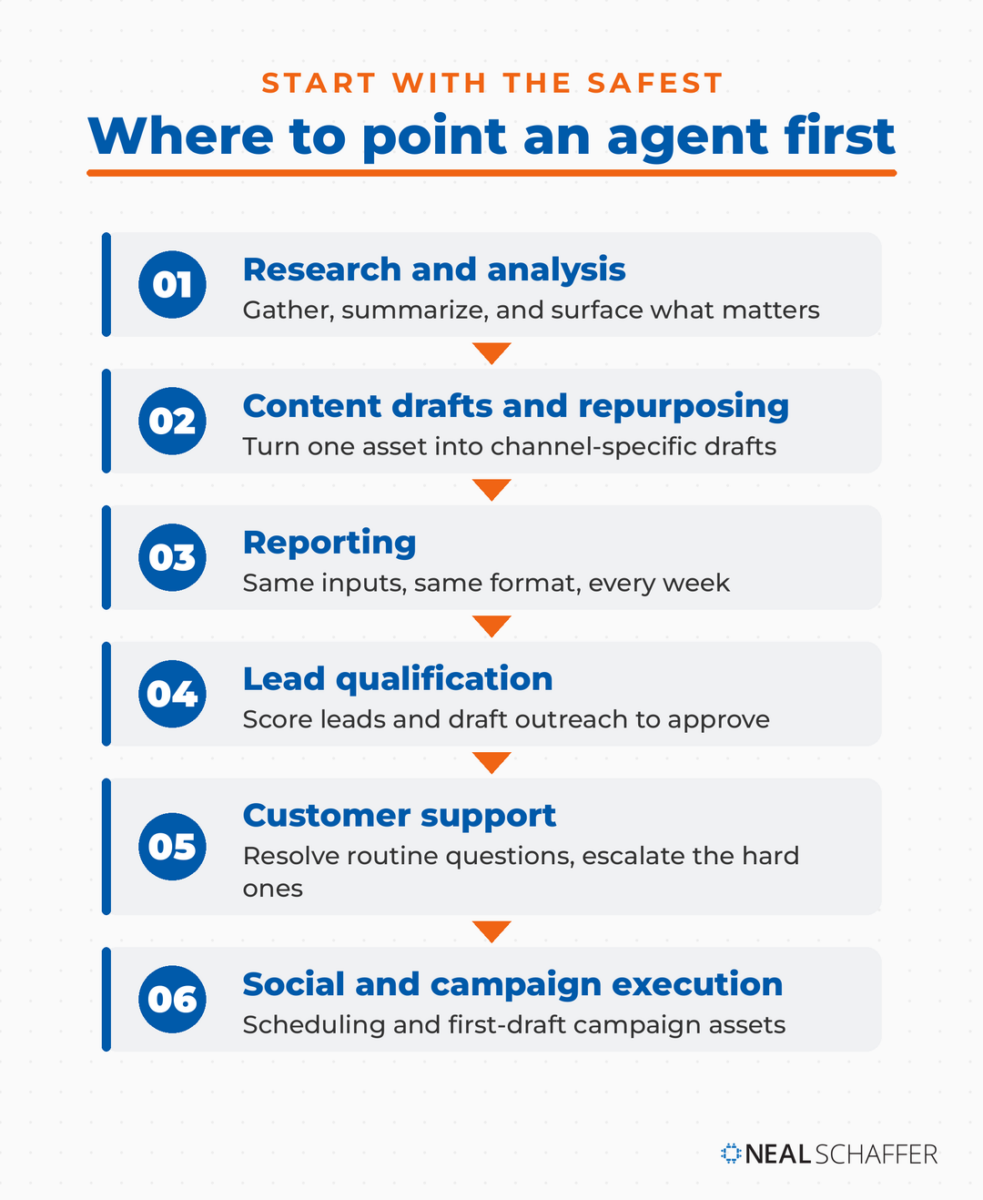 The best first jobs are repetitive and well-defined. These six are ordered roughly by how safe they are to hand over, starting with research and analysis.
The vendors are leaning into this hard. Salesforce’s marketing agents can build an audience, launch a campaign, and generate the content from a stated goal. Sporting goods brand Rawlings reported 75% faster campaign creation using those agentic marketing tools. Results like that are real, but notice the pattern. The agent did the assembly, and a marketer still set the goal and owned the outcome.
You do not need a new platform to begin. The semi-autonomous agents inside tools you already pay for are the fastest way in. Fully autonomous, build-it-yourself platforms make sense later, once you know exactly which workflow you want to hand off and what a mistake would cost. Start where you already work.
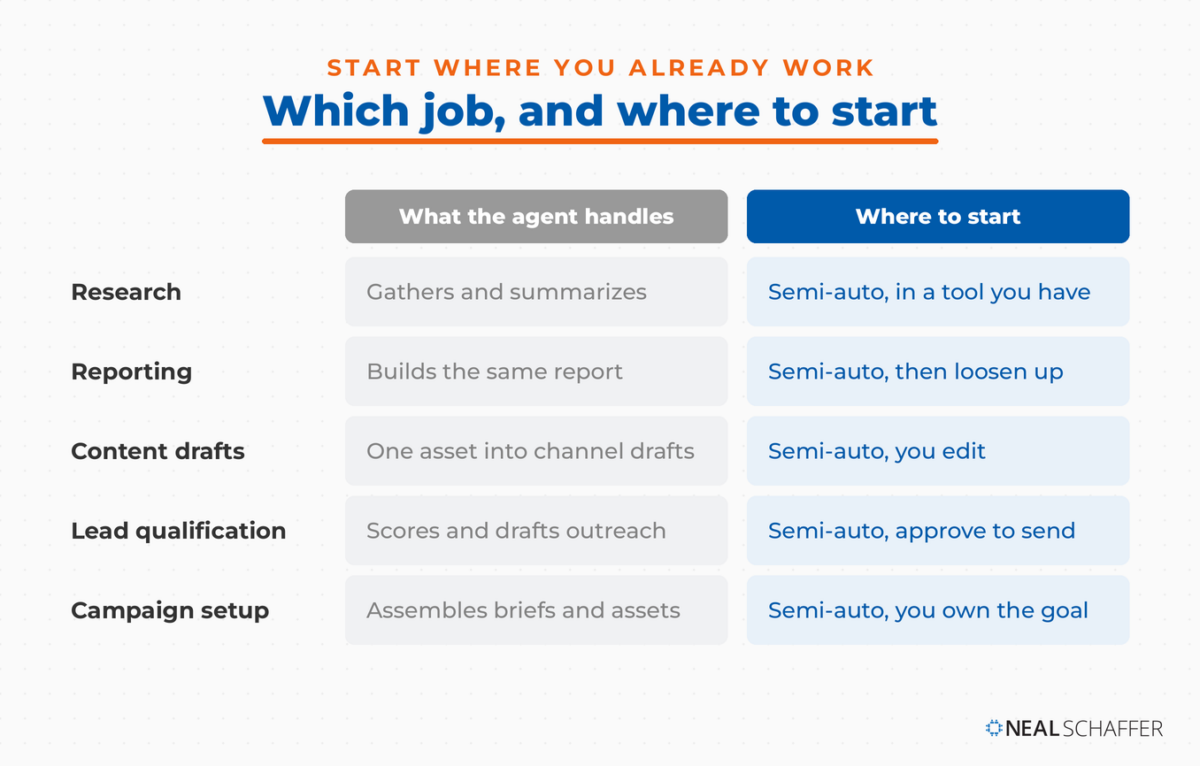 For every core job, the fastest start is the same: a semi-autonomous agent inside a tool you already pay for. Build custom platforms later, once a workflow is proven
| Marketing job | What the agent handles | Where to start |
|---|
| Research and analysis | Gathers and summarizes across sources | Semi-autonomous, in a tool you have |
| Reporting | Builds the same report on a schedule | Semi-autonomous, then loosen the reins |
| Content drafts | Turns one asset into channel drafts | Semi-autonomous, you edit |
| Lead qualification | Scores leads and drafts outreach | Semi-autonomous, approve before it sends |
| Campaign setup | Assembles briefs, audiences, and assets | Semi-autonomous, the human owns the goal |
For most marketers, the on-ramp is a tool you have open right now. ChatGPT projects and Claude both let you set up a workspace, load your context, and run multi-step tasks with your review. That is agent behavior without any setup. If you run a CRM, your agents are often already built in. HubSpot’s Breeze agents run full workflows inside the platform while keeping approvals in your hands. These are the best AI tools to start with, precisely because you are not adding anything new.
One Strategy to Connect All Your Marketing
My latest book helps small businesses, entrepreneurs, and marketers bring search, email, and social together into one digital marketing strategy that actually compounds.
Drawing on my work as a Fractional CMO, Digital Threads turns complicated tactics into a clear, practical plan you can follow, whatever your budget or team size.
Grab your copy on Amazon and start weaving your own digital threads. Click the cover or the button below to get started.
When you are ready for more autonomy, that is when platforms like Salesforce Agentforce or a workflow builder like n8n come in. They let you construct agents that connect several apps and run with less supervision. This is also where the AI marketing tools landscape gets crowded and pricey, so wait until you have a proven workflow before you build.
One honest caution. Agents are arriving fast, but they are not magic. Gartner expects 40% of enterprise applications to include task-specific AI agents by the end of 2026, up from less than 5% in 2025. Yet Gartner also predicts more than 40% of agentic AI projects will be scrapped by the end of 2027, undone by unclear value, rising costs, or weak controls. Both things are true. The teams that win start small and prove value before they scale.
What do most guides get wrong about AI agents?
Most guides tell you to build a complex autonomous system first, and that is backwards. The mistake I see is treating full autonomy as the goal instead of the last step. Start semi-autonomous, keep a human in the loop, and let an agent earn independence one workflow at a time.
The data supports patience over hype. According to McKinsey’s 2025 State of AI survey, 62% of organizations are at least experimenting with AI agents, and 23% are scaling one somewhere in the business. Adoption is real, but most companies are still early, and most are scaling in only one or two functions. Being deliberate here is normal, not slow.
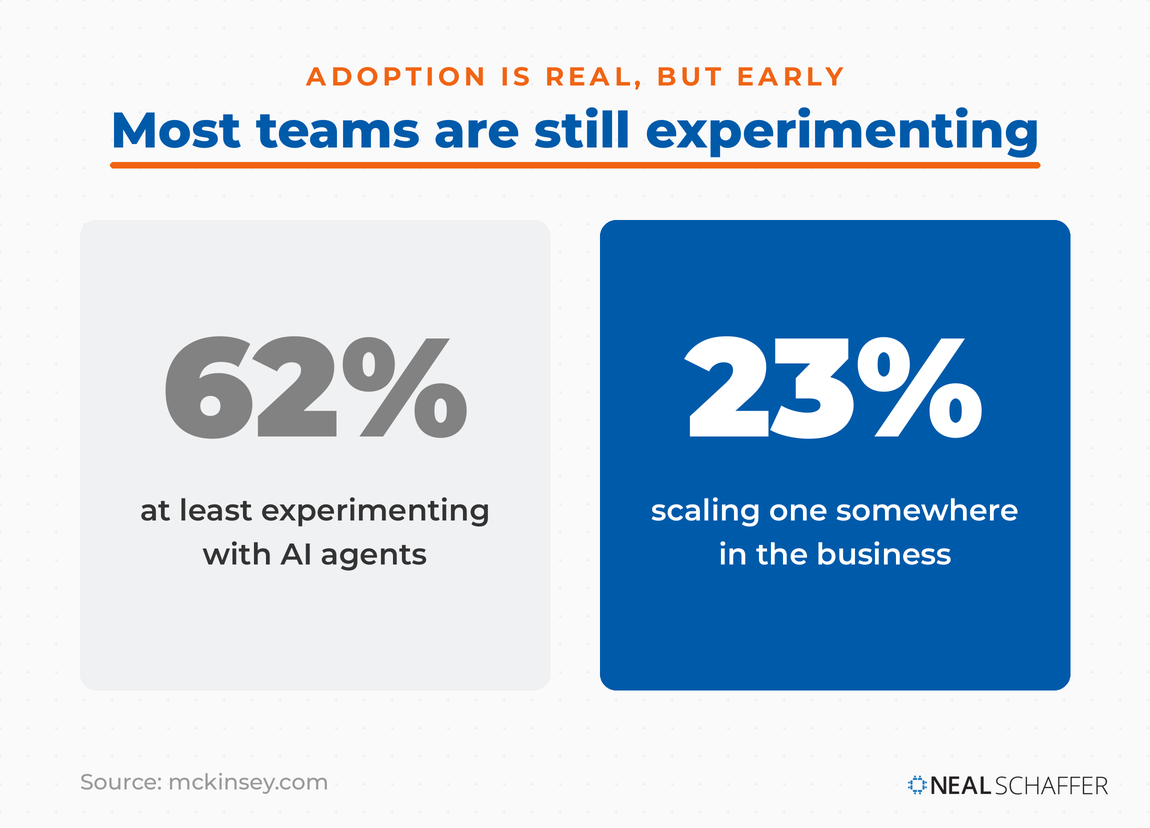 Adoption is real but early. 62% of organizations are at least experimenting with AI agents, yet only 23% are scaling one somewhere. Being deliberate here is normal, not slow. Source
I made this point on a recent episode of my podcast Your Digital Marketing Coach, where I described where fully autonomous agents stand today: “That’s coming. It’s real. It’s already here for some businesses and some people.” The shift is genuine. It is just unevenly distributed. That means the marketers who build the habit now will be ready when the tools mature.
So here is the discipline I would follow. Pick one repetitive workflow. Run it with an agent while you review every step. When the output is consistently good, loosen the reins. Keep your judgment on the strategy, the goals, and the final call, and let the agent carry the busywork in between.
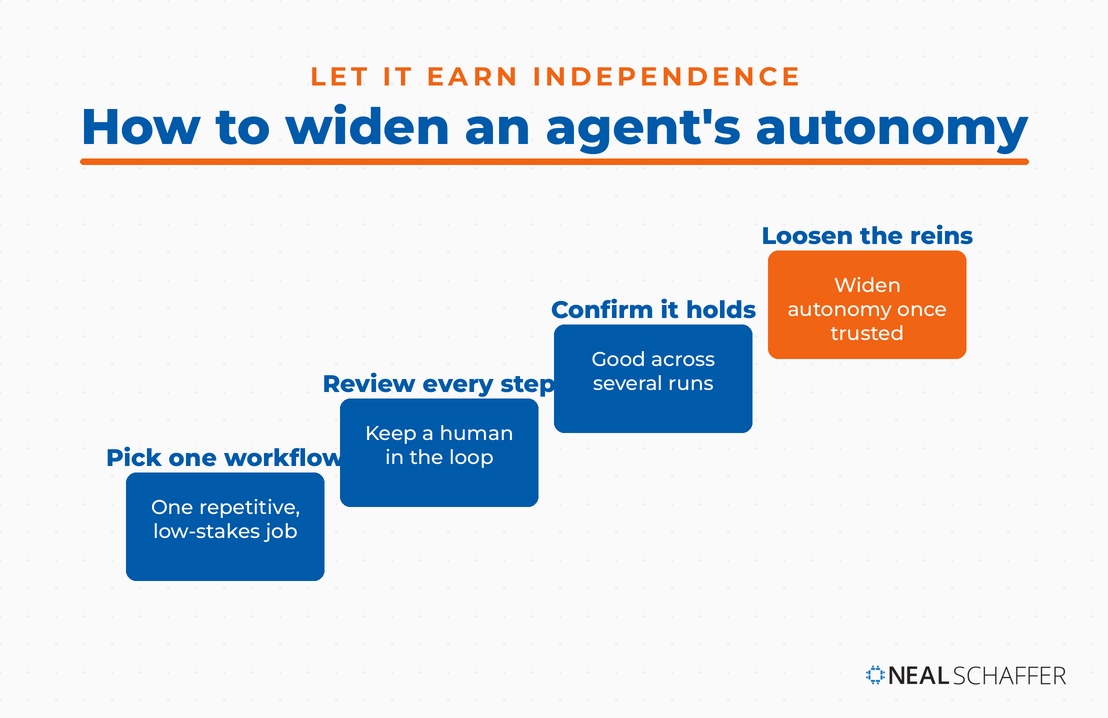 Full autonomy is where you end up, not where you begin. Pick one workflow, review every step, confirm quality holds, then widen autonomy once the agent earns your trust.
Frequently Asked Questions
What is the difference between an AI agent and automation like Zapier? Automation follows a fixed set of rules you define in advance and does the same thing every time. An AI agent reasons about a goal and decides its own steps, so it can adapt when a situation changes or a first attempt fails. Many strong setups combine both.
Do I need coding or a tool like n8n to use AI agents? No. The fastest starting point is the semi-autonomous agent already inside a tool you use, such as ChatGPT projects, Claude, or your CRM’s built-in agents. Workflow builders like n8n add power and connect more apps, but they are a later step, not a prerequisite.
Will AI agents replace marketing jobs? Current evidence points to agents handling execution while people own strategy, creativity, and judgment. The role shifts from doing every task to directing agents and deciding what good looks like. The marketers at most risk are the ones who ignore the tools entirely.
What is the safest first task to give an AI agent? Pick something repetitive, well-defined, and low-stakes, like a weekly report, a research summary, or first-draft content that you will edit. Keep yourself in the review loop, confirm the quality holds over several runs, and only then consider more autonomy.
Start With One Workflow This Week
You do not have to overhaul how you work to get value from AI agents. You need to notice that you are probably already using one, then get intentional about it. Choose a single repetitive workflow, run it with an agent while you check every step, and expand only once it earns your trust. That is the entire on-ramp.
If you want to go deeper on where this fits in your strategy, my work on AI marketing is a good next stop. Digital Threads shows how AI weaves into every channel. And if you would like hands-on help building an AI-ready marketing operation, that is exactly what I do through my fractional CMO services. Start small this week, keep a human in the loop, and let the agents handle the rest.
Actionable advice for your digital / content / influencer / social media marketing.
Join 13,000+ smart professionals who subscribe to my regular updates.