Tuesday, July 28, 2026
The most effective routine for office pain relief focuses on targeted movement every hour, plus a brief deep-tissue tool session when stiffness builds. OSHA recommends scheduling frequent short movement breaks as a primary strategy for preventing musculoskeletal strain at the desk. Start right now with these three actions:
- Seated chest opener + shoulder rolls: Interlace fingers behind your head, draw elbows back, hold briefly, then roll shoulders backward several times.
- Standing hip-flexor release or seated figure-four: Step one foot back into a mini-lunge and press the back hip forward for a short period per side. If standing is not possible, cross one ankle over the opposite knee and fold gently forward for a similar duration.
- Posture reset + brisk walk: Sit tall, chin tucked, shoulders back, feet flat. Hold briefly, then walk briskly for about a minute, even if just to the water cooler.
That is your baseline. Everything below makes it more targeted, more sustainable, and more effective.
Table of Contents
Why does movement frequency matter more than session length?
Short, frequent movement breaks interrupt static load before it accumulates into pain. Sitting locks the spine, compresses discs, and shortens hip flexors. A single long stretch session at lunch cannot undo six hours of that compression. Hourly micro-breaks prevent the buildup in the first place.
The behavioral case is just as strong. Small habits attach to existing routines more easily than large ones. Doing two shoulder rolls at the top of every hour requires no schedule change. A 45-minute mobility class requires one.
Pro Tip: Fix monitor height and lumbar support first, then add hourly movement reminders. These two ergonomic adjustments deliver the fastest return before you change anything else.
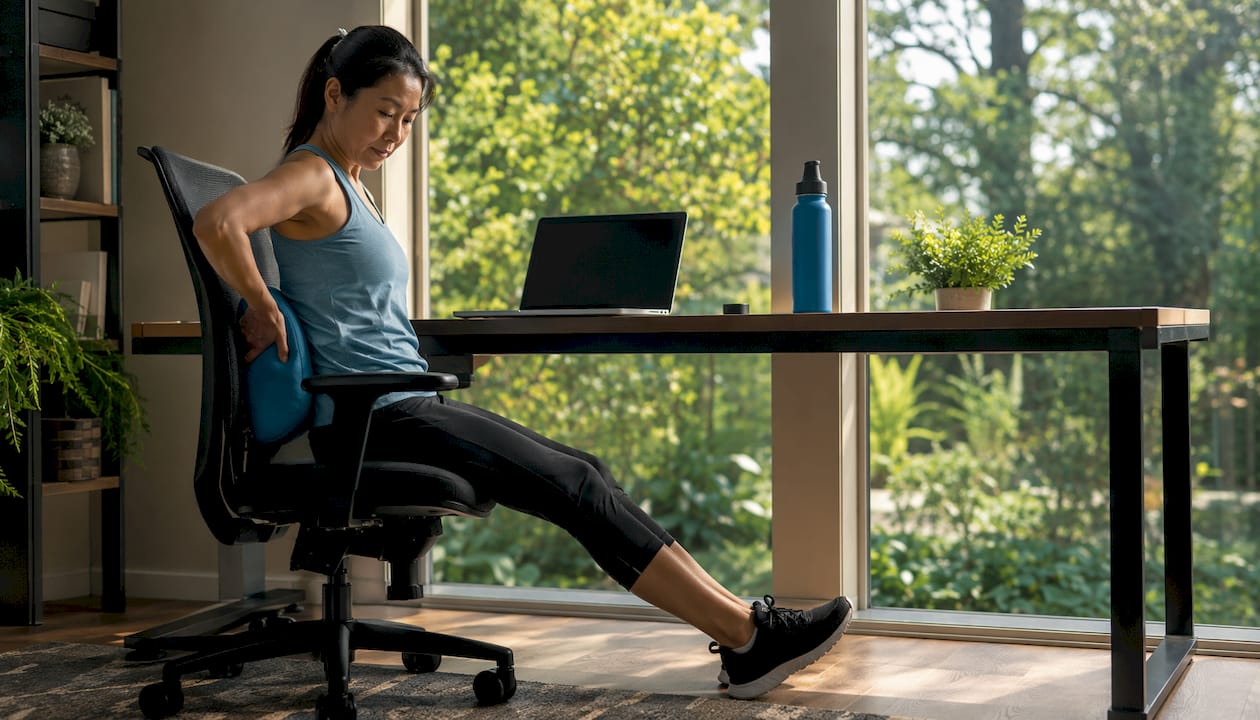
Small adjustments like raising a monitor or adding a lumbar roll yield large immediate benefits and are more practical than chasing a perfect setup. Layer micro-breaks into calendar blocks or pair them with audio-only calls so movement becomes automatic rather than aspirational.
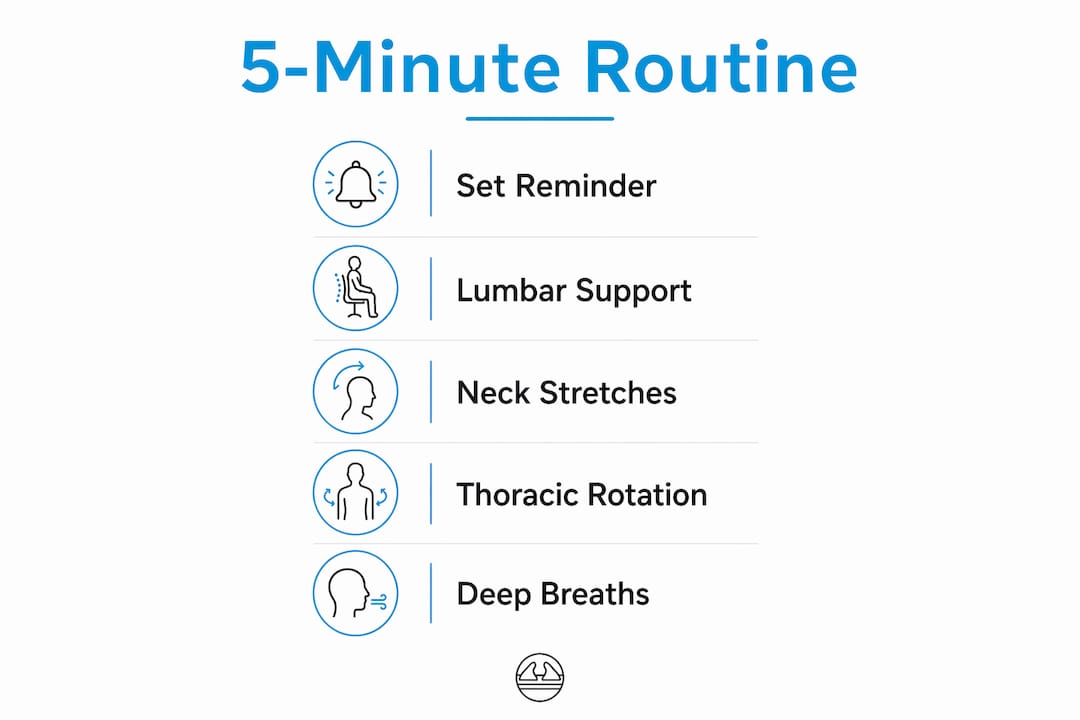
What does a 5-minute hourly office routine look like?
A consistent routine repeated every hour helps stop stiffness better than any single long workout. Here is a sequence you can do in business attire, at your desk or just beside it.
- Neck and shoulder release: Drop your ear toward your shoulder briefly, switch sides. Follow with slow shoulder shrugs.
- Seated cat-cow: Sit at the edge of your chair, hands on knees. Inhale arch your back; exhale and round your spine. Several slow breath cycles.
- Hip-flexor or figure-four stretch: Stand for the hip-flexor lunge or stay seated for the figure-four with gentle forward fold.
- Thoracic rotation: Seated, rotate your torso gently to each side with steady breath.
- Posture reset + walk: Sit tall, then walk for about a minute.
Pro Tip: Anchor this routine to a work trigger: the start of every hour, the end of a meeting, or the moment you hit “send” on a long email. Habit stacking beats willpower every time.
For seated-only variants during formal calls, skip steps 3 and 5 and extend the cat-cow and thoracic rotation to 90 seconds each.
Which stretches target the worst desk-pain hotspots?
Focus on hip flexors, thoracic extension, neck, and glutes. These four areas produce the biggest relief when addressed briefly and often, because they bear the most static load during prolonged sitting.
Hold targeted hip-flexor stretches for 20–30 seconds and repeat multiple times daily for effective relief. The same 20–30 second window applies to most of the stretches below.
- Hip-flexor lunge: Standing split stance, back heel down, pelvis tucked under. Feel the stretch at the front of the back hip. 20–30 seconds per side, twice daily minimum.
- Seated figure-four: Ankle over opposite knee, gentle forward fold. Targets the piriformis and outer glute. 30 seconds per side.
- Thoracic extension over chair back: Sit near the edge, place hands behind your head, and gently extend your upper back over the top of the chair. 15–20 seconds. Repeat 2–3 times.
- Neck lateral tilt: Ear to shoulder, 15 seconds per side, three repetitions each. Releases the levator scapulae and upper trapezius.
- Chest opener: Fingers interlaced behind the back, squeeze shoulder blades, lift sternum. Hold 20 seconds. Directly counters rounded-shoulder posture.
For neck tension relief and hip flexor work, consistency of repetition matters more than hold duration. Two or three brief sessions daily outperform one long one.
Safety note: Never force a stretch into sharp or shooting pain. Scale back pressure or skip the movement entirely if you have a recent injury, and consult a clinician before resuming if symptoms worsen.
What ergonomic fixes actually reduce daily strain?
The three highest-impact changes take under 10 minutes and cost nothing beyond what you already own. Mayo Clinic recommends placing your monitor about an arm’s length away, keeping feet flat on the floor, and supporting the lower back for long-term comfort.
- Monitor height: Center of screen should be set below eye level. Stack books or use a stand. Adjusting this can reduce forward head posture load significantly.
- Lumbar support: Roll a small towel or use a lumbar cushion at the curve of your lower back. Preserves the natural lordosis that a flat chair back collapses.
- Keyboard and mouse height: Elbows at roughly 90 degrees, wrists neutral. Raising or lowering your chair is faster than buying new equipment.
For laptop-only setups, a laptop stand plus an external keyboard is the single most cost-effective upgrade available. Laptop screens force the head down; elevating the screen to eye level fixes that immediately.
Ergonomic fixes and frequent movement are synergistic. A well-supported spine fatigues more slowly, which means your hourly micro-breaks maintain quality rather than fighting accumulated collapse.
How do you safely use the Thrival system at your desk?
Short, controlled tool sessions of 1–3 minutes per area are safe and effective when you follow pressure, positioning, and timing guidance. The Thrival base board accepts four interchangeable attachments, each matched to a specific tissue type and body region.
| Body area | Recommended attachment | Primary benefit |
|---|
| Upper back / thoracic | Wave | Broad tissue release across the thoracic spine |
| Neck / upper traps | Bullseye | Focused trigger-point pressure on tight spots |
| Glutes / hips | Ballhead | Large-muscle coverage for the glutes and outer hip |
| Psoas / deep hip flexors | Adjustable Psoas Release Tool | Targeted deep-hip and psoas release |
| Spinal arch / plantar | Arch | Spinal decompression and foot arch support |
Safety checklist before each session:
- Apply moderate, comfortable pressure. You should feel a “good hurt,” not sharp or shooting pain.
- Limit each area to 1–3 minutes. More time does not equal more benefit in a single session.
- Avoid direct tool pressure over recent surgical sites, bruised tissue, or areas with known deep vein thrombosis risk.
- Stop immediately if you feel numbness, tingling, or radiating pain.
Thrival is manufactured in the United States, carries FDA registration, and backs every tool with a lifetime warranty and free shipping. Guided routines in the Thrival app walk you through each attachment’s correct positioning, which is especially useful when you are new to non-motorized deep-tissue work.
Pro Tip: Complete a 2–3 minute mobility sequence first, then move into your Thrival tool session. Warmed tissue responds better and the risk of over-pressuring a cold muscle drops significantly.
What does a realistic daily schedule look like?
| Schedule type | Morning (start of day) | Mid-morning (mid work session) | Lunch (midday) | Mid-afternoon (2–3 PM) | End of day (5 PM) |
|---|
| Light | Posture reset + neck stretch | 5-min micro-routine | Short walk | Hip-flexor stretch | Thrival tool session (upper back) |
| Balanced | 5-min micro-routine | Thrival Bullseye (neck/traps) | Walk + thoracic extension | 5-min micro-routine | Thrival Wave (thoracic) + stretch |
| Recovery-focused | Thrival Arch (spinal) + cat-cow | 5-min micro-routine | Thrival Ballhead (glutes) + walk | 5-min micro-routine | Psoas Release Tool + full sequence |
Pair tool sessions with predictable day anchors: before lunch and at end of day are the two slots most desk workers can protect. During audio-only calls, do the seated cat-cow or thoracic rotation with your camera off. Water-break walks cover the brisk-walk step without adding any extra time.
Start with two reminders per day and build to hourly micro-breaks over two weeks. Daily gentle routines outperform aggressive, infrequent sessions for sustained improvement. For a fuller workflow integration plan, see pain relief techniques for real results.
When should you stop the routine and see a clinician?
Stop and seek care if you experience new severe pain, numbness, progressive weakness, or any loss of bowel or bladder control. These are red flags that require professional evaluation before continuing any self-directed routine.
Short-term contraindications for aggressive tool use:
- Recent surgery or open wounds in the target area
- Known or suspected deep vein thrombosis
- Acute inflammatory flare (swelling, heat, redness at the site)
- Fracture or suspected fracture
For routine soreness, stiffness, or mild aching, conservative care, including the micro-practices and tool sessions described above, is appropriate. Modify pressure downward and shorten session time rather than stopping entirely.
Key Takeaways
A frequency-first approach, combining hourly 3–5 minute movement breaks with brief targeted tool sessions, is the most sustainable routine for office pain relief.
| Point | Details |
|---|
| Set an hourly reminder | Schedule 3–5 minutes of movement every 60 minutes; 1–2 minutes per hour is an acceptable alternative. |
| Fix ergonomics first | Adjust monitor height and add lumbar support this week; these two changes deliver the fastest relief. |
| Hold stretches 20–30 seconds | Hip flexors, thoracic, neck, and glutes respond best to 20–30 second holds repeated multiple times daily. |
| Use tool sessions after movement | A 1–3 minute Thrival tool session after a mobility micro-break is safer and more effective than cold use. |
| Thrival system for desk workers | The base board with Wave, Bullseye, Ballhead, Arch, and Psoas Release Tool attachments covers every major desk-pain area. |
Why frequency-first is the only approach worth defending
The conventional advice for office pain is to “sit less and stretch more.” That framing is not wrong, but it sets the bar too high to be useful. Most desk workers cannot restructure their day around movement. What they can do is interrupt static posture for three minutes every hour, and that turns out to be enough.
What gets overlooked is the compounding effect. One micro-break does almost nothing. Twenty micro-breaks per week, done consistently for a month, change how tissue behaves, how posture defaults, and how much pain accumulates by Friday afternoon. The muscle recovery tips that actually stick are the ones that cost almost no time and attach to habits already in place.
Adding a professional-grade non-motorized tool like the Thrival system to that foundation is not about intensity. It is about precision. A broad stretch cannot reach the psoas. A Ballhead attachment can. That specificity, applied for 90 seconds after a mobility sequence, closes the gap between “I stretched today” and “I actually released the tissue that was causing the problem.”
Consistency beats intensity. Simple fixes scale better than perfect ergonomics. Start with the hourly reminder and the two ergonomic adjustments, and build from there.
Thrival makes professional-grade recovery practical for desk workers
Desk workers need a recovery tool that travels from the office to the couch without a power outlet or a gym bag. The Thrival base board with interchangeable attachments is exactly that: a non-motorized, US-manufactured system that delivers professional-grade deep-tissue work in 1–3 minute sessions.
For most desk workers, the best starting point is the Thrival Wave attachment for broad thoracic release, paired with the Bullseye attachment for targeted trigger-point work on the neck and upper traps. Add the Arch attachment for spinal decompression, the Ballhead for glutes and large muscle groups, and the Adjustable Psoas Release Tool for deep hip work. Every attachment fits the same base board. Every order ships free, carries a lifetime warranty, and comes with FDA-registered device documentation. Guided routines in the Thrival app show you exactly how to position each attachment so your first session is safe and effective. Visit Thrival.com to choose your first attachment based on where you hurt most.
This article provides general wellness information, not medical advice. Confirm any new routine with a qualified healthcare professional, especially if you have an existing injury or medical condition.
Sources and further reading
Primary research and clinical sources used in this article:
- OSHA — Guidance on scheduling 3–5 minutes of movement every 60 minutes to prevent musculoskeletal disorders.
- Harvard Health — Clinical recommendation for 20–30 second holds on hip-flexor and targeted stretches, repeated multiple times daily.
- Mayo Clinic — Office ergonomics — Monitor distance, lumbar support, and foot positioning for long-term comfort.
- PCWorld — Desk setup fixes — Monitor height and lumbar support changes achievable in 10 minutes.
- Healthline — Deskercise — Chair-friendly stretches held 10–30 seconds for circulation and stiffness.
- GMB — Desk mobility routine — Exercise selection and sequencing for 3–5 minute micro-versions of desk routines.
- Eureka Ergonomic — Dynamic sitting guide — Daily gentle routines versus infrequent aggressive sessions for sustained improvement.
- Contour Design — Ergonomic desk setup — Prioritizing monitor height and lumbar support as first ergonomic fixes.
Recommended