Thursday, June 4, 2026
Recovery routines are defined as planned, structured activities that promote muscle healing, reduce soreness, and restore physical performance between training sessions. The core reason to use recovery routines is straightforward: your muscles do not grow or strengthen during exercise. They grow during recovery. Without deliberate recovery practices, repeated training loads accumulate as fatigue, inflammation, and tissue damage that compound over time. Research confirms that active recovery accelerates repair by up to 40% compared to complete rest. Tools like foam rollers, mobility work, and targeted myofascial release techniques are the practical backbone of any effective recovery program.
Why use recovery routines to improve muscle repair and reduce soreness
The physiological case for recovery routines centers on blood circulation. When you perform low-intensity movement after training, blood flow to fatigued muscle tissue increases, delivering oxygen and nutrients that accelerate cellular repair. At the same time, metabolic waste products, including lactic acid and inflammatory byproducts, are cleared from the tissue more efficiently than they would be during passive rest.
Delayed-onset muscle soreness, commonly called DOMS, peaks 24 to 72 hours after intense exercise. Active recovery directly addresses DOMS by keeping circulation elevated without adding new stress to the tissue. Active recovery reduces DOMS by up to 40%, which means you return to full training capacity faster and with less discomfort. That is not a minor convenience. For athletes training four or more days per week, faster recovery between sessions directly translates to higher training volume over time.

Myofascial release is one of the most evidence-backed tools in this process. A 2019 Journal of Athletic Training review found that foam rolling post-workout for 10 to 15 minutes reduces soreness by 25 to 50% and improves flexibility. That improvement in flexibility matters because restricted tissue mobility is a primary contributor to compensation patterns and overuse injuries. Pairing foam rolling with targeted mobility work creates a recovery session that addresses both soreness and movement quality simultaneously.
Pro Tip: Perform your foam rolling and mobility work before checking your phone after a workout. Attaching recovery to an existing post-training habit removes the decision of whether to do it.
| Recovery method | Soreness reduction | Flexibility gain | Time required |
|---|
| Active recovery (low-intensity movement) | Up to 40% | Moderate | 20–30 minutes |
| Foam rolling (myofascial release) | 25–50% | Significant | 10–15 minutes |
| Complete passive rest | Minimal | None | N/A |
Why psychological recovery is a key part of your routine
Physical repair and mental recovery are not separate processes. Stress hormones like cortisol directly suppress tissue repair and immune function, which means psychological stress slows physical healing in measurable ways. Poor sleep compounds this further, reducing growth hormone secretion and limiting the body’s primary repair window.
Research from the University of Utah Health shows that 44% of female NCAA athletes report feeling overwhelmed during recovery, which increases re-injury risk and extends recovery timelines. That figure reflects a systemic gap in how recovery is taught. Most fitness programs address physical load management but ignore the psychological barriers that determine whether athletes actually follow through on recovery practices.
Guilt is one of the most underestimated recovery bottlenecks. Viewing a missed workout or a reduced training day as failure activates stress responses that prolong recovery compared to treating disruption as neutral. Reframing a recovery day as a productive training input, not an absence of training, is a concrete mindset shift that changes how your nervous system responds to rest.
Practical psychological recovery strategies used by high-performance athletes include:
- Mindfulness and body scanning to reduce cortisol and improve sleep quality
- Visualization of successful movement patterns to maintain neuromuscular readiness during rest periods
- Small milestone setting to maintain motivation without rushing return to full load
- Goal journaling to track recovery progress as a measurable outcome, not just a gap between workouts
- Stress auditing to identify non-training stressors that are consuming recovery resources
Pro Tip: Treat your recovery day like a scheduled training session. Write it into your calendar with specific activities listed. Pre-written recovery plans reduce decision fatigue and increase follow-through.
Active recovery vs. complete rest: which one does your body need?
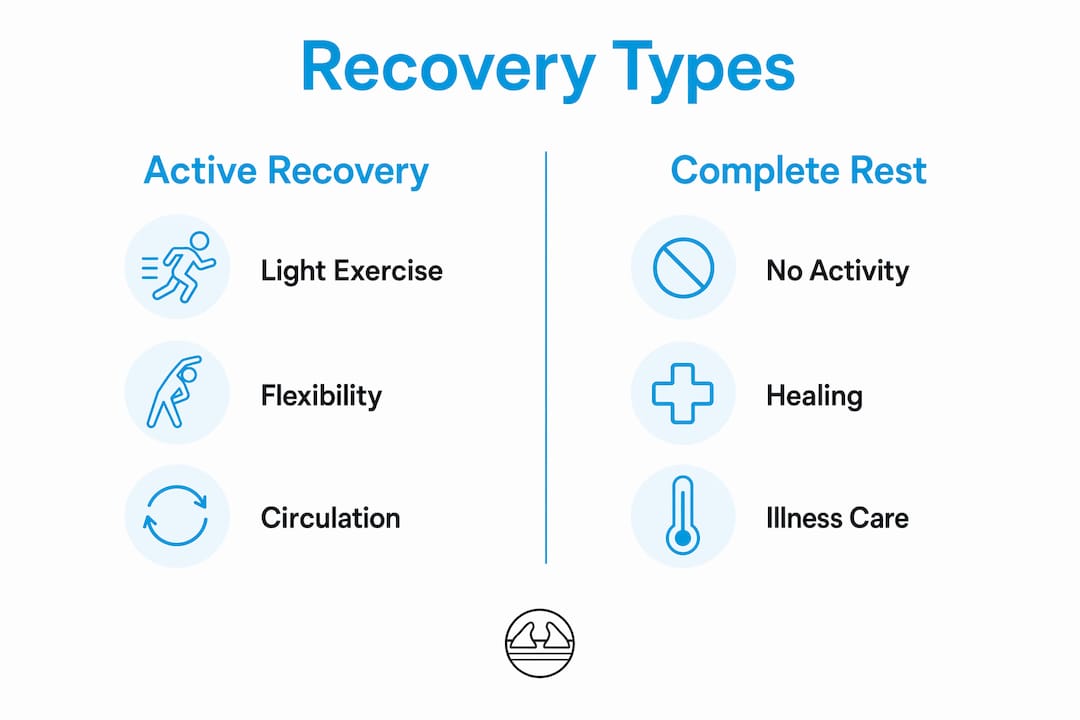
Active recovery is defined as low-intensity movement performed at 30 to 50% of maximum effort, lasting 20 to 30 minutes. Appropriate activities include gentle walking, yoga, light cycling, and swimming. The goal is to increase blood flow and support nervous system regulation without adding mechanical stress to fatigued tissue. According to NASM, active recovery manages nervous system stress while simultaneously increasing circulation, making it the superior choice for most routine recovery days.
Complete rest, meaning no structured physical activity, serves a different and more specific purpose. It is appropriate when you are dealing with acute illness, diagnosed injury, or confirmed overtraining syndrome. Using complete rest as a default recovery strategy when none of those conditions are present actually slows the repair process by leaving circulation and lymphatic drainage at resting levels.
The distinction matters practically. If you trained hard on Monday and feel general muscle fatigue on Tuesday, a 25-minute walk or a yoga session is more effective than spending the day sedentary. If you have a stress fracture or are running a fever, complete rest is the correct call. Knowing which situation you are in prevents both under-recovery and unnecessary inactivity.
| Factor | Active recovery | Complete rest |
|---|
| Best use case | General fatigue, DOMS, routine recovery days | Illness, acute injury, overtraining |
| Primary mechanism | Increases blood flow, clears waste products | Reduces all physical stress |
| Effect on soreness | Reduces by up to 40% | Minimal reduction |
| Effect on flexibility | Maintains or improves | No effect |
| Nervous system impact | Regulates and supports | Full downregulation |
Pro Tip: On active recovery days, keep your heart rate below 120 BPM. If you are breathing hard, you have crossed from recovery into training.
How to incorporate recovery routines into your fitness regimen
Building a recovery routine that actually sticks requires structure, not willpower. Jason Pullara, Director of Strength and Conditioning at Purdue University, states that recovery is proactive and foundational, built first on sleep, nutrition, and hydration before any advanced modality like cold plunges or percussion therapy. That hierarchy matters. No foam roller compensates for five hours of sleep and chronic dehydration.
Here is a practical daily recovery routine framework:
- Hydrate immediately after training. Muscle tissue is roughly 75% water. Rehydration within 30 minutes of finishing a session supports nutrient transport and waste clearance.
- Perform 10 to 15 minutes of foam rolling or myofascial release targeting the primary muscle groups used in that session.
- Complete 5 to 10 minutes of static or dynamic stretching to restore range of motion before tissue cools fully.
- Eat a protein-containing meal within 60 minutes to supply amino acids for muscle protein synthesis.
- Prioritize 7 to 9 hours of sleep. Growth hormone secretion peaks during deep sleep, making sleep the single highest-leverage recovery input available.
- Schedule 1 to 3 dedicated recovery days per week depending on training intensity. High-volume athletes need more; recreational athletes training three days per week need at least one.
Attaching recovery habits to existing routines increases consistency by using environmental cues to bypass motivation gaps. Stretching before you check your phone, foam rolling while watching film, or doing mobility work during a lunch break all work because they remove the activation energy required to start a separate recovery session.
After a training break or illness, use a graduated re-entry protocol starting at 30 to 50% of normal intensity. Returning to full load immediately after disruption overloads depleted systems and triggers secondary fatigue. Ramping back over 3 to 5 days prevents that cycle. You can find more detail on recognizing when your body needs intervention in Thrival’s guide to muscle recovery warning signs.
Common challenges in maintaining recovery routines and how to solve them
The most common reason people abandon recovery routines is not laziness. It is a lack of early education combined with the mistaken belief that more training always produces better results. Recovery is rarely taught with the same rigor as programming, which means most athletes learn its value only after an injury or a performance plateau forces the lesson.
The barriers that come up most consistently include:
- Time constraints: Recovery sessions feel like additions to an already full schedule. The fix is integration, not addition. Attach recovery to existing training bookends rather than scheduling it separately.
- Motivation dips: Motivation is unreliable. Pre-written recovery protocols remove the need for motivation by making the decision in advance. You follow the protocol, not your mood.
- Perfectionism: Missing one recovery session leads some athletes to abandon the routine entirely. Treating disruption as neutral rather than as failure is the evidence-backed approach to maintaining long-term consistency.
- Misinformation: The belief that soreness equals progress and rest equals weakness is widespread and counterproductive. Soreness is a signal, not a goal. Recovery is where adaptation happens.
The role of recovery tools for athletes is to make recovery sessions simple, targeted, and immediately beneficial. When recovery feels effective and takes less than 20 minutes, adherence increases significantly.
Key takeaways
Recovery routines accelerate muscle repair, reduce soreness, and sustain performance by combining physical and psychological strategies that work together, not in isolation.
| Point | Details |
|---|
| Active recovery outperforms rest | Low-intensity movement reduces DOMS by up to 40% and clears metabolic waste faster than passive rest. |
| Psychological recovery is physical | Stress and guilt slow tissue repair; reframing recovery as productive training input speeds return to performance. |
| Habit stacking drives consistency | Attaching recovery to existing post-workout habits removes motivation barriers and increases follow-through. |
| Sleep is the highest-leverage input | Growth hormone peaks during deep sleep, making 7 to 9 hours the most impactful recovery tool available. |
| Graduated re-entry prevents relapse | Starting at 30 to 50% intensity after a break protects depleted systems and avoids secondary burnout. |
Recovery is training: a perspective worth defending
I have worked with enough fitness content to recognize a pattern. Athletes who plateau or get injured are almost never under-training. They are under-recovering. The training stimulus is there. The adaptation is not, because the body never gets the conditions it needs to complete the repair cycle.
What frustrates me about mainstream fitness culture is that recovery is still treated as optional, something you do when you have extra time or when something hurts. That framing is backwards. Recovery is where the results of your training actually materialize. The workout is the stimulus. Recovery is the response. Without the response, the stimulus is just damage.
The psychological piece is the part most people skip entirely. I have seen athletes obsess over their macros and their split programming while running on six hours of sleep and carrying unmanaged stress from work. The cortisol load alone is enough to blunt most of the adaptation signal. Addressing sleep, stress, and recovery mindset is not soft advice. It is physiology.
My honest recommendation is to start with the simplest possible recovery habit and make it non-negotiable. Ten minutes of foam rolling after every session. Seven hours of sleep as a hard floor. One active recovery day per week. Build from there. Consistency with simple habits outperforms occasional perfection with complex ones every time.
— Cameron
If you are serious about putting these recovery principles into practice, the right tools make the difference between a routine you maintain and one you abandon.

The Thrival Deep Tissue Pro is a non-motorized, US-manufactured recovery system built around a single base board with interchangeable attachments, including the Wave, Bullseye, Arch, and Ballhead. Each attachment targets a specific muscle group, from the thoracic spine to the hips and shoulders, giving you professional-grade myofascial release without a clinic visit. The Thrival app pairs with the system to guide you through targeted routines so you are never guessing where to apply pressure. Free shipping, a lifetime warranty, and FDA registration back every purchase.
FAQ
What are recovery routines and why do they matter?
Recovery routines are structured post-training activities, including foam rolling, mobility work, hydration, and sleep, designed to accelerate muscle repair and reduce soreness. They matter because adaptation to training occurs during recovery, not during the workout itself.
How often should you do active recovery?
Most athletes benefit from 1 to 3 active recovery days per week, depending on training volume and intensity. Active recovery sessions should last 20 to 30 minutes at 30 to 50% of maximum effort.
Does foam rolling actually reduce muscle soreness?
A 2019 Journal of Athletic Training review confirmed that foam rolling for 10 to 15 minutes post-workout reduces soreness by 25 to 50% and improves flexibility, making it one of the most evidence-supported recovery tools available.
When is complete rest better than active recovery?
Complete rest is appropriate during acute illness, diagnosed injury, or confirmed overtraining syndrome. For general fatigue and DOMS, active recovery produces better outcomes by maintaining circulation and clearing metabolic waste.
How do you build a recovery routine you will actually stick to?
Attach recovery activities to existing habits, such as stretching before checking your phone after a workout, and write your recovery sessions into your schedule in advance. Pre-written protocols reduce decision fatigue and increase consistency during low-motivation periods.
Recommended