Wednesday, June 10, 2026
Hip mobility is the active control of your hip joint through its full range of motion, and it is one of the most critical factors in maintaining pain-free movement, preventing injury, and sustaining physical performance across every stage of life. Most people treat the hips as a passive structure, something that just holds you upright. That assumption costs them. Tight, undercontrolled hips are a leading driver of lower back pain, knee strain, and movement dysfunction that compounds over time. Understanding the importance of hip mobility is the first step toward doing something about it.
Why hip mobility matters for movement and injury prevention
The hip joint functions as the primary transfer station in your body’s kinetic chain. Every force generated from the ground up through your legs must pass through the hips before reaching the spine. When that transfer is clean and controlled, movement is efficient. When it is not, the body compensates.
Compensation patterns are the root cause of most overuse injuries in active people. When the hip cannot rotate, flex, or extend through its full range, the lumbar spine picks up the slack. The knees rotate inward to compensate for limited hip internal rotation. The IT band tightens as the glutes disengage. These are not isolated problems. They are predictable consequences of restricted hip function.
Common injuries directly linked to poor hip mobility include:
- IT band syndrome caused by lateral hip weakness and limited internal rotation
- Patellofemoral pain (runner’s knee) driven by femoral adduction the hip fails to control
- Chronic lower back pain from lumbar spine overcompensating for immobile hips
- Hip flexor strains in runners and cyclists from repetitive motion without adequate range
Strong, mobile hips reduce strain on the lower back and knees while enhancing athletic output. This is not a marginal benefit. It is structural protection built into how your body is designed to move.
Pro Tip: If you experience recurring lower back tightness after workouts, test your hip internal rotation before assuming the spine is the problem. Restricted rotation is often the hidden driver.
Is hip mobility the same as hip flexibility?
Flexibility and mobility are not interchangeable, and confusing them leads to training approaches that produce temporary relief at best. Flexibility refers to the passive length of a muscle, how far it can be stretched when an external force is applied. Mobility is active. It is the ability to move your joint through a range of motion under your own muscular control.
You can have flexible hamstrings and still have poor hip mobility. A gymnast who can do a full split but cannot control a single-leg squat demonstrates this gap clearly. Static stretching alone does not produce lasting mobility improvements because the nervous system continues to guard the new range it perceives as unsafe.
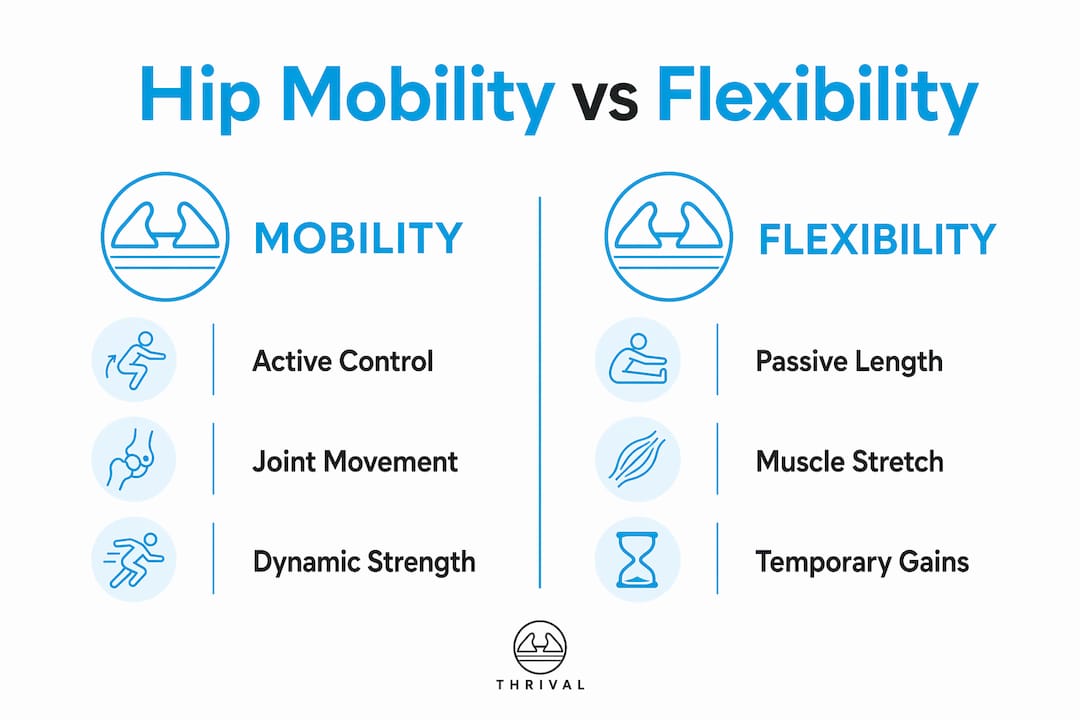
This is the concept of neuromuscular guarding. Your nervous system restricts access to ranges of motion it does not trust you to control. Stretching opens the door temporarily. Strengthening through that new range tells the nervous system the door is safe to walk through permanently. That distinction is why mobility requires retraining movement patterns and nervous system control, not just adding more stretching volume.
The practical difference looks like this:
- Flexibility training: Passive hip flexor stretch held for 60 seconds
- Mobility training: Controlled hip CARs (controlled articular rotations) through full range with active muscular engagement
- Mobility training: Deep squat holds with active posterior tilt to build end-range strength
- Mobility training: Single-leg Romanian deadlifts to reinforce hip hinge control
Pro Tip: After any passive stretch, follow it immediately with an active movement through the same range. This signals to the nervous system that the new length is usable, not just temporary.
How does hip mobility affect aging and fall prevention?
Hip mobility is not just a performance concern. For adults over 60, it is a direct determinant of independence. Maintaining hip mobility in aging adults improves balance and reduces fall risk, making daily tasks safer and easier. Falls are the leading cause of injury-related death in adults over 65 in the United States, and hip strength and controlled movement are among the most modifiable risk factors.
The mechanism is straightforward. When hip abductors and external rotators are weak, the pelvis drops during single-leg stance, a movement pattern required every time you take a step. That pelvic instability forces compensatory trunk lean, shifts your center of gravity, and increases the probability of losing balance. Restoring hip mobility and strength corrects this chain reaction at its source.
Practical steps for aging adults to prioritize hip mobility:
- Side-lying clamshells to activate hip abductors without joint loading
- Seated hip circles to maintain joint capsule mobility in those with limited standing balance
- Standing hip hinge practice with a wall for feedback to reinforce posterior chain engagement
- Step-up progressions to build single-leg hip stability under controlled load
- Supine hip 90/90 stretches combined with active holds to build end-range strength
The goal is not flexibility for its own sake. The goal is controlled, confident movement that supports daily function, from climbing stairs to getting up from a chair without assistance.
How to improve hip mobility beyond stretching
Effective hip mobility training follows a three-phase sequence: joint preparation, mobilization of restricted areas, and stabilization of new ranges through strengthening. This structured approach is necessary for lasting adaptation. Skipping stabilization is why most people who stretch consistently still feel tight six months later.
The key muscle groups that govern hip function include the glutes (maximus, medius, and minimus), hip flexors (iliopsoas and rectus femoris), deep external rotators (piriformis, obturator group), and adductors. Each group must be both mobile and strong. An imbalance in any one of them alters the mechanics of the entire joint.
| Approach | What it targets | Lasting results? |
|---|
| Static stretching only | Passive muscle length | Temporary |
| Joint mobilization | Joint capsule stiffness | Yes, with repetition |
| Active mobility drills | Neuromuscular control | Yes |
| Strength through range | End-range stability | Yes, most durable |
Joint capsule stiffness is a distinct problem from muscle tightness. Prolonged sitting tightens the hip joint capsule itself, not just the surrounding muscles. This requires targeted joint mobilization, not more stretching. If you sit for more than six hours a day, your hip capsule is almost certainly contributing to your restricted range.
Hypermobility is the other end of the spectrum and carries its own risks. Joints that move too freely without muscular support are unstable and injury-prone. The goal is always mobility and recovery in balance: full range of motion backed by strength at every point in that range.
Pro Tip: If your hips feel tight after long runs or cycling sessions, the issue is often overworked hip flexors combined with underactive glutes. Address the hip flexor overload before adding more stretching volume.
How hip mobility connects to posture and chronic pain
The relationship between hip mobility, lumbar spine mechanics, and chronic pain is well-documented. Dr. Stuart McGill’s research identifies the hips as the kinetic chain’s primary transfer station, meaning the lumbar spine compensates immediately when hip movement is restricted. That compensation increases spinal load and creates the conditions for chronic pain.
Limited hip extension is one of the most common patterns seen in desk workers and runners alike. When the hip cannot fully extend during walking or running, the lumbar spine hyperextends to complete the movement. Over time, this produces facet joint irritation, disc stress, and the persistent lower back tightness that most people attribute to “sitting too much” without identifying the actual mechanical cause.
Knee pain follows a similar logic. Restricted hip internal rotation causes the femur to adduct and internally rotate during loading, increasing stress on the medial knee and patellofemoral joint. Many common aches that present as knee or back problems are actually hip dysfunction in disguise.
“Targeted hip strengthening programs improve function more significantly than stretching alone. In strength-focused groups, 80% of participants reported significant functional improvements in individuals with low back pain.”
That finding reframes how you should approach back pain. Stretching the back is not the primary solution. Strengthening the hips is. For practical guidance on combining these approaches, the Thrival guide on back pain relief outlines exercises that address the hip-spine relationship directly.
Key takeaways
Hip mobility is the active, controlled movement of the hip joint, and it is the foundation of pain-free movement, injury prevention, and long-term physical function.
| Point | Details |
|---|
| Mobility vs. flexibility | Mobility requires active muscular control; flexibility alone does not prevent injury or improve function durably. |
| Kinetic chain impact | Restricted hips force the lumbar spine and knees to compensate, causing chronic pain in both areas. |
| Aging and fall risk | Hip strength and mobility directly reduce fall risk and preserve independence in adults over 60. |
| Strengthening over stretching | 80% of participants in hip strengthening programs reported significant functional gains vs. stretching-only approaches. |
| Joint capsule stiffness | Prolonged sitting tightens the hip joint capsule itself, requiring targeted mobilization beyond muscle stretching. |
Why I think most people are solving the wrong hip problem
I have watched people spend years stretching their hip flexors without meaningful improvement. They foam roll, they do pigeon pose, they add 10 minutes of stretching before every workout. And six months later, they describe the exact same tightness. The reason is almost always the same: they are treating a control problem like a length problem.
The hips are not tight because the muscles are short. They are restricted because the nervous system does not trust the range. Until you build strength through the ranges you are trying to access, the nervous system will keep guarding them. That is not a flexibility deficit. That is a neuromuscular one.
What actually works, in my experience, is pairing every passive stretch with an active drill immediately after. Hip 90/90 stretch followed by active hip rotation holds. Couch stretch followed by single-leg glute bridges. The passive work creates the window. The active work keeps it open. This combination, along with physical activity for longevity, is what separates people who make lasting progress from those who stay stuck in the same cycle.
The other thing most people miss is that hypermobility is a real risk. More range is not always better. If your hips move freely but your glutes and rotators cannot control that movement under load, you are setting up for instability injuries, not preventing them. The goal is always strength through range, not range alone.
— Cameron
Support your hip mobility with Thrival

Releasing tight hip flexors and deep rotators requires more than stretching. Thrival’s deep tissue tools are designed to target the specific muscle groups that restrict hip mobility, including the iliopsoas, piriformis, and glute complex, with precision that foam rollers cannot match. The Thrival Deep Tissue Pro uses interchangeable attachments like the Bullseye and Arch to apply targeted pressure directly to tight spots around the hip and lower back. For focused relief on the hip flexors and surrounding tissue, the Thrival Relief Pro delivers professional-grade muscle release in a portable, non-motorized system. Both tools are FDA-registered, US-manufactured, and backed by a lifetime warranty.
FAQ
What is hip mobility and why does it matter?
Hip mobility is the active, controlled ability to move your hip joint through its full range of motion. It matters because restricted hip mobility forces the lumbar spine and knees to compensate, leading to chronic pain and injury.
Can stretching alone improve hip mobility?
Static stretching alone does not produce lasting mobility improvements because the nervous system continues to guard ranges it perceives as unsafe. Strengthening through new ranges is required to make gains permanent.
How does poor hip mobility cause lower back pain?
When the hip cannot move freely, the lumbar spine compensates by increasing its own movement, which raises spinal load and leads to chronic pain. Dr. Stuart McGill’s research identifies this hip-spine compensation as a primary driver of back dysfunction.
What hip mobility exercises are most effective?
Controlled articular rotations (CARs), hip 90/90 active holds, single-leg Romanian deadlifts, and deep squat progressions are among the most effective because they combine range of motion with active muscular control.
Does hip mobility matter for older adults?
Hip mobility is critical for older adults. Strong, mobile hips improve balance, reduce fall risk, and preserve the ability to perform daily tasks independently, making it one of the highest-priority areas for healthy aging.
Recommended