Sunday, May 24, 2026
If you live with chronic muscle pain or persistent tension, you’ve likely heard the term myofascial release thrown around. Many people assume it’s just another form of massage. It isn’t. Myofascial release therapy targets a specific biological structure — fascia — using sustained pressure techniques that are fundamentally different from traditional massage strokes. Understanding what sets it apart can completely change how you approach pain management, which muscles you focus on, and what kind of relief is actually possible for you.
Table of Contents
Key takeaways
| Point | Details |
|---|
| Fascia drives many pain patterns | Fascial restrictions from trauma or posture can cause chronic pain that doesn’t respond to standard massage. |
| Sustained pressure is the core principle | Effective myofascial release therapy holds pressure for 90 to 120 seconds per site, not rhythmic strokes. |
| MFR works best as adjunct therapy | Research shows myofascial release is most effective when combined with exercise and physical rehabilitation. |
| Self-myofascial techniques have real value | Foam rollers, massage boards, and targeted tools can extend the benefits of professional MFR between sessions. |
| Realistic expectations matter | Results vary by condition and individual; multimodal care including education and movement produces the best outcomes. |
Understanding fascia and the myofascial system
Before defining myofascial release, you need to understand what fascia is. Fascia is a dense, fibrous connective tissue that surrounds and permeates your muscles, bones, nerves, and organs. Think of it as a three-dimensional web that holds your entire body together and gives it structural continuity. Every muscle fiber you have is wrapped in fascia at multiple levels, from the individual fiber to the whole muscle group.
What makes fascia clinically significant for chronic pain sufferers is how it responds to stress. Trauma, poor posture, repetitive movement patterns, and inflammation all cause fascia to tighten, thicken, and form adhesions. These adhesions are essentially areas where fascial layers that should glide freely get stuck together. Because fascia forms a 3D interconnected system, a restriction in one area can create tension and pain in an entirely different region of the body.
This explains something that frustrates a lot of people with chronic pain: you can have significant discomfort in your shoulder even though the real source of restriction is in your upper back or chest. Fascia doesn’t follow the neat anatomical boundaries that most people expect.
Here’s what happens when fascia becomes restricted:
- Reduced gliding between tissue layers limits joint range of motion
- Compressed nerves and blood vessels within fascial compartments can cause local and referred pain
- Altered movement mechanics increase load on joints and surrounding muscles
- Fascial tension activates nociceptors (pain receptors), contributing to heightened pain sensitivity
Pro Tip: If your chronic pain doesn’t respond to stretching or conventional massage, fascial restrictions may be the underlying cause. Ask a physical therapist or myofascial specialist specifically about fascial assessment, not just muscle testing.
What myofascial release therapy involves
Manual MFR is defined as therapist-delivered hand techniques that apply sustained compression, shear, or traction to modify fascial tissue behavior and mobility. The 2026 Frontiers in Physiology review makes a clear distinction: MFR is not rhythmic, it is not lubricant-based, and it does not involve the sliding strokes characteristic of Swedish or deep tissue massage.
Here’s what a standard manual MFR session typically involves:
- Evaluation. The therapist assesses your posture, movement patterns, and areas of fascial restriction. The site treated may not be where you feel pain, because referred pain patterns are common.
- Positioning. You are positioned to place the target tissue in a specific orientation that allows optimal access and tension.
- Pressure application. The therapist applies a light to moderate load into the fascial restriction, then waits. There is no forcing, no pushing through resistance.
- Sustained hold. Pressure is held for 90 to 120 seconds per site. This duration is not arbitrary — it reflects the time required for viscoelastic tissue to respond and begin releasing.
- Follow-up and sequencing. The therapist reassesses and moves through connected fascial regions, often treating a chain of tissue rather than a single isolated spot.
Pro Tip: When evaluating a therapist, ask directly: “How long do you hold pressure at each site?” If the answer is less than 90 seconds, their approach may be closer to Swedish massage than true myofascial release.
Beyond manual therapy delivered by a clinician, there is a secondary category: self-myofascial release (SMR). Tools like foam rollers, massage balls, and specialized device-based boards fall into this group. The role of self-myofascial techniques differs from primary MFR in that the force is applied through a device rather than directly by trained hands. Still, SMR tools provide genuine benefit when used consistently and correctly.

One safety note: certain conditions rule out myofascial release entirely. Medical screening before MFR is critical because conditions like deep vein thrombosis, active cancer, aneurysms, and uncontrolled hypertension carry real complication risks. Always disclose your full health history to any practitioner before beginning therapy.
What the science says about MFR effectiveness
The evidence on myofascial release is honest: promising, but not conclusive on its own. Here’s what recent research actually shows.
MFR consistently demonstrates benefit when used alongside other treatments. A 2025 systematic review on knee osteoarthritis found mixed but meaningful benefits when MFR was combined with exercise or conventional physical therapy, including improvements in pain scores and range of motion. Studies on low back pain show similar patterns: adjunctive MFR improves outcomes that exercise or manual therapy alone does not fully address.
The mechanisms driving these effects are not a single structural fix. A 2026 Frontiers in Physiology analysis explains that MFR effects span multiple pathways: mechanical changes in fascial glide, modulation of nociceptor activity, and shifts in autonomic nervous system tone. That last point is particularly relevant for people with chronic pain, because the autonomic nervous system plays a significant role in how the body amplifies or dampens pain signals.
Key evidence-based points on what MFR realistically delivers:
- Pain reduction. Moderate evidence supports reduced pain intensity in conditions including myofascial pain syndrome, which by definition lasts six or more months and typically requires multimodal management.
- Range of motion. Multiple trials report improved joint mobility and tissue extensibility after MFR, particularly in the lumbar and cervical spine.
- Muscle function. Some studies report improved muscle activation patterns and reduced protective tension following fascial release.
- Variability. Outcomes differ widely based on therapist training, session frequency, condition severity, and whether MFR is combined with active rehab.
The practical takeaway: MFR is not a cure. It is a high-value input that helps your body reduce restriction and pain. But without movement, strengthening, and lifestyle changes, the benefits are likely to be temporary. You can review evidence-based benefits of soft tissue release to see how fascia-targeted work fits within a broader recovery picture.
Integrating MFR into your chronic pain plan
Knowing what myofascial release is only helps if you can apply it well. Here’s how to build it effectively into your pain management approach.
Finding the right therapist. Look for physical therapists, osteopaths, or massage therapists who have specific training in myofascial release, not just general manual therapy. Confirm they use standardized pressure and duration protocols, specifically the 90 to 120 second hold standard used in clinical research. Credentials matter, but so does asking the right questions about their specific technique.
Using self-myofascial release tools. SMR tools are appropriate for maintenance between professional sessions, for mild restrictions, and for areas you can access safely on your own. The role of self-myofascial techniques is not to replace professional care but to extend its effects. Tools with targeted attachments allow you to apply precise pressure to areas like the thoracic spine, hips, and neck more effectively than a standard foam roller.
- Start with lighter pressure and longer holds, not aggressive grinding across tissue
- Target one area at a time and pause on tender spots rather than rolling continuously
- Combine SMR with gentle movement immediately after to reinforce fascial mobility
Building a multimodal plan. Chronic myofascial pain syndrome responds best to combined care. Pair your MFR sessions with corrective exercise, ergonomic adjustments at your workstation, and education about pain neuroscience. This combination addresses the mechanical, neurological, and behavioral drivers of your pain simultaneously.
- Avoid overdoing SMR. Two to four sessions per week on any given area is enough.
- Track your symptoms. If pressure during self-release consistently increases your pain (rather than producing the temporary discomfort typical of fascial work), stop and consult a professional.
- Involve your other providers. Let your physician or physical therapist know you’re incorporating MFR so they can coordinate care appropriately.
Pro Tip: Pair your self-myofascial release sessions with diaphragmatic breathing. Slow, deep breaths during sustained pressure help shift your nervous system toward a parasympathetic state, which makes fascial tissue more receptive to release.
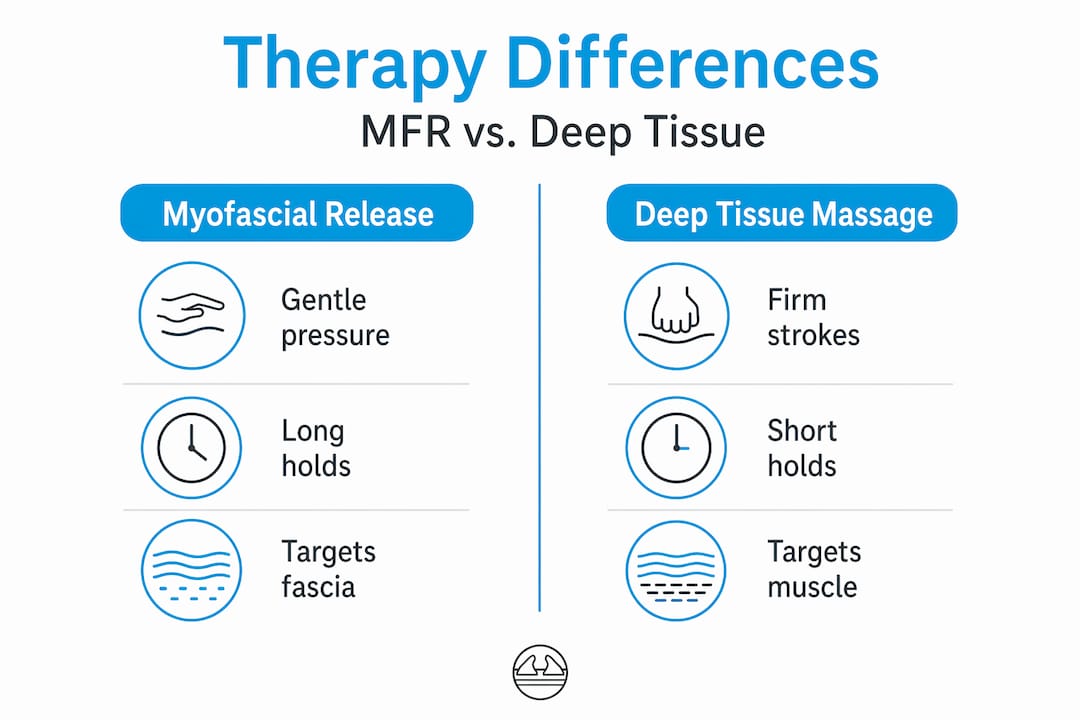
People frequently confuse myofascial release with deep tissue massage and trigger point therapy. They are related but distinct. Here’s a direct comparison to help you decide which approach fits your situation.
| Therapy | Pressure type | Hold duration | Primary target | Best for |
|---|
| Myofascial release | Sustained, low to moderate | 90 to 120 seconds | Fascial restrictions across tissue chains | Chronic restriction, referred pain, reduced mobility |
| Deep tissue massage | Rhythmic, moderate to deep | Seconds per stroke | Muscle belly and deeper soft tissue | Acute muscle tension, post-workout recovery |
| Trigger point therapy | Direct, focused pressure | 10 to 30 seconds | Hyperirritable nodules in muscle | Localized pain referral from specific trigger points |
| Self-myofascial release | Device-delivered, variable | User-controlled | Fascial and superficial muscle layers | Home maintenance, general recovery support |
The differences matter in practice. Deep tissue massage and MFR address overlapping problems but use different mechanisms. Deep tissue massage moves through tissue; MFR waits for tissue to change. Trigger point therapy targets discrete painful nodules; MFR addresses the broader fascial system those nodules are embedded in.
Many effective treatment programs use all three in sequence: MFR to address fascial restriction, trigger point work for specific nodule pain, and soft tissue massage for overall muscle recovery.
My perspective on MFR and chronic pain management
I’ve worked with enough people managing chronic muscle pain to know that myofascial release generates two common responses: people either expect it to fix everything, or they dismiss it because it doesn’t feel like “real” treatment. Both positions miss the point.
In my experience, MFR is most powerful when people stop treating it as a standalone intervention and start treating it as one essential input in a larger system. The patients I’ve seen make the most meaningful progress combine professional fascial work with consistent self-care, targeted exercise, and honest attention to the postural and behavioral habits that created the restrictions in the first place.
What I’ve also learned is that individual response varies significantly. Two people with nearly identical diagnoses can respond completely differently to the same protocol. This isn’t a failure of the therapy. It reflects the complexity of the fascial system and the fact that chronic pain is never purely mechanical. Neurological sensitivity, stress load, sleep quality, and movement history all influence outcomes.
My honest take: don’t wait for a perfect protocol. Start with a thorough evaluation from a qualified practitioner, be specific about your symptoms and history, and commit to the combination of professional and self-care. That’s where the real results come from.
— Cameron
Support your recovery with Thrival

If you’re ready to extend the benefits of myofascial release between professional sessions, Thrival’s recovery system was built for exactly that. The Thrival Deep Tissue Pro is a non-motorized base board designed for targeted fascial and muscle release at home. You select from specialized attachments based on the area you want to treat. The Bullseye attachment delivers pinpoint pressure for focused fascial work, while the Arch attachment targets the spinal regions and larger muscle groups effectively. All tools are US-manufactured, FDA-registered, and backed by a lifetime warranty. Free shipping, a dedicated app with guided routines, and professional-grade durability make Thrival a practical, reliable part of any chronic pain management plan.
FAQ
What is myofascial release in simple terms?
Myofascial release is a manual therapy technique that applies slow, sustained pressure to the fascia (the connective tissue surrounding your muscles) to reduce restrictions, relieve pain, and restore mobility. Unlike traditional massage, it holds pressure for 90 to 120 seconds rather than using rhythmic strokes.
What is fascia and why does it matter for pain?
Fascia is a dense connective tissue that wraps around every muscle, nerve, and organ in your body. When it becomes tight or restricted due to injury, posture, or stress, it can cause pain, reduced range of motion, and referred discomfort in areas away from the actual restriction.
How does myofascial release work differently from deep tissue massage?
Myofascial release uses sustained, stationary pressure held for 90 to 120 seconds to allow fascial tissue to release, while deep tissue massage uses firm rhythmic strokes through muscle tissue. They target overlapping issues but through different mechanisms and are often used together for best results.
Is myofascial release effective for chronic pain?
Research shows MFR produces meaningful benefits for conditions like low back pain, myofascial pain syndrome, and knee osteoarthritis, particularly when combined with exercise and physical therapy. Used alone, results vary; combined with active rehabilitation, it consistently improves pain and mobility outcomes.
Can I do myofascial release on my own at home?
Yes. Self-myofascial release tools like massage boards and targeted attachments allow you to apply sustained pressure to accessible areas between professional sessions. The key is holding pressure on tight spots for adequate time rather than rolling quickly, and staying within a pressure level that is firm but not acutely painful.
Recommended