Wednesday, May 27, 2026
You push through a tough workout, feel great afterward, and wake up the next morning barely able to walk down stairs. That stiffness and aching is muscle soreness, and despite what many people still believe, lactic acid has almost nothing to do with it. What is muscle soreness, really? It’s a normal physiological response to physical stress on your muscles. Whether you’re returning to exercise after a break, trying a new movement pattern, or pushing intensity beyond your usual range, your muscles are telling you they’re adapting. Understanding why it happens and how to manage it makes all the difference.
Table of Contents
Key Takeaways
| Point | Details |
|---|
| DOMS appears after exercise | Soreness typically begins 24–48 hours post-workout and peaks within 1–3 days. |
| Lactic acid is a myth | Microscopic muscle fiber damage and inflammation cause DOMS, not lactic acid buildup. |
| Soreness vs. injury matters | Sharp pain during movement or soreness lasting over a week signals possible injury, not normal DOMS. |
| Recovery is multimodal | Combining rest, hydration, massage, and cold-water immersion works better than any single method. |
| Prevention starts with progression | Gradual increases in training load and proper warm-ups significantly reduce soreness severity. |
What is delayed onset muscle soreness?
Muscle soreness after a workout comes in two forms. The first type hits immediately after exercise and fades within a few hours. The second type is delayed onset muscle soreness (DOMS), and it’s far more common and often more intense. DOMS typically starts 24–48 hours after intense or unfamiliar exercise, peaks between one and three days later, then gradually improves as the muscles heal.
The symptoms of DOMS are distinctive. You’ll notice:
- Muscle stiffness that makes normal movement feel restricted, especially first thing in the morning
- Tenderness to the touch, where even light pressure on the affected muscle causes discomfort
- A dull, persistent ache that differs from the sharp sensation of an acute injury
- Temporary weakness in the affected muscles, which can reduce strength and range of motion for a day or two
- Mild swelling in some cases, particularly after very intense training sessions
What actually causes this? Microscopic muscle fiber damage and inflammation drive DOMS, not the lactic acid buildup you may have heard about for years. During intense exercise, especially with unfamiliar movements, small tears develop in muscle fibers. Your immune system responds with inflammation, and nerve endings called nociceptors become sensitized. That sensitivity is what you feel as soreness.
A key trigger is eccentric muscle action, which means the muscle is lengthening while under tension. Lowering weights, downhill running, lunges, and jump landings are classic examples. The lowering phase of a biceps curl stresses the muscle far more than the lifting phase. This is why a long hike downhill can leave your quads more sore than an uphill climb at the same distance.
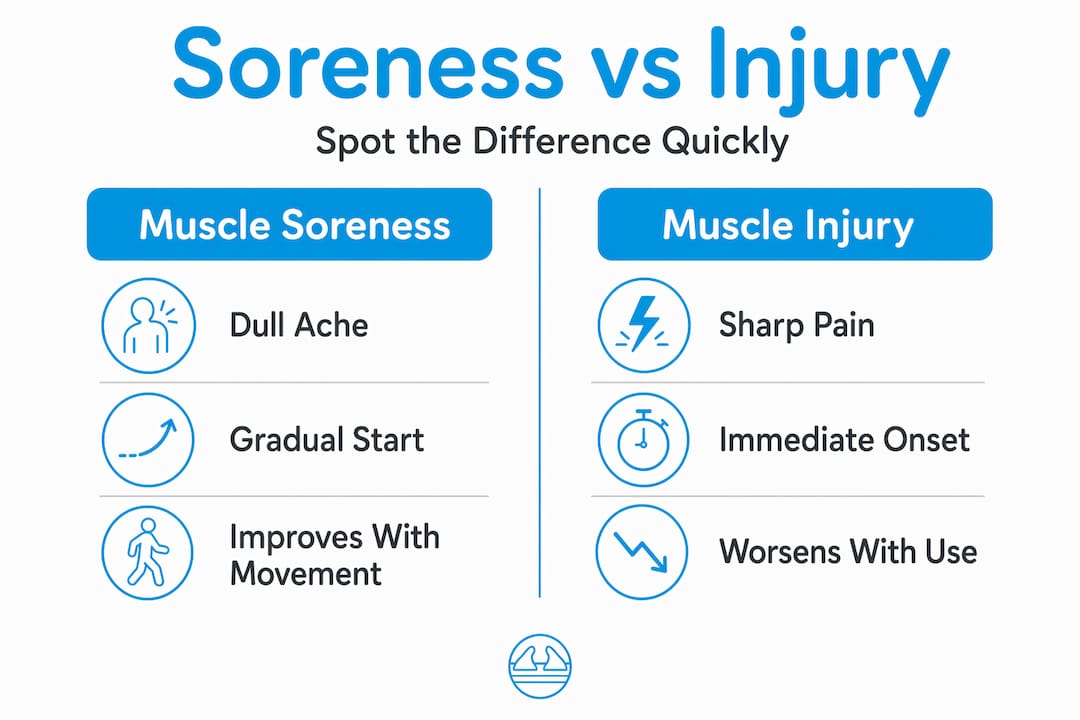
Pro Tip: If your soreness feels like a dull ache that started a day after your workout and improves when you move around gently, that’s DOMS. If you feel sharp, stabbing pain during a specific movement or at rest, stop exercising and assess for possible injury.
Soreness versus actual injury
Explaining delayed onset muscle soreness is straightforward once you understand the timeline. But knowing the difference between normal soreness and a real injury could protect you from making a minor problem significantly worse.
DOMS pain develops with a delay and lessens gradually. An acute injury typically produces sharp, immediate pain at the moment it happens. That contrast in timing is one of the most reliable indicators you have.
Here’s a side-by-side comparison to clarify what you’re dealing with:
| Feature | Normal muscle soreness (DOMS) | Possible muscle injury |
|---|
| Pain onset | 24–48 hours after exercise | Immediate, during or right after activity |
| Pain quality | Dull ache, generalized | Sharp, localized, stabbing |
| Duration | Typically resolves in 3–5 days | Can persist or worsen without treatment |
| Response to movement | Mild activity often eases discomfort | Movement usually aggravates pain |
| Visible signs | Mild swelling possible | Bruising, significant swelling, visible deformity |
| Strength impact | Temporary, mild reduction | Significant, persistent weakness |
Soreness that persists beyond a week or worsens is a warning sign. At that point, you’re likely dealing with a muscle strain or something that needs medical evaluation, not more time or more training.
Other red flags to take seriously include sharp pain during a specific movement, visible bruising that appears within hours, swelling concentrated in one area, and any sensation of something “popping” or “tearing.” Distinguishing injury from DOMS relies on tracking pain onset, pain quality, how it progresses, and whether your strength is coming back or declining. When in doubt, stop training the affected area and consult a healthcare provider.
Sports medicine experts advise not to exercise through pain above a 2 to 3 out of 10 on a discomfort scale. Manageable soreness that improves with light activity is acceptable. Pain that stays or worsens is not.
Recovery methods that actually work
The good news about muscle soreness causes is that recovery responds well to the right interventions. The not-so-good news is that there is no single solution that works for everyone. Recent clinical research confirms that multimodal personalized recovery approaches tend to outperform single-method strategies.
Here are the recovery methods with the strongest evidence behind them:
- Rest and sleep: This is non-negotiable. Muscle repair happens primarily during sleep, when growth hormone release peaks. Skimping on sleep extends your recovery window significantly.
- Gentle active recovery: Light movement like walking or easy cycling increases blood flow without adding further stress to damaged fibers. This often reduces the sensation of stiffness faster than complete rest.
- Hydration and nutrition: Protein intake supports muscle protein synthesis. Carbohydrates replenish glycogen stores. Anti-inflammatory foods like tart cherry juice and fatty fish have some evidence behind them for reducing soreness markers.
- Cold-water immersion: RCT evidence shows cold-water immersion suppresses early inflammation effectively. It works best within the first few hours after exercise.
- Vibration therapy and massage: Vibration therapy improves muscle response at 72 hours post-exercise. Deep tissue massage can reduce tension, improve circulation to affected areas, and speed up the overall recovery timeline.
- Stretching: Static stretching post-workout has mixed evidence for preventing DOMS, but gentle dynamic movement during recovery days helps maintain range of motion.
Timing matters more than most people realize. Cold-water immersion is most effective early, when the inflammatory response is just beginning. Techniques that promote neuromuscular activation, like targeted muscle release therapy, tend to show stronger benefits at 48 to 72 hours, once the acute phase has passed.
Pro Tip: Skip the “lactic acid flush” concept entirely. Lactic acid clears from your blood within an hour of stopping exercise. Your soreness two days later has nothing to do with it. Focus your recovery efforts on reducing inflammation and supporting tissue repair instead.
How to prevent muscle soreness before it starts
Why prevent muscle soreness in the first place? Because DOMS can impair muscle function temporarily, reduce your training quality for several days, and create a cycle of overtraining if you don’t account for adequate recovery. Prevention doesn’t mean avoiding challenging workouts. It means managing how you introduce them.
Here are five practical steps to reduce soreness severity before it starts:
- Apply progressive overload gradually. Increase your training volume, weight, or intensity by no more than 10% per week. Sudden jumps in load are the most common trigger for severe DOMS, especially in people returning after a break.
- Warm up properly. A five to ten minute warm-up that raises heart rate and takes muscles through their range of motion prepares the connective tissue for eccentric loads. Cold muscles sustain more microtears under the same workload.
- Manage eccentric loading deliberately. Eccentric phases cause the most muscle fiber disruption. When starting a new exercise, slow down the lowering phase intentionally and use lighter loads until your muscles adapt.
- Build in rest days. Muscles don’t get stronger during training. They adapt during recovery. Scheduling at least one to two rest or low-intensity days per week gives your body the time it needs. Check out these signs you need muscle recovery to know when to dial back.
- Track your soreness patterns. Keep a simple training log noting soreness levels after each session. If you’re consistently hitting 7 to 8 out of 10 soreness, your load is too high. Adjust intensity before you’re forced to by injury.
The goal is adaptation, not punishment. Mild soreness is a natural sign your muscles are responding to training. Severe, debilitating soreness after every session is a signal your approach needs adjustment.
My take on muscle soreness after years of watching people train
I’ve worked with enough people at different fitness levels to spot one persistent pattern: almost everyone misunderstands what muscle soreness is actually telling them.
The lactic acid myth refuses to die. I still hear it weekly. People do an ice bath and say they’re “flushing out the lactic acid” without realizing that wasn’t their problem to begin with. The real cause, microscopic muscle damage and the inflammatory response that follows, requires a completely different mental model for recovery.
What I find more interesting is how differently people experience the same physiological process. Two people can do identical workouts and one will barely notice soreness while the other can’t sit down comfortably the next day. Genetics, training history, sleep quality, and nutritional status all play a role. This is why I’m skeptical of one-size-fits-all recovery advice.
Here’s what I’ve actually seen work: paying attention. Not obsessing over soreness as a performance metric, but listening to the quality of discomfort. Dull and diffuse after a hard session? That’s normal adaptation. Sharp and specific during movement? That’s a conversation with a healthcare provider. The difference between someone who trains for decades without serious injury and someone who constantly gets sidelined often comes down to that level of body awareness.
Soreness is progress. But it’s one data point, not the whole story.
— Cameron
If you’re dealing with persistent muscle soreness or want to speed up recovery between training sessions, physical tools make a real difference alongside rest and nutrition.

Thrival’s Deep Tissue Pro is a non-motorized deep tissue massage system built for targeted muscle release. The base board accepts multiple attachments, including the Bullseye for pinpoint trigger point work, the Wave for broader muscle groups, and the Arch for spinal decompression. Each attachment targets specific areas like the back, hips, shoulders, and neck. Every unit is manufactured in the US, FDA registered, and backed by a lifetime warranty. For more on building a recovery routine, explore Thrival’s guide to muscle therapy for pain relief.
FAQ
What is muscle soreness and why does it happen?
Muscle soreness is discomfort caused by microscopic damage to muscle fibers during exercise, followed by inflammation as the body repairs tissue. It’s a normal and expected part of physical adaptation.
How long does delayed onset muscle soreness last?
DOMS typically begins 24–48 hours after exercise, peaks around 1–3 days, and resolves within 3–5 days for most people. Soreness lasting beyond a week may indicate injury.
Is muscle soreness normal after every workout?
Some degree of soreness after new or intense exercise is normal. However, severe soreness after every session suggests your training load may be too high and your recovery plan needs adjustment.
What are the signs of muscle soreness versus injury?
DOMS presents as a dull, diffuse ache with delayed onset and gradual improvement. Injury typically causes sharp, localized pain that starts immediately during activity and does not improve with gentle movement.
What are the best muscle recovery tips for soreness?
Combining rest, quality sleep, hydration, gentle active recovery, and targeted massage or cold-water immersion gives the best results. No single method works equally well for everyone.
Recommended