Friday, July 17, 2026
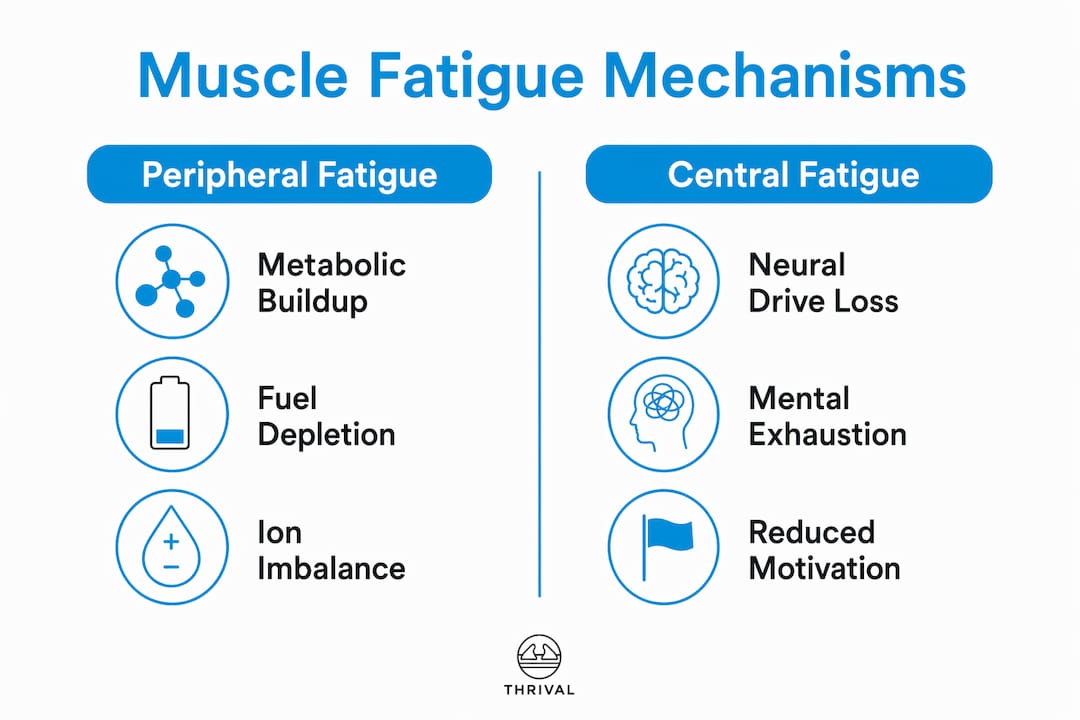
Muscle fatigue is defined as a progressive, exercise-induced decline in a muscle’s ability to generate maximal force or power, driven by both central nervous system factors and peripheral muscular changes. The condition is multifactorial and reversible, meaning rest restores function in most cases. Understanding what is muscle fatigue matters because it affects everyone from desk workers to competitive athletes, and misreading its signals leads directly to injury. The two core mechanisms are peripheral fatigue, which happens inside the muscle itself, and central fatigue, which originates in the brain and spinal cord.
What causes muscle fatigue at the physiological level?
Muscle fatigue does not have a single cause. Research identifies at least four distinct mechanisms working simultaneously during intense or prolonged activity.
The most significant driver of peripheral fatigue is the buildup of inorganic phosphate (Pi) and hydrogen ions (H+) inside muscle fibers. Inorganic phosphate reduces calcium sensitivity in muscle fibers, impairing contraction even when energy reserves remain. That finding overturns the older belief that lactic acid alone causes the burning sensation during hard exercise. Protons (H+) compound the problem by further disrupting force generation at the cross-bridge level, the molecular site where actin and myosin filaments pull against each other to create movement.

Fuel depletion
Muscles rely on three primary fuel sources: adenosine triphosphate (ATP), phosphocreatine (PCr), and glycogen. ATP is the immediate energy currency, PCr replenishes ATP during short bursts, and glycogen sustains effort over longer durations. When glycogen stores drop significantly, substrate depletion impairs the muscle’s ability to maintain force output. Dehydration compounds this effect by reducing blood volume and slowing nutrient delivery to working muscles.
Ion imbalances
Muscle contractions depend on precise electrical signals carried by sodium (Na+), potassium (K+), and calcium (Ca2+) ions. Repeated contractions shift these ions across cell membranes, disrupting the electrical gradient needed to trigger each contraction. The result is a muscle that receives the signal to contract but cannot respond with full force.
Central fatigue
Central fatigue reduces neural drive from the brain and spinal cord, creating feelings of exhaustion that are independent of the muscle’s actual fuel status. The brain limits motor unit recruitment as a protective mechanism, which explains why you feel spent even when your muscles technically have energy left. This is not weakness. It is the nervous system applying the brakes before damage occurs.
| Fatigue type | Location | Primary cause | Recovery time |
|---|
| Peripheral fatigue | Muscle fiber | Pi, H+ buildup, glycogen depletion | Minutes to hours |
| Central fatigue | Brain and spinal cord | Reduced neural drive | Hours to days |
| Ion imbalance fatigue | Cell membrane | Na+/K+/Ca2+ disruption | Minutes to hours |
| Substrate depletion | Whole muscle | Low ATP, PCr, glycogen | Hours with nutrition |
Pro Tip: Hydrate before you feel thirsty. By the time thirst signals arrive, ion balance and blood volume are already compromised, accelerating fatigue onset.
What are the common symptoms of muscle fatigue?
Recognizing muscle fatigue early prevents it from crossing into injury territory. Symptoms appear across both the body and the mind.
Physical signs include:
- A measurable drop in strength or the number of repetitions you can complete
- Muscle tremors or shakiness during sustained effort
- Slowed movement speed and reduced coordination
- A burning sensation in the working muscle
- Delayed onset muscle soreness (DOMS), which peaks 24–72 hours after activity
DOMS is normal. It reflects microscopic muscle fiber disruption that triggers repair and growth. The concern begins when soreness extends well past 72 hours, which often signals excessive tissue damage rather than standard fatigue. For a closer look at how soreness differs from fatigue, the difference between the two is worth understanding before you push through pain.
Mental symptoms are equally real. Central fatigue causes lack of motivation and reduced drive even when muscles retain capacity. Athletes often describe this as “heavy legs” or a general unwillingness to continue, despite no obvious physical limitation. Irritability and difficulty concentrating can accompany these feelings.
Pro Tip: Track your resting heart rate each morning. A rate elevated by more than 7 beats per minute above your baseline is a reliable early warning sign of accumulated fatigue before symptoms become obvious.
Symptoms that persist beyond a week, or that include sharp localized pain, swelling, or significant weakness, require medical evaluation. These patterns suggest injury rather than normal fatigue.
How does muscle fatigue increase injury risk?
Fatigue and injury share a close relationship, and understanding where one ends and the other begins is critical for anyone training regularly.
Neuromuscular fatigue alters kinematic patterns and reduces a muscle’s ability to absorb energy during movement. When a fatigued muscle cannot decelerate a limb effectively, surrounding joints and connective tissue absorb the excess load. Hamstring strains, ACL tears, and rotator cuff injuries all show higher incidence rates in the later stages of competition, when fatigue is greatest.
The overlap between physiological fatigue and mechanical muscle damage creates a continuum rather than a clean boundary. Consider these stages:
- Acute fatigue: Develops during a single session. Resolves with rest. No structural damage.
- Residual fatigue: Carries over between sessions when recovery is insufficient. Coordination and force steadiness decline.
- Chronic fatigue: Accumulates over weeks of inadequate recovery. Increases injury risk significantly and may indicate overtraining syndrome.
Fatigue also impairs proprioception, the body’s sense of joint position. A fatigued athlete cannot react as quickly to unexpected loads, which is why ankle sprains and knee injuries cluster in the final minutes of a game. Injury risk increases through complex neuromuscular mechanisms, not simply because muscles are “tired.”
The concept of a fatigue limit is useful here. Every muscle has a threshold beyond which continued loading produces damage rather than adaptation. Respecting that limit through structured rest is not optional. It is the mechanism through which training actually works. For athletes managing high training loads, understanding pitcher fatigue prevention offers a clear model of how sport-specific fatigue management reduces injury rates.
| Fatigue stage | Duration | Injury risk | Recommended action |
|---|
| Acute | During activity | Low to moderate | Rest and hydrate |
| Residual | 24–48 hours post-session | Moderate | Reduce training load |
| Chronic | Weeks | High | Full recovery protocol |
What strategies effectively manage and prevent muscle fatigue?
Recovery from muscle fatigue follows a clear sequence. Skipping steps slows the process and raises injury risk.
Stop the activity causing fatigue. Continuing past the point of significant force decline accelerates damage. Persistent fatigue beyond 72 hours signals tissue damage, not normal recovery, and requires activity modification.
Rehydrate immediately. Water restores blood volume and supports ion rebalancing. For sessions lasting longer than 60 minutes, electrolyte replacement addresses Na+ and K+ losses directly.
Replenish glycogen within 30–45 minutes post-activity. Carbohydrates consumed in this window reload muscle glycogen stores faster than at any other time. Pairing carbohydrates with protein supports muscle fiber repair simultaneously.
Use progressive training loads. Gradual increases in volume and intensity give muscles time to adapt. The body responds to controlled stress by building greater fatigue resistance. Jumping load too quickly is the most common cause of residual and chronic fatigue in recreational athletes.
Apply targeted muscle release techniques. Deep tissue work addresses tight spots and restricted fascia that persist after rest and nutrition alone. Tools that apply focused pressure to specific muscle groups accelerate tissue recovery by improving circulation and reducing localized tension. The science behind muscle recovery supports combining passive rest with active recovery modalities for faster return to full function.
Prioritize sleep. Growth hormone release during deep sleep drives muscle repair. Cutting sleep short by even 90 minutes measurably reduces recovery rate and increases next-day fatigue perception.
Pro Tip: Young athletes especially benefit from structured recovery between training sessions. The principles of arm recovery for young pitchers apply broadly: tissue that does not recover fully between sessions accumulates damage faster than it adapts.
Listening to your body remains the most underrated recovery tool available. Transient fatigue differs fundamentally from chronic weakness or underlying pathology. Knowing which one you are dealing with determines the right response.
Key Takeaways
Muscle fatigue is a reversible decline in force production driven by metabolic byproducts, fuel depletion, ion imbalances, and reduced neural drive, and each factor requires a specific recovery response.
| Point | Details |
|---|
| Fatigue is multifactorial | Both the nervous system and muscle metabolism contribute simultaneously to force decline. |
| DOMS beyond 72 hours is a warning | Soreness lasting past three days signals tissue damage, not normal recovery. |
| Central fatigue is real | The brain reduces motor unit recruitment independently of muscle fuel status. |
| Progressive training prevents chronic fatigue | Gradual load increases build fatigue resistance and reduce injury risk over time. |
| Recovery requires active steps | Hydration, glycogen replenishment, sleep, and targeted muscle release all accelerate return to full function. |
What I’ve learned about muscle fatigue that most people get wrong
Most people treat fatigue as a single problem with a single solution. Rest more, eat more, done. The reality is more specific, and getting it wrong costs weeks of training.
The biggest misconception I see is around fuel depletion. People assume they are fatigued because they ran out of energy. Inorganic phosphate buildup and ion disruption impair force production long before glycogen is fully depleted. That means eating more carbohydrates will not fix fatigue that is primarily driven by metabolite accumulation. The fix there is rest and time, not food.
The second mistake is ignoring the 72-hour rule. Soreness that lingers past three days is not toughness. It is a signal that the tissue damage from your last session has not resolved. Training on top of unresolved damage does not build fitness. It builds injury.
The third thing I would tell anyone managing fatigue is to take the mental symptoms seriously. When motivation drops sharply and effort feels disproportionate to the load, that is central fatigue talking. Pushing through it with willpower does not override the nervous system. It delays recovery and increases the risk of a more serious breakdown.
The most effective approach combines scientific understanding with honest body awareness. Know what type of fatigue you are dealing with, respond to it specifically, and build recovery into your schedule the same way you build training into it.
— Cameron
When rest and nutrition alone are not enough, targeted muscle release accelerates recovery from fatigue in ways that passive rest cannot replicate. Thrival’s non-motorized recovery system uses a single base board with interchangeable attachments, including the Thrival Arch, Bullseye, Wave, and Ballhead, to apply focused pressure to specific muscle groups across the back, hips, neck, and shoulders.

Each attachment targets a different tissue type and depth, giving you control over where and how hard you work a fatigued area. The system is US-manufactured, FDA-registered, and backed by a lifetime warranty. Step-by-step guidance is available through Thrival’s how-to videos, so you know exactly how to use each tool for maximum relief. Thrival is built for active individuals, desk workers, and athletes who need professional-grade muscle recovery without a clinic visit.
FAQ
What is the difference between muscle fatigue and muscle soreness?
Muscle fatigue is a real-time decline in force production during or immediately after activity. Muscle soreness, specifically DOMS, is a delayed response peaking 24–72 hours post-exercise and reflects microscopic fiber repair.
How long does muscle fatigue take to recover from?
Acute fatigue resolves within minutes to hours with rest and hydration. Residual fatigue from heavy training sessions typically clears within 24–48 hours. Soreness or weakness lasting beyond 72 hours indicates tissue damage requiring activity modification.
What triggers muscle fatigue fastest?
High-intensity exercise depletes phosphocreatine within seconds and accelerates inorganic phosphate buildup, making it the fastest route to acute fatigue. Dehydration and heat significantly speed up the process by disrupting ion balance and reducing blood flow.
Can muscle fatigue cause injury?
Yes. Fatigued muscles lose the ability to absorb energy and maintain coordination, shifting load to joints and connective tissue. Injury rates increase in the later stages of competition precisely because neuromuscular fatigue impairs movement control.
Is central fatigue the same as being mentally tired?
Central fatigue is a physiological reduction in neural drive from the brain to the muscles, not simply a mood state. It produces genuine reductions in motor unit recruitment and force output, independent of how much energy the muscles themselves contain.
Recommended