Thursday, July 16, 2026
Muscle adhesion is defined as an abnormal fibrous connection between muscle layers and fascia, where collagen fibers stick to adjacent tissues due to injury, overuse, or inflammation. The result is dense, disorganized scar tissue that restricts how muscle fibers glide against each other, causing stiffness, localized pain, and reduced range of motion. This condition affects both athletes pushing their limits and desk workers sitting in static postures for hours. Understanding what muscle adhesion is, what causes it, and how to treat it gives you a real path toward restoring mobility and comfort.
Muscle adhesion is not the same as general muscle soreness. It represents a structural change inside the tissue, where fibrotic scar tissue acts as biological glue between muscle layers and the surrounding fascia. Healthy fascia is designed for frictionless gliding. When chronic irritation thickens the fascia, adhesions form and movement becomes restricted at the source.
The formation process starts at the cellular level. When muscle tissue is damaged or stressed, the body sends fibroblasts to repair the area. Those fibroblasts deposit collagen, but under conditions of ongoing stress or inflammation, the collagen lays down in a disorganized pattern rather than the aligned structure of healthy tissue. That disorganized collagen is what creates the adhesion.

The standard clinical term for this process is myofascial adhesion or soft tissue fibrosis. Both terms describe the same core problem. You may also hear it called scar tissue buildup or fascial restriction, depending on the context and the clinician you speak with.
What causes muscle adhesion?
| Cause | Biological mechanism |
|---|
| Acute injury or surgery | Triggers collagen repair response; disorganized deposition creates scar tissue |
| Repetitive motion | Microtrauma accumulates faster than tissue can repair cleanly |
| Prolonged immobilization | Reduces blood flow and tissue gliding, promoting fiber adhesion |
| Sustained static posture | Hypoxia activates fibroblasts to produce excess collagen |
| Chronic inflammation | Cytokines like TNF-a and IL-6 drive fibroblast overactivity and fibrosis |
| Obesity and systemic inflammation | Increases adhesion risk through low-grade inflammatory signaling |
Hypoxia is one of the most underappreciated causes. When a muscle stays contracted or compressed for extended periods, oxygen levels in the tissue drop. That low-oxygen environment signals fibroblasts to produce collagen as a protective response. Desk workers are particularly vulnerable because sustained sitting creates exactly this condition in the hip flexors, upper back, and neck.
Chronic inflammation adds another layer. Cytokines like TNF-a and IL-6 activate fibroblasts to produce excessive collagen, and oxidative stress creates a feedback loop that accelerates fibrosis. This means conditions like obesity or autoimmune disorders can make someone more likely to develop adhesions even without a specific injury.
Pro Tip: If you sit at a desk for more than four hours a day, your hip flexors and thoracic spine are the most common sites for hypoxia-driven adhesion. A two-minute movement break every 45 minutes significantly reduces that risk.
How do muscle adhesions differ from muscle knots?
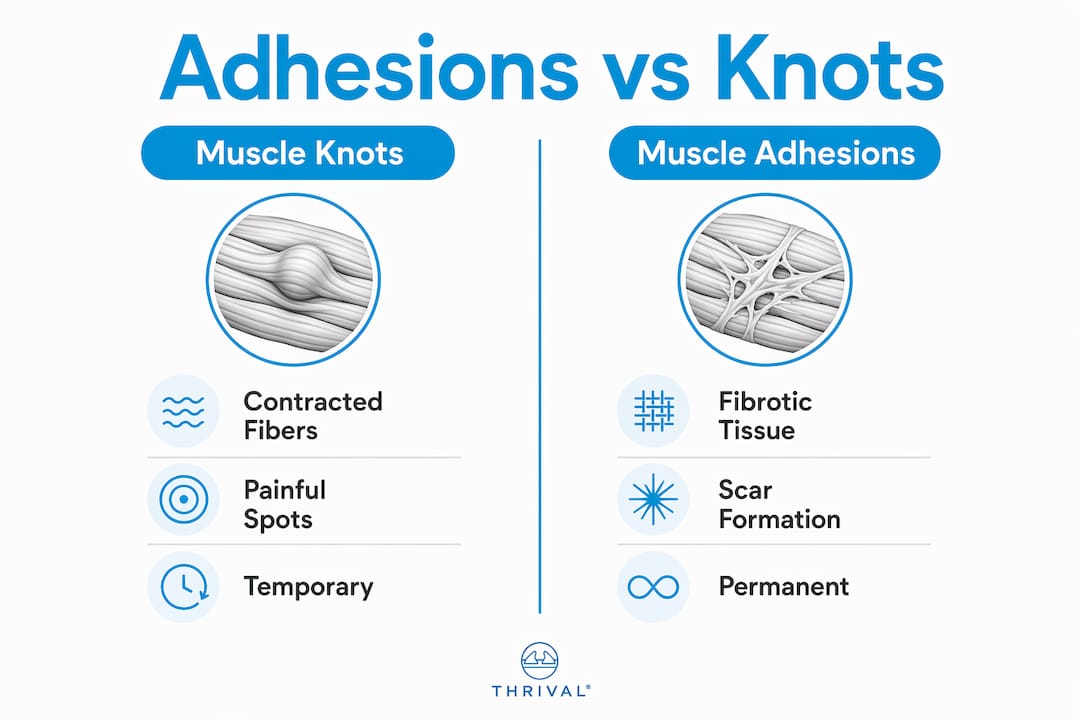
Muscle knots and muscle adhesions are not the same thing, though they are often confused. A muscle knot, also called a trigger point, is a localized area of sustained muscle contraction. It is a functional problem, meaning the muscle fibers are in a state of tension but have not undergone structural change. Trigger points can resolve with pressure, stretching, or rest.
Muscle adhesions are structurally different. They are fibrotic scar tissue, a permanent physical change in the tissue architecture. You cannot simply relax an adhesion the way you can release a muscle knot. Breaking down adhesions requires sustained mechanical input over time, whether through manual therapy, targeted pressure tools, or movement-based techniques.
| Feature | Muscle knot (trigger point) | Muscle adhesion |
|---|
| Tissue type | Contracted muscle fibers | Fibrotic scar tissue |
| Reversibility | Often resolves with rest or pressure | Requires targeted therapy to break down |
| Duration | Acute to subacute | Chronic, often long-standing |
| Mobility impact | Localized tension | Broader restriction of tissue gliding |
| Treatment priority | Release tension | Restore tissue structure and gliding |
There is ongoing debate in clinical literature about the extent and pathology of muscle adhesions outside of surgical trauma. Some clinicians argue that adhesions are overdiagnosed in soft tissue contexts. The current standard practice combines clinical observation with therapy response to guide diagnosis and treatment.
Pro Tip: If pressing on a tender spot produces a referred pain pattern elsewhere in the body, that points toward a trigger point. If the area feels hard, fibrous, and does not release with sustained pressure, that is more consistent with an adhesion.
What are the symptoms of muscle adhesion?
Symptoms of muscle adhesion include chronic stiffness, pulling sensations during movement, localized soreness, and hard tender areas within the muscle tissue. These symptoms tend to persist longer than typical muscle soreness and do not resolve with rest alone. That duration is one of the clearest signals that something structural is involved.
- Persistent stiffness that does not improve after warming up
- Pulling or tethering sensations when moving through a full range of motion
- Hard, tender nodules within the muscle belly or along fascial lines
- Reduced strength in the affected muscle group without a clear neurological cause
- Chronic localized discomfort that worsens with repetitive activity or prolonged sitting
- Limited range of motion that feels mechanical rather than pain-limited
Adhesion symptoms can resemble other musculoskeletal problems including tendinopathy, bursitis, or nerve entrapment. The key difference is that adhesion-related restriction tends to feel like a physical barrier rather than sharp pain at end range. If your symptoms have lasted more than six weeks and do not respond to standard rest and stretching, a professional assessment is the right next step.
Pro Tip: Track your symptoms with a simple daily log. Note which movements trigger discomfort, how long the stiffness lasts after activity, and whether the tender area feels the same or changes over time. That information is far more useful to a clinician than a general description of tightness.
What treatment options are effective for muscle adhesions?
Treating muscle adhesions requires breaking down disorganized scar tissue and restoring normal tissue gliding. No single method works for every case, and the most effective protocols combine multiple approaches.
Myofascial release. This manual therapy applies sustained pressure to fascial restrictions to soften and lengthen the tissue. Myofascial release is one of the most widely used non-invasive treatments for adhesions and works best when applied consistently over several weeks.
Active release therapy (ART). A clinician applies targeted pressure to the adhesion while the patient moves the affected limb through a specific range of motion. The combination of compression and movement shears the scar tissue more effectively than static pressure alone.
Deep tissue massage. Sustained, firm pressure applied across the grain of the muscle fibers helps break down collagen cross-links. Muscle release therapy applied regularly reduces both pain and functional restriction.
Heat therapy. Applying heat before manual work increases tissue extensibility and blood flow. Warmer tissue responds better to pressure-based therapies and stretching.
Targeted stretching and yoga. Lengthening the affected tissue under controlled load helps realign collagen fibers over time. Yoga-based protocols that emphasize long holds in end-range positions are particularly effective for fascial adhesions.
Extracorporeal Shockwave Therapy (EWST). EWST and active release therapy have demonstrated efficacy in breaking down scar tissue and improving mobility in clinical settings. EWST uses acoustic waves to stimulate tissue remodeling and is typically reserved for cases that do not respond to manual therapy.
Surgery. Surgical intervention is rare and reserved for severe adhesions that cause significant functional impairment. Most people resolve their adhesions with consistent non-invasive treatment.
The goal of every treatment on this list is the same: increase blood flow to the fibrotic tissue, restore the tissue’s ability to glide, and gradually replace disorganized collagen with healthier, aligned fibers. Soft tissue therapy works best when it is applied consistently rather than sporadically.
Pro Tip: Combine heat application with self-massage tools before stretching. The heat primes the tissue, the pressure begins breaking down the adhesion, and the stretch helps realign the collagen. That sequence produces better results than any single step alone.
How can you prevent muscle adhesions?
Prevention centers on keeping tissue healthy, mobile, and well-oxygenated. The role of fascial training in maintaining tissue health is significant. Varied, multi-directional movement keeps fascia supple and reduces the risk of hypoxia-driven fibrosis.
- Vary your exercise routine. Repetitive single-plane movements create microtrauma in predictable patterns. Rotating activities and movement directions distributes stress more evenly across tissue.
- Correct your posture. Good posture and proper lifting techniques prevent the microtrauma and excess collagen buildup that lead to adhesions.
- Take movement breaks. If you sit for work, stand and move for two minutes every 45 minutes. This restores blood flow and prevents the hypoxic conditions that trigger fibroblast activity.
- Stay hydrated. Fascia requires adequate hydration to maintain its gliding properties. Dehydrated fascia becomes stiff and more prone to adhesion.
- Follow an anti-inflammatory diet. Reducing systemic inflammation through nutrition lowers the cytokine activity that drives fibroblast overproduction of collagen.
- Stretch regularly. Daily stretching, especially targeting areas of known tension, maintains tissue length and prevents fiber cross-linking.
Prevention is not complicated, but it requires consistency. The people who develop chronic adhesions are usually those who ignore early warning signs like persistent stiffness or localized tenderness. Catching those signals early and responding with targeted movement and therapy keeps the tissue from progressing to fibrosis.
Key Takeaways
Muscle adhesion is a structural tissue problem caused by disorganized collagen buildup, and it requires targeted, consistent therapy to resolve rather than rest alone.
| Point | Details |
|---|
| Definition | Muscle adhesion is fibrotic scar tissue that abnormally binds muscle layers and fascia, restricting movement. |
| Primary causes | Hypoxia, repetitive microtrauma, chronic inflammation, and immobilization all trigger disorganized collagen formation. |
| Knots vs. adhesions | Trigger points are reversible tension; adhesions are permanent structural changes requiring active therapy to break down. |
| Effective treatment | Myofascial release, active release therapy, EWST, and deep tissue massage restore tissue gliding and reduce pain. |
| Prevention | Varied movement, correct posture, hydration, and regular stretching keep fascia healthy and reduce adhesion risk. |
What I’ve learned about muscle adhesion that most people get wrong
Most people treat muscle adhesion like a temporary problem. They assume it will resolve the same way delayed-onset muscle soreness does, given enough rest and time. That assumption costs them months of unnecessary discomfort.
Adhesions do not self-resolve. The disorganized collagen that forms them is stable tissue. Without mechanical input, whether from a therapist’s hands, a targeted pressure tool, or structured movement, that tissue stays exactly where it is. I have seen people manage chronic back and hip tightness for years with stretching alone, making no real progress, because they were addressing the symptom without touching the structural cause.
The psychological dimension is real too. Chronic pain from adhesions erodes confidence in movement. People start avoiding activities that trigger discomfort, which leads to further deconditioning and more adhesion formation. Breaking that cycle requires both physical treatment and a willingness to move through controlled discomfort during therapy.
Early intervention is the single most important factor in outcomes. Adhesions that are addressed within the first few months of formation respond far better to manual therapy than long-standing fibrosis. If you feel persistent tightness that does not respond to stretching within two to three weeks, treat it as a signal worth acting on, not something to wait out.
— Cameron
Persistent muscle adhesions need consistent, targeted pressure to break down. Thrival builds recovery tools specifically for that purpose.

The Thrival Deep Tissue Pro is a non-motorized recovery system with a base board and interchangeable attachments, including the Wave, Bullseye, Arch, and Ballhead, each designed to target specific muscle groups and fascial layers. You can apply sustained, precise pressure to the back, hips, neck, and shoulders without a clinic appointment. The system is FDA-registered, made in the US, and backed by a lifetime warranty. Thrival also provides an app with guided routines so you know exactly how to use each attachment for maximum tissue release.
FAQ
What is the definition of muscle adhesion?
Muscle adhesion is an abnormal fibrous connection between muscle layers and fascia, formed by disorganized collagen scar tissue that restricts normal tissue gliding and causes stiffness, pain, and reduced mobility.
Muscle adhesions form when injury, repetitive microtrauma, sustained static posture, or chronic inflammation triggers fibroblasts to deposit disorganized collagen in the affected tissue.
How do I know if I have a muscle adhesion or a muscle knot?
Muscle knots are localized areas of muscle tension that often release with pressure or rest. Muscle adhesions feel hard and fibrous, do not release with sustained pressure, and cause a broader restriction of movement that persists over weeks or months.
What is the most effective treatment for muscle adhesions?
Myofascial release, active release therapy, and deep tissue massage are the most widely used treatments. Extracorporeal Shockwave Therapy is effective for cases that do not respond to manual therapy.
Can muscle adhesions be prevented?
Muscle adhesions can be significantly reduced through varied exercise routines, correct posture, regular stretching, adequate hydration, and movement breaks during prolonged sitting.
Recommended