Friday, May 8, 2026
If you’ve ever walked away from a brutal workout feeling nothing the next day and wondered if you even trained hard enough, you’re not alone. The idea that soreness equals progress is one of the most persistent myths in fitness. In reality, muscle recovery is the biological process through which damaged fibers are repaired, metabolic waste is cleared, and your body adapts to become stronger. This article breaks down the phases of recovery, the nutrition targets that actually matter, the tools with real science behind them, and the common mistakes costing you gains.
Table of Contents
Key Takeaways
| Point | Details |
|---|
| Recovery is a process | Muscle recovery involves sequential phases of repair, regeneration, and adaptation after exercise. |
| Timing and nutrition matter | Immediate protein and carbohydrate intake can optimize muscle repair and glycogen replenishment. |
| Evidence over tradition | Science shows cold water immersion and massage help soreness, but stretching and some protocols need reevaluation. |
| Smart tools aid recovery | Using specialized recovery tools enhances repair, pain relief, and mobility for athletes and fitness enthusiasts. |
| Adapt recovery for growth | Personalize your recovery strategy to promote long-term strength, avoid pitfalls, and achieve best results. |
Understanding the science of muscle recovery
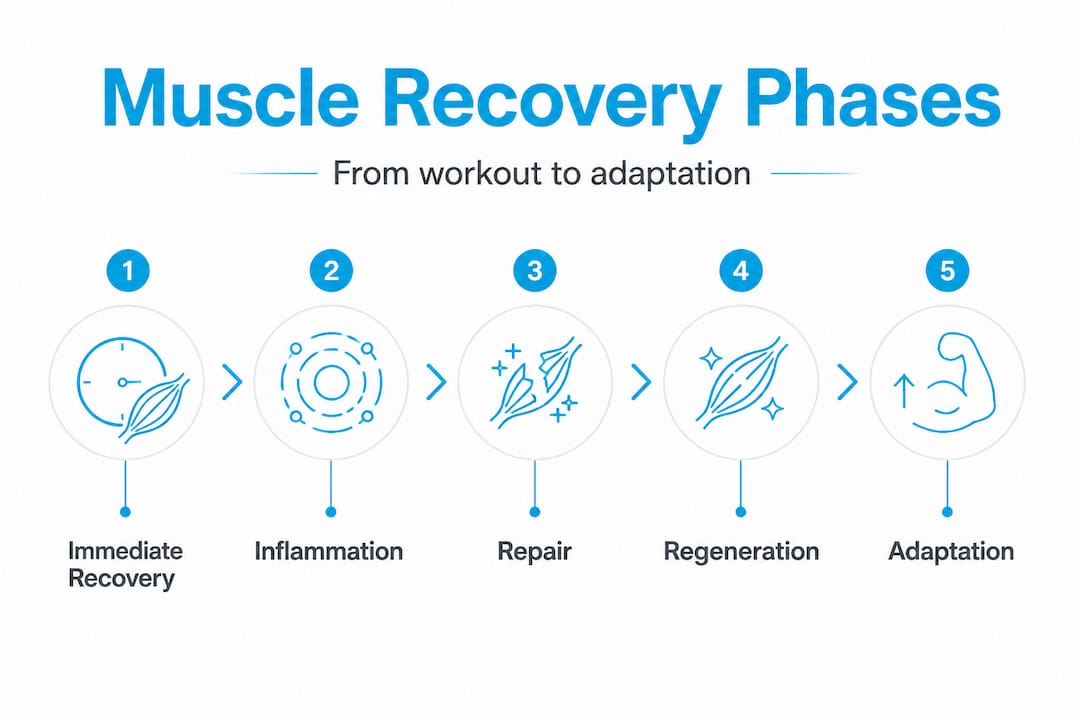
Muscle recovery isn’t a single event. It’s a sequence of biological responses triggered the moment you finish your last rep. Understanding these phases helps you make smarter decisions about rest, training frequency, and which tools to use.
Muscle recovery occurs in four distinct phases: Immediate Recovery, Inflammatory Response, Repair and Regeneration, and Remodeling and Supercompensation. Each phase has a specific window and purpose.
| Phase | Timeframe | What happens |
|---|
| Immediate Recovery | 0-30 minutes | Heart rate normalizes, ATP and phosphocreatine replenish |
| Inflammatory Response | 1-24 hours | Immune cells flood damaged tissue; soreness begins |
| Repair and Regeneration | 24-72 hours | Satellite cells rebuild muscle fibers |
| Remodeling and Supercompensation | 72-120+ hours | Fibers grow stronger, capacity increases |
Recovery times vary significantly depending on training intensity. Light sessions may resolve in 24 to 48 hours, moderate sessions in 48 to 72 hours, and high-intensity or heavy loading can require 72 to 120 hours or more. That window is not fixed. Individual factors like fitness level, age, sleep quality, and stress load all influence how fast you move through the phases.
One factor athletes often overlook is muscle tension recovery, which plays a direct role in how quickly tissue returns to a functional state. Persistent tension in surrounding muscles can slow the process even when the primary repair is complete.
Similarly, mobility and recovery are closely linked. Limited range of motion after training isn’t just discomfort. It’s a signal that recovery is incomplete and that soft tissue may still be under stress.
Pro Tip: Soreness is not a reliable measure of training quality. You can have a productive session with minimal soreness, and a high-soreness session can sometimes reflect poor recovery rather than effective stimulus.
Nutrition strategies for improving muscle recovery
Once the science framework is clear, the next question becomes: what you eat and when you eat it directly shapes how well your body repairs itself. Nutrition is the raw material for the entire repair process.
Optimal protein intake for muscle repair sits at 1.6 to 2.2 grams per kilogram of body weight per day. For a 180-pound athlete, that translates to roughly 130 to 180 grams of protein daily. Spreading this across four to five meals is more effective than loading most of it into one post-workout shake.
Carbohydrate intake of 1 to 1.2 grams per kilogram per hour during the first four hours after exercise is the optimal range for glycogen replenishment. This matters most when you train more than once per day or in back-to-back sessions. If your next workout is 48 hours away, the urgency is lower, but refueling still supports the repair phase.
Here’s a practical post-workout nutrition framework you can apply immediately:
- Within 30 minutes: 20-40 g fast-digesting protein (whey or lean protein source) plus simple carbs
- 2-3 hours later: Full mixed meal with lean protein, complex carbs, and vegetables
- Evening: Casein-rich foods like cottage cheese or Greek yogurt to support overnight repair
- Hydration: Replace fluids at 1.5x the weight lost during training
- Micronutrients: Prioritize magnesium, zinc, and vitamin D, all of which support muscle function and immune response
| Nutrient | Target | Timing | Primary benefit |
|---|
| Protein | 1.6-2.2 g/kg/day | Spread across meals | Fiber repair and growth |
| Carbohydrates | 1-1.2 g/kg/h | First 4 hours post-workout | Glycogen replenishment |
| Fluids | 1.5x sweat loss | Throughout recovery | Cellular function |
| Magnesium | 300-400 mg/day | Evening preferred | Muscle relaxation, sleep quality |
Pro Tip: Plan your meals around your upcoming sessions, not just the one you just finished. Knowing you have a heavy leg day in 36 hours should shape what you eat today.
Nutrition handles the internal side of recovery. What about external interventions like massage, cold water immersion, and stretching? The research gives a clear picture, and some results are surprising.

Cold water immersion improves jump performance and reduces perceived fatigue and soreness effectively. However, routine use after strength training may blunt hypertrophy over time. This means cold water immersion is a strong tool for athletes focused on performance and back-to-back competition, but not ideal as an everyday protocol if building muscle is your primary goal.
Massage enhances blood flow and reduces soreness, though much of the strongest evidence comes from animal studies. In human research, massage consistently reduces perceived soreness and improves range of motion. The mechanism is partly circulatory and partly neurological, calming the nervous system’s tension response in affected tissue.
What about stretching?
Post-exercise stretching has trivial to non-significant effects on soreness, strength, and performance outcomes.
That’s a significant finding. Stretching has value for mobility and flexibility over time, but relying on it as a primary recovery strategy after hard sessions doesn’t hold up under scrutiny.
Here’s a practical breakdown of what works, what’s situational, and what’s oversold:
- Deep tissue massage: Strong evidence for soreness reduction and circulation. Works well as a regular protocol. Explore muscle recovery tools designed for targeted release.
- Cold water immersion (10-15 min at 10-15°C): Effective for competition recovery windows. Use selectively, not daily.
- Foam rolling: Useful for increasing range of motion short-term. Limited standalone effect on muscle repair.
- Active recovery (light movement, walking): Strong evidence for clearing metabolic waste and reducing stiffness. Underutilized by most athletes.
- Sleep: The most powerful recovery tool available. Seven to nine hours of quality sleep accelerates every phase of the recovery cycle.
- Targeted deep tissue massage techniques: More precise than foam rolling, targeting tight spots and trigger points in a way surface-level tools cannot.
Understanding therapeutic massage evidence helps explain why consistent manual pressure on affected tissue produces measurable results, particularly for chronic soreness and overuse areas. For athletes dealing with recurring tightness, exploring soft tissue release benefits adds another layer of practical strategy.
Muscle recovery pitfalls and common misconceptions
Even well-informed athletes fall into recovery traps. These aren’t fringe mistakes. They’re common patterns that systematically reduce the quality of your recovery.
Here are the most frequent errors, ranked by how often they go unaddressed:
- Treating soreness as progress: Delayed onset muscle soreness (DOMS) is an inflammatory response, not a growth signal. Chasing soreness leads to overtraining and blunts adaptation.
- Using cold water immersion daily: Effective for pain relief but counterproductive as a daily strength training companion. Blunts the inflammatory signals needed for hypertrophy.
- Relying solely on stretching post-workout: As noted, stretching’s standalone effects on soreness and recovery are minimal. Combine it with other strategies instead.
- Extended bed rest after injury: Research supports a shift from traditional RICE protocols to PEACE and LOVE frameworks, which emphasize early loading, movement, and gradual return to activity over extended rest.
- Ignoring sleep and stress: Both disrupt the hormonal environment that drives repair. Cortisol from chronic stress directly impairs tissue regeneration.
- Eating too little after training: Under-fueling is one of the fastest ways to stall recovery. The body will not prioritize muscle repair when caloric intake is too low.
- Skipping active recovery days: Complete rest has a place, but gentle movement on off days clears metabolic byproducts more efficiently than full inactivity.
The PEACE and LOVE protocol shift is worth examining in more detail. Protection, Elevation, Avoidance of harmful anti-inflammatories, Compression, and Education form the early phase. This is followed by Load, Optimism, Vascularization, and Exercise. This framework treats early movement as therapeutic rather than risky. Your body needs appropriate mechanical loading to signal repair correctly. Prolonged rest removes that signal.
Listening to your own body recovery cues is a skill worth developing. Recovery signals like resting heart rate elevation, persistent stiffness, or declining performance across sessions are data points. Learn to act on them.
Pro Tip: Track your perceived recovery score each morning on a simple 1-to-10 scale. If you score below 6 for three consecutive days, treat that as a signal to reduce training load, not push harder.
Long-term adaptation: turning recovery into strength
Recovery isn’t just about bouncing back. It’s the mechanism through which you actually get stronger, more durable, and more resilient over time. This is the concept of supercompensation.
Muscle recovery culminates in adaptation and supercompensation, a process where fibers not only return to baseline but rebuild slightly stronger than before. Repeated cycles of stress, recovery, and supercompensation compound into real performance gains over months and years. Disrupting this cycle, through insufficient recovery or chronic overtraining, breaks the chain.
Individual factors like muscle endurance capacity affect how long recovery takes and how much adaptation occurs. This is why two athletes doing identical workouts can have very different recovery needs. Personalizing your recovery protocol is not a luxury. It’s a requirement for consistent long-term progress.
Practical steps for building a long-term recovery-centered training approach:
- Periodize your training: Plan recovery weeks every four to six weeks to allow full supercompensation cycles to complete.
- Track your recovery metrics: Resting heart rate, sleep quality, grip strength, and subjective energy levels all reflect your actual recovery state.
- Use targeted tools consistently: Devices that release tight spots in the hips, back, and shoulders help maintain tissue quality between hard sessions.
- Build nutrition habits, not just post-workout routines: Daily protein targets matter more than any single recovery meal.
- Invest in tools that last: Professional-grade recovery adaptation methods and durable muscle recovery tools compound in value over time the same way training does.
- Prioritize high-risk areas proactively: The back, hips, and shoulders accumulate the most tension in athletes. Consistent targeted release in these areas prevents the small issues from becoming injuries.
Recovery, when approached systematically, becomes a competitive advantage. It’s not passive. It’s a skill you build over time.
Why real muscle recovery means smarter—not harder—training
Here’s a perspective that most training content won’t say directly: the athletes who recover best are almost never the ones doing the most recovery work. They’re the ones doing the right recovery work at the right time.
The fitness culture default is to treat more effort as better, whether that’s more volume in training or more aggressive recovery protocols. Cold plunges every day. Stretching for 30 minutes post-session. Multiple foam rolling passes over the same tissue. These behaviors feel productive. But the evidence consistently shows that recovery responds to appropriateness, not effort.
What actually moves the needle is precision. Knowing which tissue is under stress and applying targeted release there, rather than blanketing every muscle group after every session. Understanding that trigger point therapy applied to one concentrated tight spot in the hip flexor delivers more benefit than ten minutes of general rolling around the same area.
The most underrated recovery upgrade isn’t a new device or protocol. It’s developing the body awareness to know what your body needs on a given day and responding accordingly. Some days that’s deep tissue work. Other days it’s walking, good food, and eight hours of sleep. Neither is inherently superior. Context determines what works.
Sustainable recovery isn’t about doing more. It’s about doing what fits the current load, the current phase of training, and the current state of your tissue. Athletes who internalize that principle stop chasing soreness, stop over-applying aggressive interventions, and start building the kind of resilience that compounds across seasons.
The science is clear: targeted, consistent recovery tools outperform generic protocols. If you’re ready to move from theory into action, Thrival’s line of deep tissue recovery tools is built specifically for athletes who take recovery seriously.
Whether you’re working through hip tightness, lower back tension, or shoulder knots, Thrival’s products deliver targeted, professional-grade relief. The Thrival Deep Tissue Pro is designed for precise muscle release in hard-to-reach areas. Pair it with Thrival Wave attachments for versatile coverage across multiple muscle groups. Need a complete setup? Thrival’s adjustable psoas release options target one of the most neglected and tension-prone areas in active athletes. Every product is US-manufactured, FDA-registered, and built for long-term use. Free shipping and a lifetime warranty back every purchase.
Frequently asked questions
How long does muscle recovery take after high-intensity exercise?
High-intensity recovery typically takes 72 to 120 hours, depending on individual training load, fitness level, and recovery quality. Light sessions may resolve in 24 to 48 hours.
Is soreness required for muscles to grow?
No. Soreness is an inflammatory response, not a growth signal. Adaptation occurs even without significant soreness, and post-exercise stretching has trivial effects on soreness regardless of whether growth is occurring.
What nutrition helps most with muscle recovery?
Optimal protein intake for repair is 1.6 to 2.2 g/kg body weight per day, combined with 1 to 1.2 g/kg/h of carbohydrates in the first four hours post-exercise for glycogen replenishment.
Are massage and cold water immersion safe for everyone?
Both are generally safe, but cold water immersion used routinely after strength training may blunt hypertrophy. Use both selectively based on your training goals and current phase.
Should I stretch after every workout to speed recovery?
No. Post-exercise stretching shows trivial to non-significant effects on soreness, strength, and performance outcomes. It has value for mobility, but not as a standalone recovery strategy.
Recommended