Saturday, June 13, 2026
Muscle recovery for desk workers is defined as the process of restoring optimal muscle function, circulation, and comfort after prolonged periods of sitting. Prolonged sitting causes hip flexor tightening, glute inhibition, reduced spinal blood flow, and postural imbalances that compound over time. The most effective approach combines frequent movement breaks, targeted stretching, muscle activation exercises, and selective use of therapies like manual massage or percussive tools. This guide delivers research-backed strategies drawn from ergonomic science, physical therapy, and real-world desk worker wellness tips to help you move better and hurt less.
1. Muscle recovery tips for desk workers: start with movement breaks
Movement breaks are the single highest-return habit for desk worker recovery. Individualized counseling reduced sedentary time by about 30 minutes per day over four weeks, which demonstrates that even modest reductions in sitting time produce measurable change. The key is not the length of each break but the frequency.
Research confirms that context-aware movement prompts outperform rigid timer-based schedules. Workers stand and move more when breaks align with natural task boundaries, such as finishing an email or ending a call, rather than when an alarm fires mid-task. This means you should tie your movement cues to workflow events, not a clock.

A two-minute walk to the water cooler, a set of calf raises at your desk, or a brief standing stretch between meetings all count. Frequency matters more than duration or perfect form.
2. Best stretching exercises for office workers
Stretching exercises for office workers target the muscles most compressed by sitting: hip flexors, hamstrings, chest, and the mid-back. UCLA Health recommends figure-four stretches, chest openers, and seated spinal rotations as desk-friendly options that require no equipment and under three minutes each.
Here are seven stretches that deliver the most relief per minute:
- Hip flexor lunge stretch: Step one foot forward from a kneeling position and press the rear hip forward for 30 seconds per side
- Figure-four stretch: Cross one ankle over the opposite knee while seated and lean forward gently to release the glute and piriformis
- Chest opener: Clasp hands behind your back, squeeze shoulder blades together, and lift slightly for 20 seconds
- Seated spinal rotation: Sit tall, place one hand on the opposite knee, and rotate your torso slowly for 10 reps per side
- Neck side stretch: Drop one ear toward the shoulder and hold for 20 seconds per side to release the upper trapezius
- Hamstring chair stretch: Extend one leg straight from your seat and hinge forward at the hip until you feel a pull behind the thigh
- Wrist and forearm stretch: Extend one arm, pull fingers back gently with the other hand, and hold for 15 seconds per side
Pro Tip: Set a recurring calendar block for a three-minute stretch sequence at 10 a.m. and 3 p.m. Pairing it with an existing habit, like your afternoon coffee, increases follow-through without disrupting your workflow.
3. How muscle activation and strengthening support recovery
Stretching alone does not fix the root problem. Pairing mobility with muscle activation and strengthening produces more resilient muscle function than stretching alone. Desk work inhibits the glutes, weakens the deep core stabilizers, and shuts down the mid-back muscles that hold your spine upright. Reactivating those muscles is what prevents the discomfort from returning.
Three activation exercises you can do in under five minutes:
- Pelvic tilts: Sit at the edge of your chair, flatten your lower back against the seat, hold for five seconds, then arch slightly. Repeat ten times to reactivate the lumbar stabilizers.
- Glute bridges: Lie on your back with knees bent and drive your hips upward, squeezing the glutes at the top. Ten reps during a lunch break rebuilds the posterior chain that sitting switches off.
- Seated resistance band rows: Loop a resistance band around a door handle, sit tall, and pull the band toward your ribcage. This reactivates the rhomboids and mid-trapezius that collapse during screen time.
These moves address the muscle imbalances that back pain recovery strategies consistently identify as the primary driver of desk-related discomfort.
Pro Tip: Start with just one activation exercise per break for the first two weeks. Building the habit matters more than completing a full sequence. Add exercises once the routine feels automatic.
4. Manual therapy vs. percussive therapy for pain relief at work
Both manual therapy and percussive devices reduce muscle pain and improve circulation, but they work differently and suit different situations. Understanding the distinction helps you use each one where it actually delivers results.
Manual therapy, defined as hands-on soft-tissue techniques performed by a therapist, reduces pain by 16 points on the Visual Analog Scale compared to controls. That is a clinically significant reduction, and it comes from a mechanism that includes breaking down adhesions, releasing muscle spasms, and triggering endorphin and serotonin release. For chronic desk-related tension in the neck, shoulders, and mid-back, scheduled manual therapy sessions remain the gold standard.
Percussive therapy devices offer a practical at-desk option. A single session increases muscle oxygenation with effects lasting up to 40 minutes post-application. That window aligns well with a work break. However, percussive therapy provides short-term improvements in range of motion and flexibility, with limited evidence for long-term standalone effectiveness. Use it as a complement to movement and strengthening, not a replacement.
| Factor | Manual therapy | Percussive therapy |
|---|
| Pain reduction | 16-point VAS reduction vs. controls | Short-term relief, session-dependent |
| Mechanism | Adhesion breakdown, endorphin release | Microcirculation boost, vibration stimulus |
| Duration of effect | Session-dependent, cumulative | Up to 40 minutes post-use |
| Best use case | Chronic tension, professional setting | Pre-stretch warm-up, desk-side recovery |
| Risk of overuse | Low with qualified therapist | Adverse events noted with excessive use |
Pro Tip: Space percussive therapy sessions to match the physiological window. Since microcirculation benefits fade within 40 minutes, apply the device just before a stretching or activation sequence to get the most from both.
5. Posture variation and ergonomic awareness for muscle recovery
The most important posture correction tip for desk workers is not finding the perfect position. It is changing positions frequently. Ergonomic research states clearly that frequent position changes redistribute spinal load, reduce tissue stiffness, and improve nutrient flow to intervertebral discs more effectively than any static posture, however well-aligned. The phrase used in ergonomic circles is direct: “your best posture is your next posture.”
Practical ergonomic workspace recommendations for desk workers:
- Chair height: Feet flat on the floor, knees at roughly 90 degrees, thighs parallel to the ground
- Monitor height: Top of the screen at or just below eye level to prevent forward head posture
- Keyboard and mouse position: Elbows at 90 degrees, wrists neutral, shoulders relaxed
- Lumbar support: Use a rolled towel or lumbar cushion to maintain the natural curve of the lower back
- Standing transitions: Take phone calls standing, use a standing desk for 20 to 30 minutes per hour when available
Workday spinal care practices reinforce that no single ergonomic setup eliminates discomfort without behavioral change. The chair and monitor matter, but the habit of shifting, standing, and moving is what protects the spine over a full career.
Pro Tip: Use task transitions as your posture cue instead of a timer. Stand up every time you switch from writing to reading, or from email to a video call. This context-aware approach produces better movement adherence than alarm-based reminders.
6. Lifestyle habits that enhance muscle recovery for desk workers
Recovery techniques for a sedentary lifestyle extend well beyond the workday. Sleep, hydration, and stress management each affect how quickly muscles recover from the compression and inactivity of desk work.
Sleep is the primary window for muscle repair. During deep sleep, the body releases growth hormone, reduces inflammatory markers, and restores tissue that accumulated micro-damage during the day. Seven to nine hours of quality sleep is not a luxury for desk workers. It is a physiological requirement for sustained comfort and function.
Chronic stress tightens the trapezius, levator scapulae, and psoas muscles through sustained sympathetic nervous system activation. Desk workers who manage stress poorly often carry visible tension in the neck and shoulders regardless of how much they stretch. A five-minute diaphragmatic breathing practice, where you inhale for four counts, hold for four, and exhale for six, activates the parasympathetic system and directly reduces muscle tone.
Hydration affects tissue elasticity and joint lubrication. Dehydrated muscles are stiffer, more prone to cramping, and slower to recover. Aim for consistent water intake throughout the workday rather than large amounts at once.
Additional recovery habits worth building into your office fitness routine:
- Micro-recovery rituals: Two minutes of slow neck rolls and shoulder shrugs between meetings
- Heat application: A warm pack on the lower back or neck for ten minutes reduces local muscle tension before stretching
- Foam rolling or targeted pressure tools: Applied to the thoracic spine or glutes during lunch breaks to release accumulated tension
- Walking after lunch: A ten-minute walk post-meal improves circulation, reduces postprandial fatigue, and resets posture before the afternoon session
The science behind recovery routines confirms that combining these habits with movement and therapy tools addresses circulation, muscle activation, pain modulation, and tissue health simultaneously.
Key takeaways
Desk workers recover most effectively by combining frequent movement, targeted activation, and selective use of therapy tools rather than relying on any single strategy.
| Point | Details |
|---|
| Movement frequency beats duration | Short, frequent breaks aligned with task transitions reduce sedentary time more than long, infrequent ones. |
| Activation over stretching alone | Glute bridges, pelvic tilts, and resistance band rows rebuild the muscles that sitting switches off. |
| Percussive therapy has a 40-minute window | Apply percussive tools just before stretching to maximize the circulation boost before it fades. |
| Posture variation is the real ergonomic fix | Changing positions frequently protects the spine better than maintaining any single “correct” posture. |
| Sleep and stress directly affect muscle tension | Poor sleep and chronic stress tighten muscles and slow recovery regardless of other interventions. |
What I’ve learned about recovery that most desk workers overlook
The conventional advice tells desk workers to sit up straight, take hourly breaks, and maybe do some yoga. That advice is not wrong. It is just incomplete, and the gap between knowing it and doing it is where most people get stuck.
What I have observed consistently is that the workers who actually improve are not the ones who set up the perfect ergonomic workstation or buy the best recovery device. They are the ones who build the smallest possible habit and repeat it without fail. One stretch after every meeting. One set of glute bridges at lunch. One minute of breathing before the afternoon block starts. Those micro-actions compound over weeks in ways that a single perfect recovery session never does.
The other thing worth saying plainly: workplace culture shapes movement behavior more than any individual motivation. If your team never stands during calls and your manager schedules back-to-back meetings with no gaps, you will struggle to move no matter how committed you are. Advocating for movement-friendly meeting norms is not a wellness indulgence. It is a productivity argument backed by the same research that shows muscle therapy benefits extend to mental clarity and reduced fatigue.
Customize your recovery approach to your actual schedule and body. The best routine is the one you will do on a Tuesday afternoon when you are behind on deadlines and your neck is tight.
— Cameron
If your neck, back, or hips are carrying tension that stretching and movement alone are not clearing, a targeted pressure tool can close the gap.
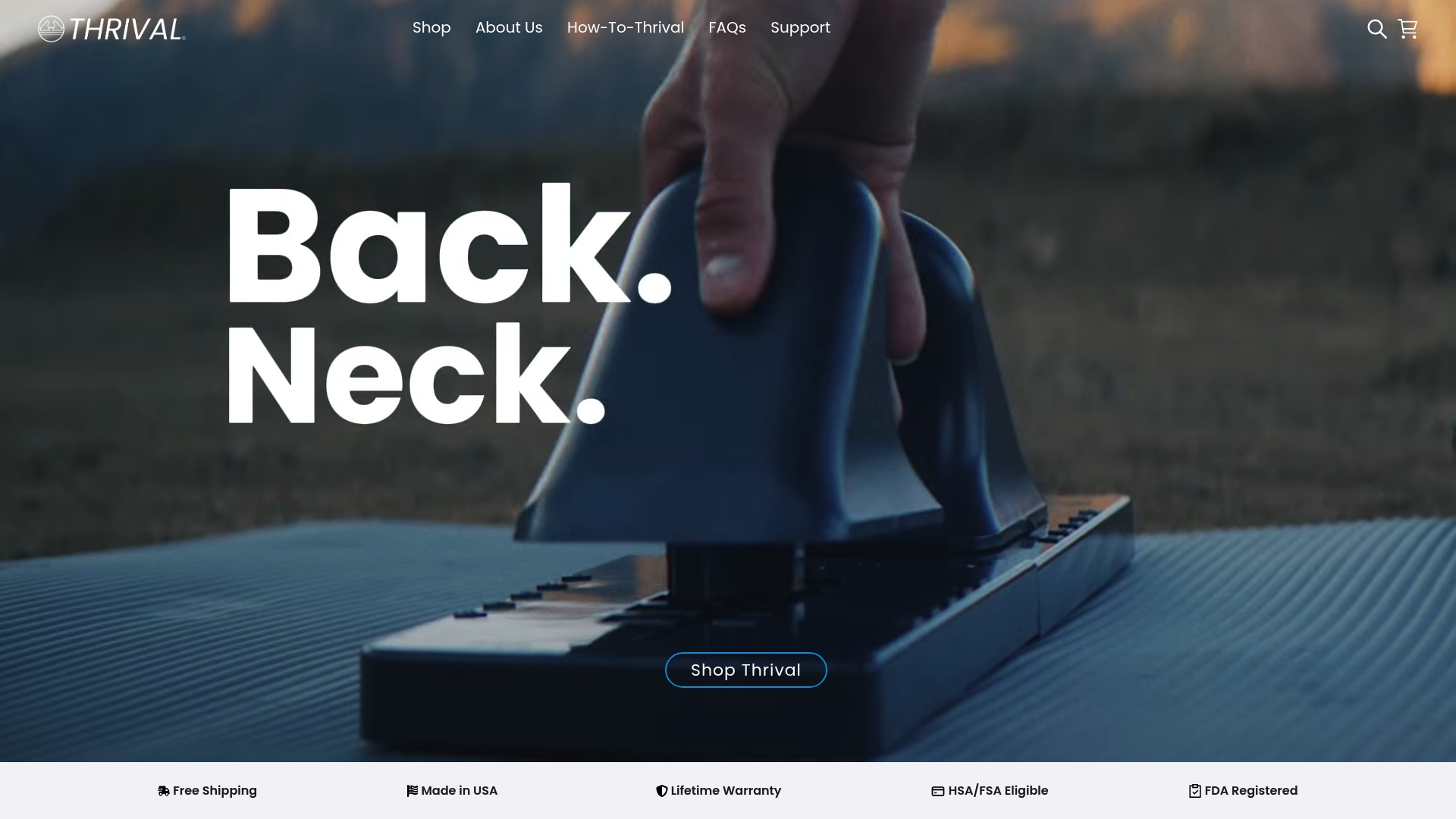
The Thrival Deep Tissue Pro is a non-motorized base board designed for precise, controlled muscle release across the back, hips, shoulders, and neck. You choose the attachment based on the area you are targeting: the Thrival Bullseye for trigger point work, the Thrival Wave for broader muscle groups, or the Thrival Arch for spinal decompression. Each tool is US-manufactured, FDA-registered, and backed by a lifetime warranty. The Thrival app guides you through routines built specifically for desk worker recovery, so you are not guessing where to apply pressure or for how long.
FAQ
How often should desk workers take movement breaks?
Movement breaks work best when tied to natural task transitions rather than fixed timers. Research shows context-aware prompts produce better adherence than rigid schedules, so aim to stand or move every 45 to 60 minutes by linking breaks to workflow events.
What muscles are most affected by prolonged sitting?
Prolonged sitting primarily inhibits the glutes, weakens the deep core stabilizers, tightens the hip flexors, and compresses the lumbar spine. These imbalances cause the back, hip, and neck pain most desk workers experience.
Is percussive therapy safe to use at work?
Percussive therapy is safe for most desk workers when used in short sessions of around five minutes and spaced to match the physiological window. Avoid applying percussive devices directly over the spine, joints, or any area with acute injury, and consult a healthcare provider if you have underlying conditions.
Stretching alone addresses flexibility but does not rebuild the inhibited muscles that cause postural imbalances. Combining stretching with activation exercises like glute bridges and pelvic tilts produces more durable relief than stretching in isolation.
What is the fastest way to relieve neck and shoulder tension at a desk?
A chest opener stretch combined with a 30-second neck side stretch on each side releases the most common tension patterns in under two minutes. Following it with a brief percussive therapy session on the upper trapezius extends the relief window by up to 40 minutes.
Recommended