Thursday, April 16, 2026
Just one of the Phillips Collection’s third-floor galleries, where “Miró and the United States” is on view through July 5, is entirely devoted to Picasso’s sole Spanish-born rival (unless you count Dalí). In that white-walled room are 22 exquisite works from the Fundació Joan Miró, a complete set of the Catalan artist’s “Constellations.”
Using a hand-stenciling technique known as pochoir, Miró in 1959 reproduced works he had painted on 15-by-18-inch sheets of paper in 1940 and 1941, first in Normandy, then, fleeing France with his wife and daughter, in Palma de Mallorca on Spain’s Balearic Islands and at his family farm about 60 miles south of Barcelona.
Classic statements in Miró’s poetic and playful visual language, the “Constellations” were inspired by the night sky, water, birdsong, music and stained glass. Beginning with “Sunrise” and “The Escape Ladder” — which hints at the artist’s wartime anxiety — the sequence concludes with “The Pink Dusk Caresses the Sex of Women and Birds” and “The Passage of the Divine Bird.” (A 23rd painting, “The Morning Star,” a gift from Miró to his wife, was not exhibited or included in the print portfolio.)
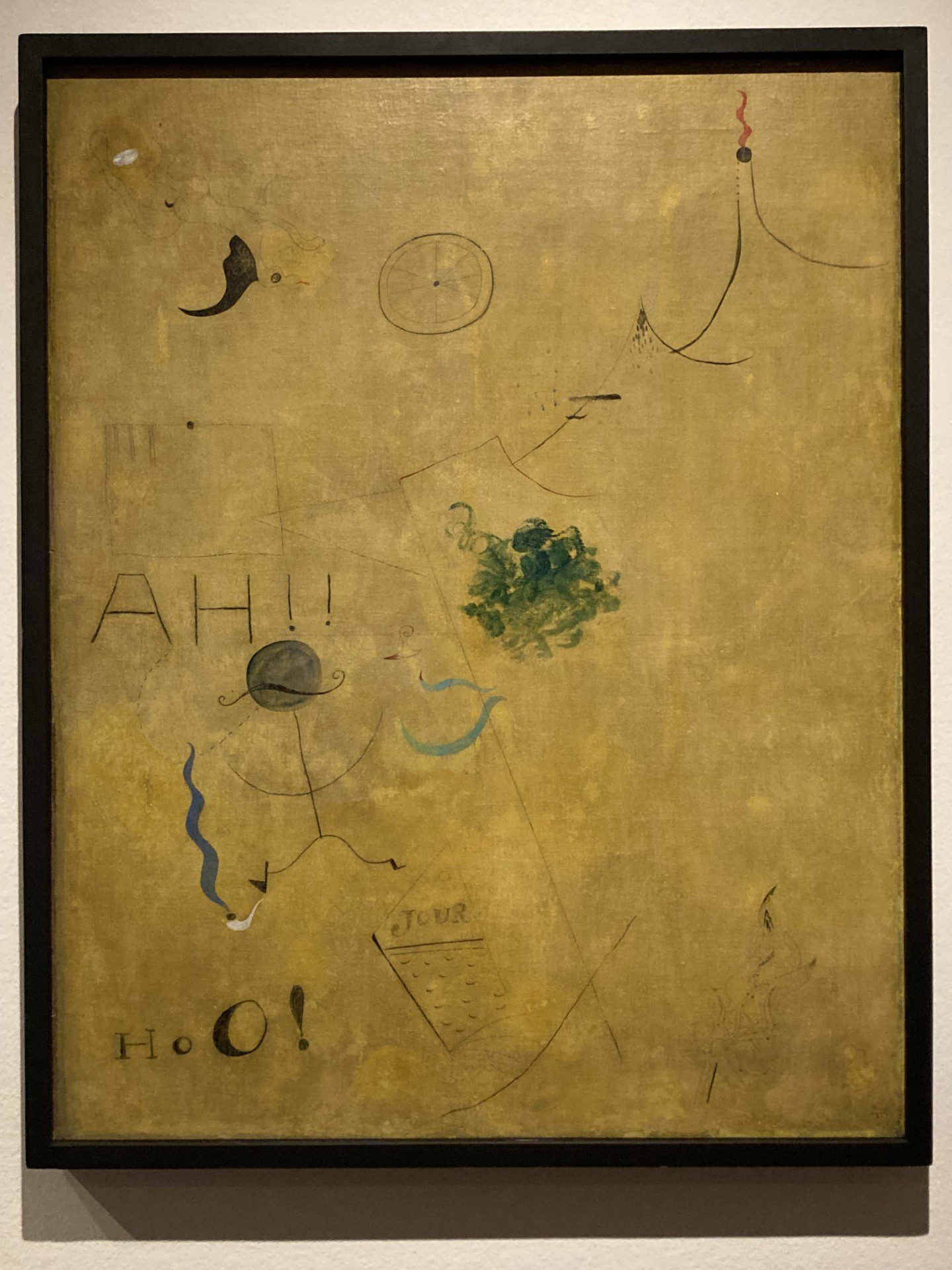
“Somersault,” 1924. Joan Miró.
Miró was well aware of their powerful cumulative impact. Yet early in 1945, when Pierre (son of Henri) Matisse exhibited the originals at his New York gallery, only 16 were on view at a time. Sold piecemeal, the series was broken up.
The infinitely varied “Constellations” not only reward close study but, at the Phillips, keep Miró from being swamped by a noisy crowd of admiring Yanks. In a show of 33 painters and sculptors, only a handful (other than Joan, pronounced “zho-AN” in Catalan) were born outside the U.S. and nearly all are considered American artists.
Of course, that’s the point — that Miró was a key influence on the New York School and was inspired in turn by several of its members. A bonus (whether intended or not): “Miró and the United States” is a pretty terrific exhibition of 20th-century American art.
Each of Abstract Expressionism’s 800-pound gorillas, de Kooning, Pollock, Rothko and Kline, has a painting or two on the wall. Even better, so do each of the “Ninth Street Women” (the title of Mary Gabriel’s 2018 book): Elaine de Kooning, Helen Frankenthaler, Grace Hartigan, Lee Krasner and Joan Mitchell.
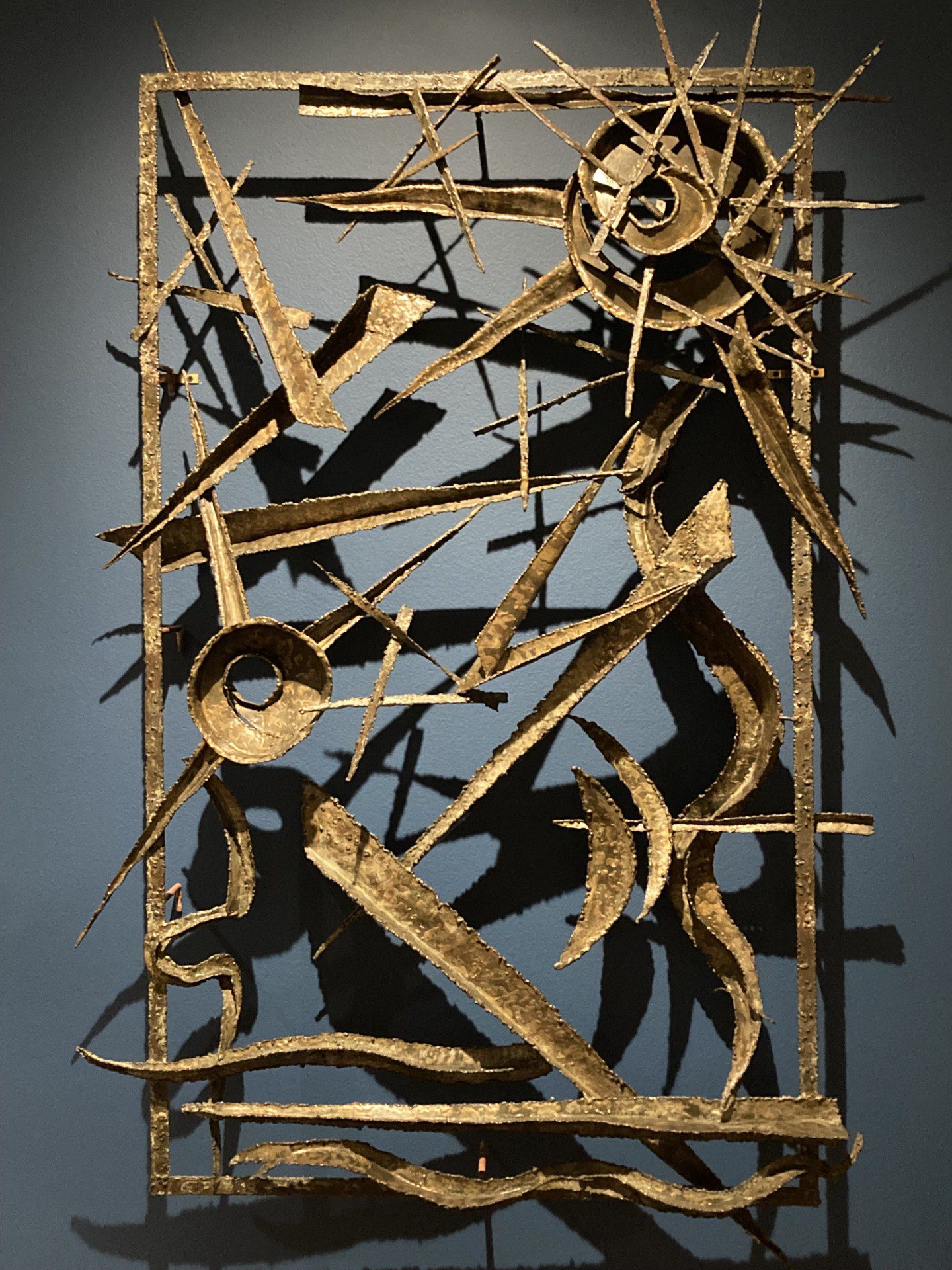
“The Sun, the Moon and the Stars II,” 1956. Herbert Ferber.
After writing to a friend that “each [Constellation] is a little miracle,” Krasner created a series of “Little Image” or “Hieroglyph” paintings,” including, at the Phillips, an untitled work of 1947-48, its black background sparkling with bristles of white and assorted colors.
“Fantastic Art, Dada and Surrealism,” a Museum of Modern Art exhibition of 1936-37, drew American attention to Miró and to the S-word. To some extent, Abstract Expressionism was an outgrowth of Surrealism, a movement obsessed with the irrational and the unconscious. A Surrealist in the 1920s, Miró became a bridge between the two approaches.
Two wonderful Mirós at the Phillips were in his first major American retrospective, at MoMA in 1941: the yellow “Somersault” of 1924, a gift to Yale by avant-garde art presenter the Société Anonyme; and the blue “Painting (Fratellini)” of 1927, from the Philadelphia Museum of Art, originally acquired by Albert E. Gallatin for his Gallery of Living Art on New York’s Washington Square.
In both these extremely simplified circus scenes (the three Fratellini brothers were Parisian clowns), Miró captures an instant of festivity and surprise in just a few shapes and wiry lines. To “Somersault,” he adds the floating exclamations “AH!!” and “HoO!”
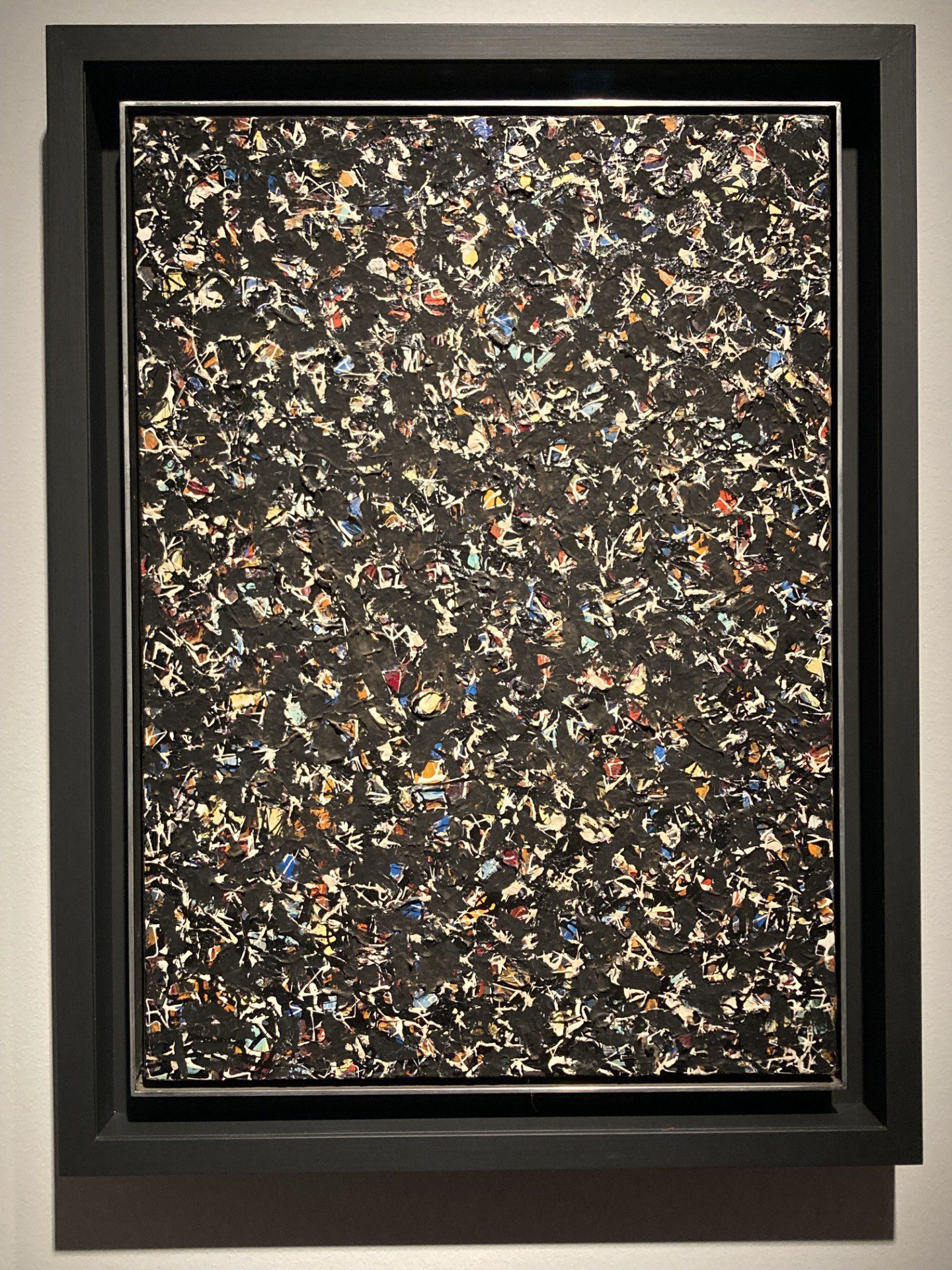
“Untitled,” 1947-48. Lee Krasner.
Paul Klee comes to mind. Though Klee and Miró never met, Miró stated: “Klee made it clear to me that a patch, a spiral, even a dot can be every bit as much an object of painting as a face, a landscape or a monument.”
The other artist pursuing a parallel path was Alexander Calder, who was rigging up his miniature circus when he called on Miró in Paris in 1928. Calder’s mobiles, begun in the early 1930s, have been described as Mirós that move. Several are in the exhibition, including one from 1948 — in an arched opening in the wall separating the entrance gallery from the blue-walled gallery behind it — and two above the stairwell: “Black Polygons,” which Calder exchanged with Miró for the painting “Women and Bird in the Night” of 1947; and “Red Polygons” (actually “Calder orange”) of 1950. Calder’s circa-1930 wire portrait of Miró, who remarked, “We are like brothers,” is nearby.
In 1947, Calder met Miró at the New York Municipal Airport (soon renamed LaGuardia) when he first visited the U.S. to carry out a commission to paint a 30-foot mural for the circular Gourmet Room on the 20th floor of Cincinnati’s new Terrace Plaza Hotel.
A sketch for the sky-blue mural, which relocated to the Cincinnati Art Museum in the 1950s, is on view at the Phillips, as is a scaled-down facsimile applied to the long wall of the entrance gallery. Miró encountered young American artists while creating the mural in a rented studio on East 119th St. and at Stanley William Hayter’s Atelier 17 print workshop, which had moved from Paris to Greenwich Village at the start of World War II.
On a platform in the center of that gallery stand white totems from the late 1940s by Louise Bourgeois, who met Miró in Paris in 1937. Three similarly tall and skinny sculptures by Jeanne Reynal from the early 1970s occupy a corner of the adjacent gallery.
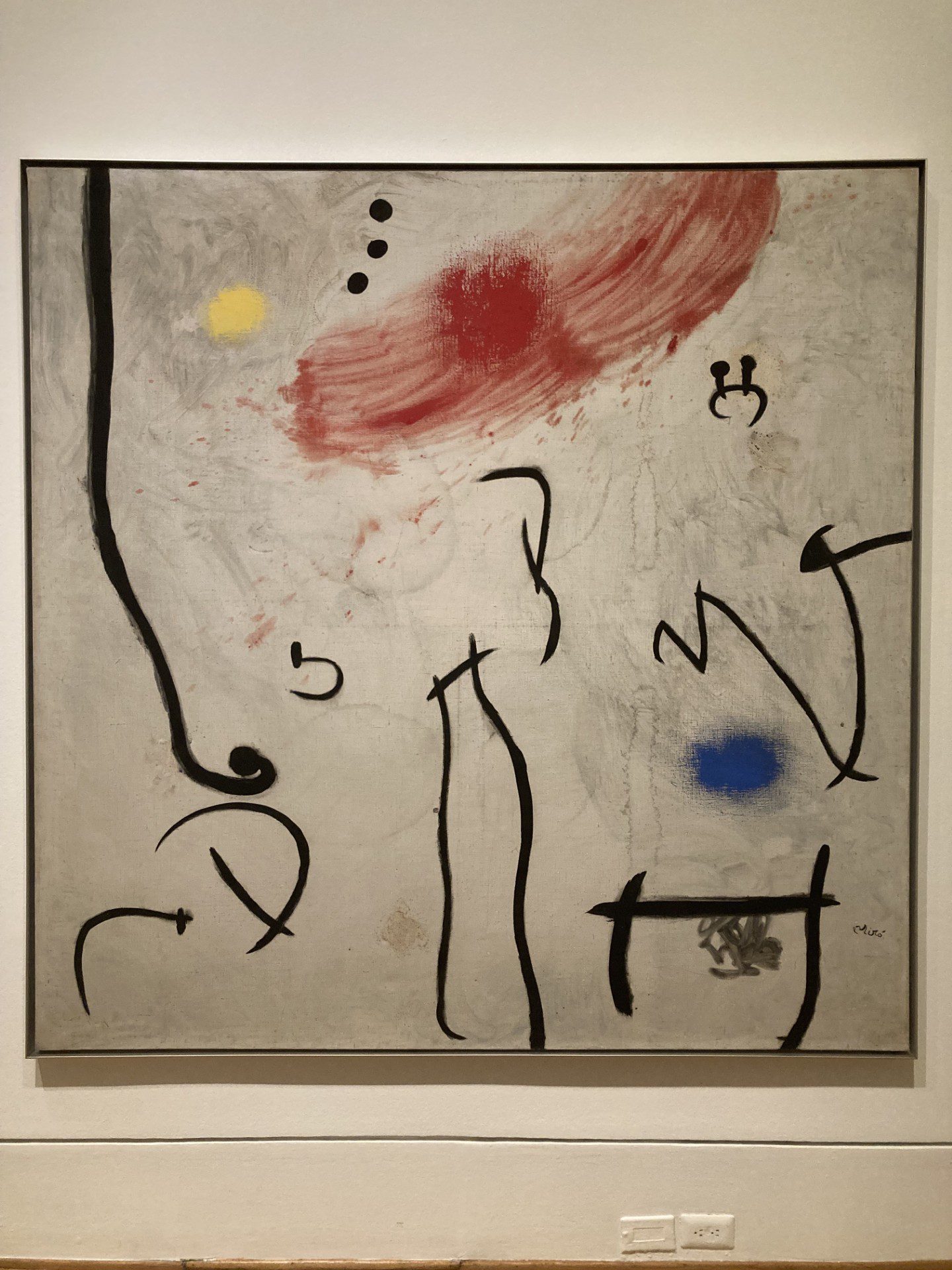
“Figures, Birds,” 1973. Joan Miró.
In the latter, in the company of paintings by Sam Francis, Rothko, Frankenthaler and Pollock (his turbulent, black-on-beige “Number 14” of 1951), are two large Miró paintings: his Harvard mural of 1961, with a rusting gold background, complete with drips and splotches; and the white “Figures, Birds” of 1973, on which thick black strokes seem to engage in activity, intruded upon by a wide wipe of red.
These late paintings — including “The First Spark of Day II” of 1966 in the blue-walled gallery — represent the impact that Abstract Impressionism had on Miró, who saw works by Pollock and Rothko in MoMA’s 1947 “15 Americans,” attended a Pollock exhibition in Paris in 1952, returned to the U.S. for a MoMA retrospective in 1959 and made four visits in the 1960s.
Along with paintings by Miró and numerous Americans, and “The Sun, the Moon and the Stars II” of 1956, Herbert Ferber’s large, Miró-esque, wall-hung brass sculpture from the Whitney Museum, the blue-walled gallery displays four Miró sculptures: “Woman” of 1949, an edition of which was owned by Frankenthaler and her then-husband Robert Motherwell; “Head” of 1969; and two bizarre, brightly painted works from 1967, “Personage” and “Her Majesty.”
Continuously screened in the room off the gallery with the Harvard mural are two short “direct films — meaning made without a camera — by Len Lye, a New Zealander who moved to New York in 1944. The stylistic link to Miró, reads a label, is that Lye “meticulously scratched into black film, leaving behind bursts of white zig-zagging shapes.” Next to the screen are three “shadowgraphs” of Miró made in 1947 using photosensitive paper. Also in this room: archival materials and a much-reworked “Self-Portrait.”
Marking the Fundació Joan Miró 50th anniversary, “Miró and the United States” was organized by three curators in Barcelona, Miró’s birthplace, with Phillips Collection Chief Curator Elsa Smithgall. On May 21 at 6:30 p.m., the Phillips will host a panel with Smithgall; Katy Rogers, president of the Motherwell-founded Dedalus Foundation; and Fundació Joan Miró Curator Dolors Rodríguez Roig.
Other events: a screening of Thomas Bouchard’s 1955 documentary “Around and About Miró,” at 6:30 p.m. on April 15; a talk by author Paul Jaskunas about poetry’s relationship to painting, at noon on May 29; and a collage workshop, from 10 a.m. to 1 p.m. on June 13.
A second Miró exhibition will open in D.C. on May 21 at the Kreeger Museum. Among the works to be displayed will be “The Mallorca Series” of 1973, acquired when David and Carmen Kreeger attended Miró’s 80th birthday, and “Makemono” of 1956, printed on a silk scroll more than 10 yards long.
Miró and the United States
Through July 5
The Phillips Collection, 1600 21st St. NW
Tuesday to Saturday, 10 a.m. to 5 p.m.
Sunday, 11 a.m. to 5 p.m.
phillipscollection.org