Tuesday, December 9, 2025
Every time Stephanie Lilley took the large plastic totes to the grocery store, someone would comment on their spaciousness and durability. Her former housekeeper, a close family friend, had brought the handwoven bags from her home country of El Salvador.? ?
Lilley realized she could help the weavers make more money, and hopefully improve their lives, by selling the bags in the States. One day in 2019, she threw a couple dozen in the back of her car and headed to the local farmers market.?
“I took them out and put a tablecloth on the ground,” Lilley recalled. “I didn’t even think to bring change. The manager said I could borrow a folding table. That’s how bad it was. I didn’t even have a table.”?
She sold them all.? ?
Eventually, the Lilley Line was born, featuring colorful totes in multiple sizes — online and in about 100 stores so far, including the Georgetown Garden Shop. But the path from that day at the farmers market to producing 5,000 bags a year was anything but predictable.?
In 2020, the pandemic forced Lilley to consider a wholesale business, bringing on graphic artist Lalie Tongour as creative director to build a website and design the bags. Lilley also solicited input from two people in the industry, including clothing designer and boutique owner Ann Mashburn.?
“Ann gave me a list of stores,” said Lilley, a former lawyer and the mother of three adult children. “I just started calling them, and a few said yes.” The number of retailers carrying the bags grew, as did her sales at Atlanta Market. She also holds trunk shows in various cities throughout the year. On her website, prices range from $50 to $175 a bag.?
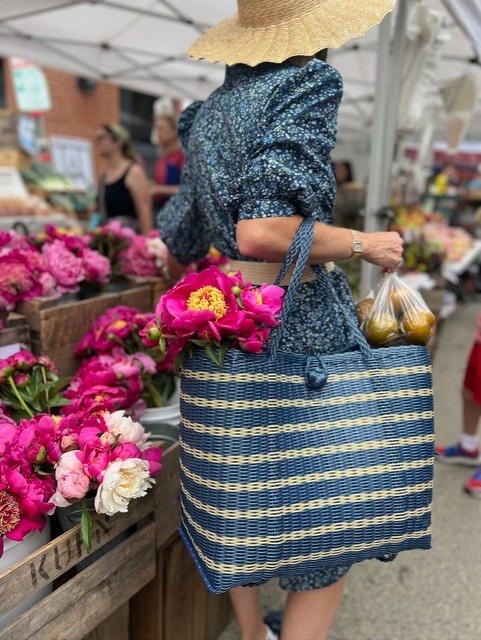
A tote bag from the Lilley Line.
Producing the bags was a bit more complicated, as Lilley — with the help of Guadalupe Lopez, her former housekeeper — managed inventory. The weavers, who use wire produced in a large factory in San Salvador, live in tiny neighborhoods near the town of Nahuizalco. Providing retailer Southern Tide with her “factory” address meant describing homes off a main road near the town.
A surprising boost occurred in 2022, when the Lilley Line’s striped clutch made it onto Oprah’s famous “O List.” But it also presented a few problems.??
“I went down there [to El Salvador] and this new team we put together didn’t want to make it,” Lilley said. “Imagine if the most popular person on TV here said they love this, and someone said, ‘We don’t have TV, we don’t have running water.’”?
An inconsistent workforce added to her issues. “We will have an expectation of 500 bags in a month and will get 400,” she said. Lilley also learned that bags made with the company’s wire were being sold in the street.?
Back in the U.S, the business operates out of Lilley’s home in the Palisades neighborhood. Collette Bruce joined as a partner, Maggie Sheedy as CFO and former intern Murphy McDonnell as director of operations and marketing. Also a partner, Gabriela Quiñónez, wife of the former Guatemalan ambassador, provides the poms and the handwoven, adjustable clutch straps.?
Lilley’s husband Justin, who grew up in Georgetown, officially contributes to the business by emptying and breaking down the boxes after a shipment arrives from El Salvador.?
“Sometimes I wake up and there are eight to 12 boxes on the front lawn,” Justin said. “I open them all up and dump them out and have to dispose of them. My role is pretty limited. I’m just a cog in the wheel.”?
Described by his wife as “so awesome,” “tolerant” and “encouraging,” Justin is equally admiring.??

Stephanie Lilley and Hembir Moran, one of the chief weavers of the Lilley Line bags, in El Salvador.
“It’s been impressive,” he said. “It’s a labor of love, I’m not going to lie. It’s a tough business. Nothing scares her. The more outrageous or bizarre it is, the more inclined she is to do it.”? ?
While the business is “barely breaking even,” according to Lilley, it is consistently expanding. She believes her penchant for taking action without overthinking has served her well so far.??
“If you’re a person that really thinks things through, you’d never do this,” she said, half-laughing. “You have to think, ‘That’ll be fine!’ You have to have that mindset.”? ?
Propelling Lilley forward as she seeks to expand, scale production and hire more workers is her mission to help improve the lives of residents of El Salvador. Currently, two of the weavers have new homes — proof that she is making a difference, however incrementally.?
As she dreams of making an even larger impact, Lilley knows that seemingly insurmountable obstacles lie ahead.?
“I’ll put my head on the table one more time and say, ‘How am I going to get through this?’” she said. “Then, by the grace of God, we do.”?
?