Aging Parents & Dementia | Why Healthcare Systems Fail at Early Detection and What Individuals Can Do
Learn why identifying memory loss doesn’t happen by doctors or family members until an older adult loses their entire savings to a telephone or online scam, takes a drive and gets lost 100 miles from home, or is influenced by a stranger they believe to be a friend.
Early signs of dementia are rarely diagnosed at doctor appointments because doctors respond to patient concerns. An older adult who lives alone and experiences memory loss may not recognize cognitive decline as a concern. So, memory loss often doesn’t come up at a medical appointment.
Most primary care physicians are not trained to recognize signs of dementia in older patients. So, until a financial, safety, or physical catastrophe happens, an aging adult or elderly parent may not be diagnosed with memory loss.
Even then, the diagnosis might happen in the hospital emergency room, along with a recommendation to see a primary care physician for follow-up. People with memory loss experience a decline in executive function, so they may not schedule a post-emergency-room follow-up visit with a primary care physician.
As a result, an older adult continues along the path of mental confusion or cognitive decline until a friend, family member, or neighbor notices, or the police or adult protective services become involved.
 Family, friends, and professional support are extremely important for people with advancing memory loss.
This podcast and show transcript reviews experiences with doctors and healthcare systems. It offers caregiving tips and advice to prevent health and physical declines that can lead to memory loss.
Learning About Memory Loss, Healthcare System Support, and Self-Advocacy
If you have little experience with the healthcare system, you may not know that healthcare businesses don’t make money preventing disease. Doctors, specialists, hospitals, etc., make money by offering services and treating sick people with chronic health conditions.
This shift in responsibility for identifying health problems has led consumers to spend more time searching for health information online.
A PEW Research Project reports that about 80% of Americans search online for health information. After checking and responding to email, looking for health or medical information is one of the most popular online activities.
Why Primary Care Doctors Don’t Diagnose Memory Loss
 One might ask why doctors don’t take the initiative to discuss the risks and potential impact of a diagnosis of early memory loss, often called mild or moderate cognitive impairment, with patients.
The answer is that many primary care physicians lack experience diagnosing it and family members may not easily recognize the signs.
Consumers fear being diagnosed with memory loss, dementia, or Alzheimer’s disease, which are chronic health conditions without a cure.
Unlike other health conditions, billing and service codes for dementia that generate revenue for physicians are currently limited, although this may change as pharmaceutical companies advance.
Specialists like neurologists and neuropsychologists have more experience in identifying memory loss and advising family members.
Dementia Care as a Revenue Generator for Healthcare Systems
Dementia care is not a significant revenue generator for all doctors or healthcare systems. There are limitations to what can be done for a progressive diagnosis with no cure.
Dementia care diagnosis and treatment is not yet like cancer, where chemotherapy and radiation can be revenue generators for healthcare providers. Identifying memory loss is not like diagnosing kidney failure, where a patient agrees to attend dialysis appointments that generate revenue several times a week.
So, for many older adults, dementia is a condition with no cure that progresses.
The individual or family members must notice and manage the day-to-day effects of memory loss progression, which doctors cannot control.
Medications and treatments may be costly, have undesirable side effects, and show no measurable benefit are not always recommended by physicians or of interest to patients and their family members.
Pharmaceutical Company Investment in The Dementia Care Market
 Separate from healthcare systems, the pharmaceutical company market for dementia care is growing. According to Grand View Research, consumer spending on dementia care is estimated to be $20.3 billion in 2026.
Because pharmaceutical companies like Eisai, Eli Lilly, Novartis, Daiichi Sankyo, AbbVie, Lundbeck, Biogen, Cipla, Sun Pharmaceutical, and Viatris are developing therapies, healthcare systems are being encouraged to focus on dementia care programs to support more access to innovative pharmaceutical treatments.
In this context, dementia care treatments may one day be as common as chemotherapy, radiation, and dialysis. If so, more and more healthcare systems will likely have dedicated memory loss or dementia care clinics.
Currently, Cleveland Clinic, Mayo Clinic, Stanford, Johns Hopkins, UCLA, Columbia, Keck USC, UT Southwestern, Penn, Ohio State, CU Anschutz, Houston Methodist, and Northwestern offer dementia programs in major metropolitan areas with dedicated memory care centers or institutes.
If you live in the areas where these health systems are located, you may benefit from additional dementia care support.
Consumer Self-Directed Care Opportunities
Separate from healthcare systems identifying memory loss and recommending treatments, how can individuals be proactive to avoid a memory loss diagnosis? The following information provides background about causes of memory loss and actions individuals can take to prevent memory loss and disability with age.
What Causes Memory Loss and Forgetfulness?
General memory loss, often called dementia, can begin years before a diagnosis. The risk factors include age. Fifty percent of older adults over age 85 have some memory loss.
Additionally, chronic health problems like high blood pressure, diabetes, and high cholesterol affect circulation, and they contribute to plaque buildup in blood vessels and arteries. Smoking and alcohol use also contribute to memory loss.
If you have memory loss concerns, a general practitioner or primary care physician can do a simple test using acronyms like MMSE, SLUMS, MOCA, and others to establish a baseline.
Specialists like a neurologist or a neuropsychologist can do additional testing and order a CT scan, MRI, PET scan, or a blood test.
Identifying Memory Loss
 So, today, early disease detection for all health conditions- heart disease, high blood sugar, and especially early memory loss, dementia, or Alzheimer’s is the responsibility of individuals and family members who must be more proactive.
Making a list of concerns to help a doctor in identifying memory loss is the first step to confirming a diagnosis or identifying other potential causes.
If you are an individual, are you recognizing periods of forgetfulness? Do you misplace common items or forget appointments, conversations, or both?
If you have aging parents, are you noticing memory gaps or changes in behavior? For example, a mom who always had good hygiene now goes days without showering and wears dirty clothes. This can be a sign that something isn’t right.
Bringing Memory Care Concerns to the Attention of a Doctor
Because you know yourself and you spend time with parents, self-identification of health issues or noticing health issues in yourself or loved ones early on is the most direct path to early disease detection so that you can discuss concerns with doctors.
The challenge is that most doctor appointments are limited to 15 minutes.
Unless a physician treats dementia patients day in and day out, they are unlikely to notice signs of memory loss in a 15-minute appointment once a year if you don’t mention your concerns.
So, identifying memory loss and other changes and being proactive to discuss concerns is an individual and family caregiving responsibility.
Caregiver Education, Advice and Tips: Dementia and Memory
 Listen to more episodes of The Caring Generation podcast covering various topics around identifying memory loss, talking to parents with dementia, managing dementia, dealing with denial, and planning for dementia care.
Episode 11: Risks and Signs of Dementia – A Checklist
Episode 26: How to Talk to a Parent With Dementia
Episode 141: What is the Impact of Dementia on a Spouse?
Episode 145: How to Deal With Dementia in a Parent
Episode 151: 10 Tips for Dealing With Dementia
Episode 169: Why Do Persons With Dementia Struggle With Little Things?
Episode 207: The Health and Well-Being Challenges of Dementia Caregivers
Episode 211: How to Respond to Loved Ones With Dementia Who Don’t Make Sense
Episode 213: What Rights Does a Person With Dementia Have?
Episode 234: Caring for Elderly Parents with Dementia: Essential Decision-Making Advice
Episode 247 My Mother is in Denial About Dementia
Episode 234 Making Decisions for an Elderly Parent with Dementia.
Episode 247: Elder Care Strategies: Dementia Denial Spouse and Aging Parent Support
Preventing and Understanding Causes of Memory Loss and Physical Disability in Old Age
To prevent memory loss and physical disability in old age, you must stay attentive to your physical and cognitive health. This means exercising regularly to maintain and build endurance, cardiovascular fitness, and muscle mass.
While most people know that exercise, healthy eating, enough sleep, and stress reduction are a recipe for good health, only a small percentage of people make the effort to build these habits into their lives.
If being healthy in old age so you can do what you want matters, consider the following research and how you might use it to improve your day-to-day life.
Walking Speed and Gait Speed
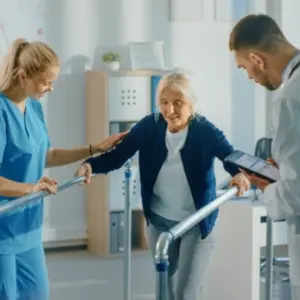 For definitional purposes, the healthcare system often refers to walking speed as “gait speed.” A more consumer-friendly term is “walking speed.”
Research suggests that a walking speed of 1.0 m/s (1 meter per second), or about 2.2 miles per hour, is the threshold at which concerns about healthy aging, independence, and longevity begin.
A walking speed lower than 1.0 m/s can predict a higher risk of falls, frailty, and mobility limitations.
A walking speed under 1.0 m/s raises the risk for 10-year cognitive decline, dementia, increased falls, physical disability, anxiety, depression, and social isolation.
The ideal pace for older adults is 3 miles per hour or 20 minutes or less per mile. For example, 3 miles per hour is the average walking speed necessary to cross the street at a standard timed traffic light.
While walking speed can decrease with age, a consistent workout routine can help maintain strength, physical endurance, and walking speed. Walking on a treadmill at the gym, using an app or a wearable, is an easy way to track daily activity.
Strengthening Ankles, Feet and Toes
Strong ankles and feet are the foundation for older adults to maintain balance, regain posture when walking on uneven surfaces, and reduce fall risk and injuries. Yet, this area of physical focus is rarely, if ever, discussed by a primary care physician.
An article in Physical Therapy and Rehabilitation reports that up to 30% of older adults have decreased ankle or foot strength, range of motion (ROM), and sensation.
Studies have found that ankle strength and flexibility in older people declined by 30% and 35%, respectively, when compared with young, healthy populations.
You might be surprised to learn that toe strength matters for balance. Strong toes support foot and ankle strength.
With a physician’s approval, strengthening and stretching exercises for the foot, ankle, and toes can support improved function, increased physical activity, and endurance.
Researching Barefoot and Minimalist Footwear
 The popularity of Barefoot and minimalist footwear is growing, especially among regular exercisers.
Barefoot or minimalist shoe wearers aim to improve foot strength, muscle and tissue structure, and stability to improve performance and reduce injury.
More research is needed to confirm whether barefoot or minimalist shoes can reduce injuries like plantar fasciitis or Achilles tendinopathy linked to weakness in core foot muscles and extrinsic foot muscles.
Switching from regular footwear to barefoot or minimalist shoes may require a period of adjustment.
These shoes typically have a wider toe box so the toes can do more work supporting walking and balance. Wearers will also notice a difference in posture.
Acknowledging the Effect of Physical Declines on Memory
As discussed above, preserving physical abilities to reduce the need for caregivers to assist with activities of daily living (ADLs) like bathing, continence care, dressing, eating, and mobility can reduce the likelihood of a memory loss diagnosis.
An interest in health and disease prevention, combined with work and life experience, supports healthy living and longevity. While turning the clock back for older generations may not be possible, caregivers of aging parents and young adults have a significant opportunity to avoid a memory loss diagnosis.
Identifying Risks of Undiagnosed Memory Loss
Watch this video to learn what doctors don’t or won’t tell their patients about mild cognitive impairment.
Click on the red arrow in the picture below to watch.
Watch Over 1000 Videos for Caregivers and Aging Adults About Caregiving, Aging, Health, Care Costs, Estate Planning and Managing Family Relationships on Pamela’s YouTube Channel
The risks of undiagnosed memory loss are significant. You, your parents, or another person with memory loss becomes a target for financial or romance scams, internet scams, elder abuse, or financial exploitation.
In some cases, the abuser is a son or daughter more interested in Mom or Dad’s money than caring for Mom or Dad. Family members most often commit elder abuse and financial exploitation.
 Beyond these concerns are the progression of other health conditions, safety, and the eventual inability of the person with memory loss to care for themselves.
The solution for a person with memory loss who can become vulnerable to the influence or neglect of others is to seek a diagnosis, discuss care needs as a family, and create a plan for memory loss and dementia care.
A typical care plan focuses on the individual’s wishes, health, healthcare, estate planning, financial costs, and social and family support.
If you’re looking for dementia care support, eldercare advice, or information about family care meetings, schedule a 1:1 or family virtual consultation with Pamela D Wilson.
©2026 Pamela D Wilson. All Rights Reserved