Saturday, June 6, 2026
Back pain relief is the process of applying targeted physical strategies, including specific exercises, stretches, heat and ice therapy, and structured self-care, to reduce pain and restore spinal function. Non-drug strategies should be tried first for back pain relief, with medications offering only modest, temporary benefit. If you are dealing with acute or chronic back pain right now, the most effective path forward combines movement, muscle conditioning, and smart daily habits. This guide walks you through exactly how to relieve back pain using evidence-based methods that work.
How to relieve back pain: understanding what you’re dealing with
Back pain relief starts with knowing which type of pain you have, because the approach differs significantly between acute and chronic presentations.
Acute back pain lasts less than six weeks and is most often caused by muscle strain, ligament sprain, or a sudden mechanical event like lifting with poor form. Chronic back pain persists beyond 12 weeks and typically involves deconditioning, postural dysfunction, or underlying structural issues. Most people experience the acute variety, and the good news is that most back pain resolves naturally with proper self-care.
Common mechanical and muscular causes include:
- Muscle or ligament strain from sudden movement or heavy lifting
- Poor sitting posture held for extended periods
- Overuse from repetitive physical activity without adequate recovery
- Weak core muscles that fail to support the lumbar spine
- Tight hamstrings and hip flexors that pull the pelvis out of alignment
Red flags that require immediate medical attention include pain following trauma, pain with numbness or tingling down the leg, loss of bladder or bowel control, or pain that worsens at night without a mechanical trigger. These symptoms suggest a cause beyond simple mechanical strain and need professional evaluation before any home care begins.
Movement and targeted therapy work for mechanical back pain because muscle tissue responds to graded loading. Staying active with back pain is more helpful than bed rest, provided the activity stays gentle and within your comfort range.
What self-care techniques effectively relieve back pain at home?
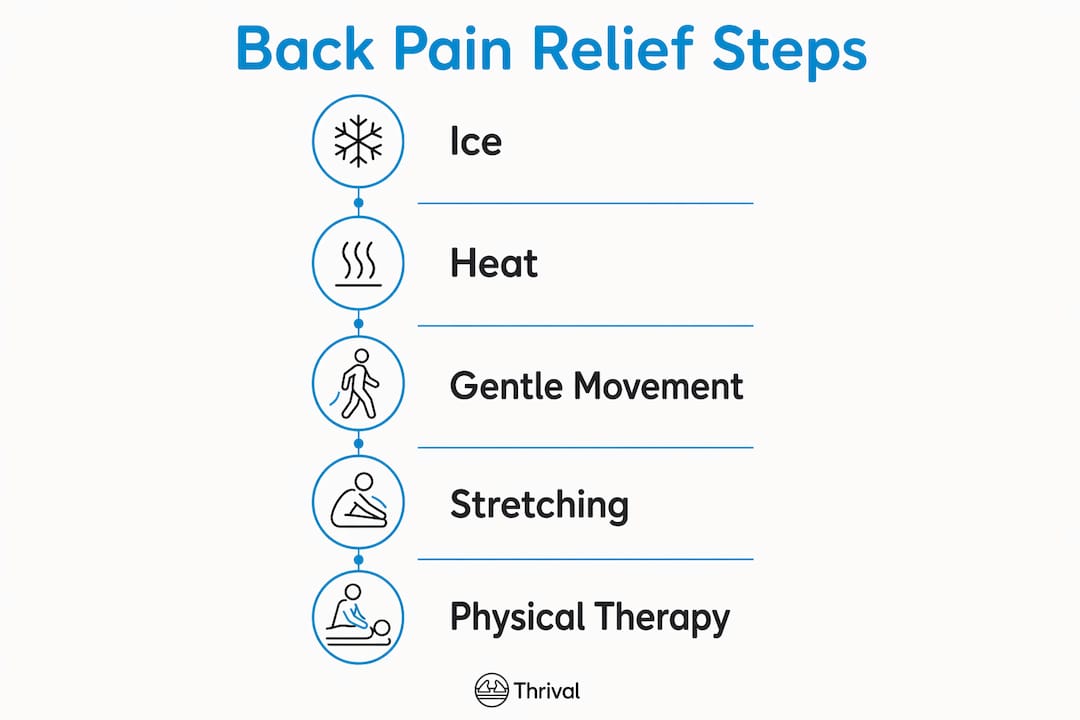
The first 72 hours after a back pain episode set the tone for recovery. Apply ice during this window to reduce acute inflammation. After 72 hours, switch to heat to address the stiffness and muscle spasm that follow the initial inflammatory phase. This phase-based approach aligns with how your body actually heals, not just how it feels.
For over-the-counter pain relief, ibuprofen (an NSAID) reduces both pain and inflammation, while acetaminophen addresses pain without anti-inflammatory action. Follow package directions precisely and avoid relying on either as a long-term solution. They create a window for movement, not a substitute for it.
Practical self-care steps to follow:
- Apply ice wrapped in a cloth for 15 to 20 minutes, up to three times daily, during the first 48 to 72 hours
- Switch to a heating pad or warm compress after the 72-hour mark to loosen tight muscles
- Avoid heavy lifting or twisting for the first six weeks after pain onset to prevent flare-ups
- Sleep on your side with a pillow between your knees to keep the spine neutral
- Adjust your workstation so your monitor sits at eye level and your hips stay at 90 degrees when seated
Prolonged bed rest is one of the most common mistakes people make. Limiting activity to just the first two or three days is appropriate. After that, gradual return to normal movement speeds recovery and prevents the deconditioning that turns acute pain into a chronic problem.
Pro Tip: Set a timer on your phone to remind yourself to stand and walk for two minutes every 45 minutes if you work at a desk. Sustained sitting compresses the lumbar discs and tightens the hip flexors, both of which directly worsen lower back pain.
Effective home exercise centers on neutral spine core activation, gradual progression, and avoiding pain onset during any movement. Many home care plans fail because they skip core control entirely and jump straight to aggressive stretching. Start here instead.
Core activation: abdominal bracing
- Lie on your back with knees bent and feet flat on the floor.
- Breathe in, then as you exhale, gently draw your lower abdomen inward as if bracing for a light punch. This is the “crush the soda can” cue used in clinical settings.
- Hold the contraction for 10 seconds without holding your breath.
- Repeat 5 to 10 times. Build toward 30 repetitions over several weeks.
Plank and side plank
- Start in a forearm plank position with elbows directly under your shoulders and your body in a straight line from head to heels.
- Hold for 10 to 30 seconds while maintaining abdominal bracing. Repeat 2 to 5 times.
- Progress to a side plank by rotating onto one forearm, stacking your feet, and holding the same duration.
- Never allow your hips to sag. If form breaks down, shorten the hold time rather than pushing through.
Hamstring and gluteal stretches
- Lie on your back and loop a towel around one foot. Straighten the leg toward the ceiling until you feel a gentle pull behind the thigh. Hold 20 to 30 seconds per side.
- For the glutes, cross one ankle over the opposite knee in a figure-four position. Gently press the crossed knee away from your body. Hold 20 to 30 seconds.
- For a hip twist stretch, lie on your back, bring one knee to your chest, and slowly rotate it across your body while keeping both shoulders flat. Hold 20 to 30 seconds per side.
Pro Tip: Start with 5 reps of any new exercise and increase gradually toward 30 repetitions over two to four weeks. Rushing this progression is the most common reason people re-injure themselves during recovery.
Avoid hyperflexion, hyperextension, and rotational twisting movements in an injured back. These ranges of motion place high load on already sensitized structures and reliably set recovery back.

How does physical therapy integrate with self-care for lasting relief?
Physical therapy for back pain focuses on spinal flexibility, posture correction, and progressive strengthening of the core and paraspinal muscles. A licensed physical therapist builds a patient-specific program rather than applying a generic protocol, which is why outcomes differ significantly from self-directed exercise alone.
Early physical therapy reduces opioid use and surgery rates for back pain patients compared to delayed therapy. This is a clinically significant finding. It means that getting professional guidance within the first few weeks of an episode is not just about faster pain relief. It actively reduces the risk of a more invasive and costly treatment path later.
The table below compares self-care and physical therapy across key dimensions:
| Approach | Best for | Core focus | Limitation |
|---|
| Self-care at home | Acute, mild to moderate pain | Ice, heat, rest pacing, basic exercise | No professional form correction |
| Physical therapy | Persistent, recurring, or severe pain | Tailored exercise, posture, body mechanics | Requires access and commitment |
| Acupuncture or massage | Chronic pain with muscle tension | Soft tissue release, nervous system regulation | Adjunct only, not standalone |
| Mindfulness-based therapy | Chronic pain with psychological overlay | Pain perception, stress reduction | Requires consistent practice |
Physical therapists also teach safe body mechanics for daily tasks like lifting, bending, and sitting, which directly reduces re-injury risk. For chronic cases, progressive conditioning programs build the load tolerance that prevents future episodes. If your pain has not improved meaningfully after two to three weeks of consistent home care, a physical therapy referral is the right next step.
What common mistakes make back pain worse?
The most damaging mistake is starting aggressive exercise too soon. Jumping into high-intensity core work or deep stretching within the first 48 hours of an acute episode reliably worsens symptoms and extends recovery time.
Other patterns that slow recovery:
- Relying on medication alone without addressing the underlying muscle weakness or postural dysfunction
- Returning to heavy lifting or sport before the six-week tissue healing window closes
- Ignoring ergonomics at work, particularly sustained forward head posture and unsupported lumbar sitting
- Skipping the gradual progression phase and attempting full exercise loads too quickly
- Treating pain as a signal to stop all movement rather than a guide for modifying it
“The goal is not to avoid pain entirely. The goal is to move within a pain-free range and expand that range progressively over time.”
Your body signals matter. Sharp, shooting, or worsening pain during an exercise means stop immediately. Mild muscle fatigue or a gentle stretch sensation is normal and expected. Learning to distinguish between these two signals is one of the most practical skills you can develop during recovery. Explore muscle therapy tips to better understand how to read and respond to what your body is telling you.
Key takeaways
Effective back pain relief requires a phased approach combining ice, then heat, targeted core exercises, and early professional guidance when symptoms persist.
| Point | Details |
|---|
| Phase your temperature therapy | Use ice for the first 72 hours, then switch to heat to address muscle spasm. |
| Prioritize core activation | Abdominal bracing and planks build the spinal stability that prevents re-injury. |
| Avoid prolonged rest | Return to gentle activity after two to three days to prevent deconditioning. |
| Seek physical therapy early | Early PT reduces opioid use and surgery rates compared to delayed intervention. |
| Progress gradually | Start with 5 reps of any exercise and build toward 30 over several weeks. |
Why most people recover slower than they should
I have seen the same pattern repeat itself across hundreds of people dealing with back pain. They do the right things for the first three days, then either stop entirely because the pain has eased, or they overcorrect and push too hard because they feel impatient. Both responses extend the recovery timeline significantly.
The counterintuitive truth is that the window between “pain is gone” and “fully recovered” is where most re-injuries happen. Tissue healing and pain resolution are not the same event. Pain often disappears before the underlying muscle weakness and movement dysfunction are corrected. This is why people who feel better after two weeks go back to their normal routine and find themselves back at square one within a month.
What actually works is boring and consistent. Daily core activation, gradual loading, and attention to posture during ordinary tasks like sitting, standing, and lifting. The mobility and recovery principles that apply to athletes apply equally to desk workers and anyone else dealing with mechanical back pain.
The other thing I would push back on is the instinct to treat back pain as purely a structural problem. For most people, it is a movement and conditioning problem. The spine is not fragile. It is designed to move, load, and recover. Your job is to give it the right inputs in the right sequence.
— Cameron
How Thrival supports your back pain relief routine

The exercises and self-care techniques in this article work best when paired with targeted muscle release between sessions. Thrival’s Deep Tissue Pro is a non-motorized recovery board with interchangeable attachments, including the Wave, Bullseye, Arch, and Ballhead, each designed to target specific muscle groups in the back, hips, and shoulders. It delivers focused pressure to tight spots along the paraspinal muscles and glutes, replicating the effect of professional soft tissue work at home. US-manufactured, FDA-registered, and backed by a lifetime warranty, it fits directly into the recovery routines described in this article. Pair it with the Thrival app for guided routines built around your specific pain area.
FAQ
What is the fastest way to relieve back pain at home?
Apply ice for the first 48 to 72 hours to reduce inflammation, then switch to heat for muscle spasm. Gentle movement and core activation exercises accelerate recovery faster than rest alone.
How long does acute back pain typically last?
Most acute back pain resolves within four to six weeks with consistent self-care, including activity pacing, targeted exercise, and avoiding heavy lifting or twisting during the healing window.
Are back pain relief exercises safe to do every day?
Gentle core activation exercises like abdominal bracing are safe daily. Start with 5 repetitions and progress gradually. Stop any exercise that produces sharp or radiating pain.
When should I see a doctor or physical therapist for back pain?
Seek professional evaluation if pain has not improved after two to three weeks of home care, if you have numbness or tingling in the legs, or if pain follows a fall or trauma.
Does physical therapy actually reduce back pain long-term?
Yes. Early physical therapy reduces opioid use and surgery rates compared to delayed treatment, and patient-specific programs address the root causes of pain rather than just the symptoms.
Recommended