Wednesday, May 20, 2026
You’ve heard all the advice to maintain a regular writing practice, whether it’s putting in almost daily words on your work in progress or writing in a journal.
While not essential, sustained practice has many benefits. One of them is that you may spend more time in a state of flow.
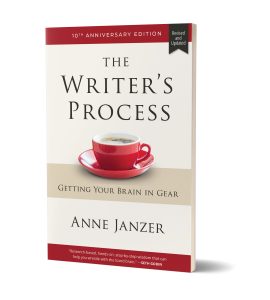
I wrote about this in the second edition of The Writer’s Process. For your entertainment, here’s the excerpt.
Practice supports the flow
Walking along the coast recently, I passed a man playing a ukulele and singing. That’s not unusual for the weekend crowd in Santa Cruz, a beach town full of colorful people. However, this guy was riding a bicycle at the same time. Pedaling, holding a ukulele with both hands, and singing.
Now that’s impressive. Frightening, yes, but impressive. Clearly, he is so adept at riding a bike hands-free that he can play the ukulele and sing while doing so.
The cycling ukulele player struck me as a reasonable metaphor for writing in a sense of flow. As writers, we’d like to achieve a similar kind of effortless fluidity to our writing craft, at least when we’re drafting.
Having the right degree of challenge is one of the attributes of flow. You need a baseline of expertise at the craft if you want to slip into flow. Practice makes it more likely.
Researchers at Drexel University’s Creativity Research Lab hooked up 32 jazz guitarists of varying degrees of experience to high-density electroencephalograms (EEGs) — essentially a netting cap laced with electrodes that tracks what’s going on under the skull in the brain. Once hooked up in their charming electrode caps, the guitarists improvised along with six tunes and rated their own degree of “flow” during the experience.
The more experienced musicians reported experiencing flow more often, and with more intensity, than those with less experience, who rarely entered the flow state. (Seriously, anyone who can find flow in a lab setting with electrodes on their skull is impressive.)
When researchers examined the EEGs of those experiencing flow, they found that areas involved with executive control in the brain showed decreased activity, while other areas, including those associated with auditory and visual areas, showed more.
When in flow, the experienced musicians weren’t thinking about theory or key signatures. Their musical understanding had transferred to a point where they knew these things almost automatically. That’s how they could improvise creative riffs.
For these musicians, at least, flow combined extensive experience with releasing control. They trusted their experience enough to let go of control. (That sounds to me like the Scribe stepping back.)
Improvising a riff and writing a story seem to be kindred experiences; what can we take away from this as writers?
Keep practicing
To make writing second nature, you’ve got to practice. If you rarely write, you can hardly expect to drop into a state of flow each time you sit down with a pen.
You can practice the craft of writing in regular, daily bursts without a huge commitment with activities like freewriting, exploratory writing, journaling, and morning pages. The format doesn’t matter. Even if you discard the words, these techniques help you practice the fluid exchange of the Muse and the Scribe in the writing process. When you polish and shine a few of those pieces, you augment your critical eyes, making that process closer to second nature as well.
You can, of course, create great work painstakingly, without ever reaching the state of flow. You’ll have a lot more fun if you figure out how to find flow in your writing.
Don’t Revise as You Write
This final piece of advice is critical—write the first draft without revising. Don’t worry about mechanics or whether you’re using the same verb all the time. You can fix that later. If you want the words to flow, remove the filters. (This is why, in the Writing Recipe, I split revision from the drafting process.)
Want more like this?
If you enjoyed this excerpt, check out the new edition of The Writer’s Process.
Cuesta Park Consulting & Publishing publishes books and online courses for writers and marketing professionals. Books are available in print, ebook, and audiobook formats from a wide range of retailers. For more information, visit AnneJanzer.com.