Saturday, May 2, 2026
Most people assume deep tissue massage simply means pressing harder. That’s one of the most persistent misconceptions in muscle recovery. In reality, deep tissue massage is a precise, science-backed practice that uses targeted pressure, specific angles, and skilled technique to reach layers of muscle and connective tissue that standard relaxation massage never touches. Whether you’re an athlete dealing with recurring tightness, or someone managing chronic back and shoulder pain, understanding how deep tissue massage actually works will help you use it more effectively and get lasting relief.
Table of Contents
Key Takeaways
| Point | Details |
|---|
| Targets deep tension | Deep tissue massage works by addressing the muscles and fascia beneath the surface to relieve chronic pain and stiffness. |
| Uses specialized techniques | It employs methods like muscle stripping, cross-fiber friction, and trigger point therapy for maximum effect. |
| Evidence-backed recovery | Scientific studies support its role in speeding recovery from exercise, reducing soreness, and improving mobility. |
| Safety is key | Be aware of contraindications and always consult a professional if you have any health concerns. |
| Pressure isn’t everything | True effectiveness comes from skilled technique and mindful application, not brute force. |
What is deep tissue massage?
Deep tissue massage isn’t just a more intense version of a relaxation rubdown. It’s a therapeutic practice with a specific goal: reaching the deeper layers of muscle, tendons, and fascia to address the root cause of tension and pain. Many people walk away from a session feeling better but not fully understanding why. The reason is that deep tissue work targets adhesions, which are bands of rigid, painful tissue that form when muscles are overworked, injured, or chronically tight.
According to WebMD, deep tissue massage is “a therapeutic technique targeting deeper layers of muscle, tendons, and fascia using slow, firm pressure and strokes to break down adhesions, relieve chronic tension, and improve mobility.” That definition captures the core intent: this isn’t about comfort during the session. It’s about functional outcomes afterward.
Here’s what deep tissue massage is designed to address:
- Chronic muscle tension that doesn’t respond to lighter touch
- Adhesions and scar tissue that restrict normal movement
- Reduced range of motion caused by tight or damaged fascia
- Postural imbalances that create ongoing discomfort in the neck, back, and hips
- Sports injuries and the residual tension left behind even after healing
The intent distinguishes deep tissue massage from a Swedish relaxation session in a fundamental way. It’s therapeutic in nature, and it works best when you have a clear target: a specific muscle group, movement restriction, or pain pattern that needs attention.
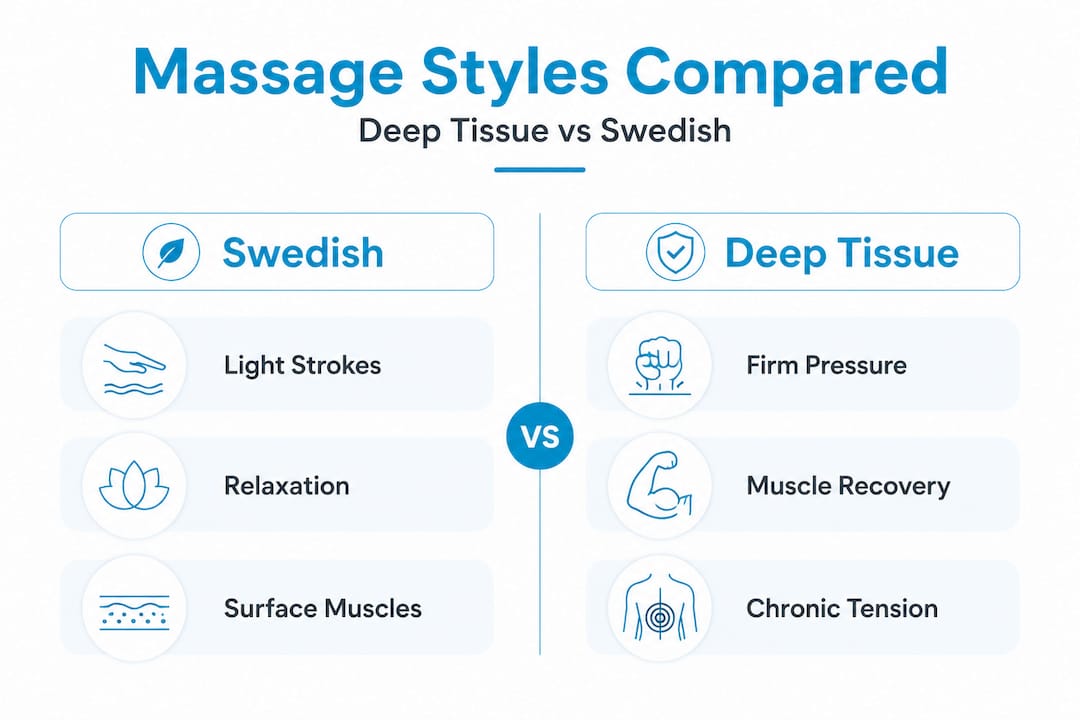
Deep tissue vs Swedish massage: Key differences
Defining deep tissue massage sets the stage for comparing it with other common styles. The Swedish massage is what most people picture when they think of massage therapy. Soft music, warm rooms, long gliding strokes. It’s designed to relax, improve circulation, and reduce general stress. Deep tissue massage shares some of the same hand movements, but the application and purpose are entirely different.
As WebMD explains, Swedish vs deep tissue massage differ significantly: Swedish uses light-to-moderate gliding strokes for relaxation and circulation, while deep tissue uses vigorous, slow strokes with fingers, thumbs, and elbows for pain relief targeting chronic issues, athletes, and sedentary individuals. The pressure is sustained and intentional, not rhythmic and soothing.
| Feature | Swedish massage | Deep tissue massage |
|---|
| Primary goal | Relaxation, circulation | Pain relief, tissue repair |
| Pressure level | Light to moderate | Moderate to firm |
| Stroke type | Long, gliding strokes | Slow, targeted strokes |
| Tools used | Palms, fingertips | Elbows, knuckles, thumbs |
| Best for | Stress, general wellness | Chronic pain, injuries |
| Session feel | Comfortable throughout | Temporarily intense |
| Recovery needed | Minimal | Possible soreness after |
Choosing between the two comes down to your specific goal. If you’re looking to unwind after a stressful week, Swedish massage delivers that. If you have a stubborn knot in your upper trapezius that’s been affecting your shoulder mobility for months, deep tissue massage is the right call.
Pro Tip: If you’re new to deep tissue work, start with a shorter session and communicate your pain tolerance clearly with your therapist. Going too deep too fast can cause unnecessary soreness that sets back rather than supports your recovery.
Core deep tissue massage techniques explained
Understanding the differences between massage styles makes it easier to appreciate what’s actually happening during a deep tissue session. There are several distinct techniques that therapists use, each targeting a specific tissue problem. Knowing what they are helps you communicate better with your provider and recognize when a technique is working.
The Alpha School of Massage outlines four foundational techniques used in deep tissue practice:
- Muscle stripping: The therapist glides firmly along the length of a muscle fiber, from origin to insertion. This technique releases knots, breaks up adhesions, and restores normal fiber alignment. It’s particularly effective for the back, hamstrings, and calves.
- Cross-fiber friction: Pressure is applied perpendicular to the muscle fibers rather than along them. This disrupts scar tissue formation, promotes blood flow to the area, and restores elasticity. It’s commonly used around tendons and joint areas recovering from minor injuries.
- Trigger point therapy: Sustained pressure is applied directly to a trigger point, which is a localized nodule of contracted muscle tissue that causes referred pain. Holding pressure on the trigger point until the tissue releases is one of the most effective methods for eliminating deep muscle pain that radiates to other areas.
- Myofascial release: Rather than targeting individual muscle fibers, this technique applies sustained pressure to the fascia, which is the connective tissue surrounding and supporting every muscle in your body. When fascia becomes restricted through overuse or injury, it limits mobility and amplifies pain signals. Releasing it restores tissue glide and reduces discomfort across entire movement patterns.
Each technique requires both knowledge and sensitivity. A therapist using cross-fiber friction on an area of active inflammation, for example, can increase pain rather than relieve it. Technique selection depends on the tissue condition, the client’s history, and the treatment goal.
Pro Tip: Self-massage tools that replicate trigger point and myofascial release work well between professional sessions. Look for tools designed with targeted surface textures that can isolate specific muscle groups without applying generalized pressure.
How science supports deep tissue massage for recovery
Now that you know the techniques, let’s see how real evidence backs their use for muscle repair and recovery. The research on deep tissue and related massage modalities is growing, and the findings consistently support what experienced therapists and athletes have known for years.
One compelling area of research involves delayed onset muscle soreness (DOMS), the familiar discomfort you feel 24 to 48 hours after intense exercise. A study published in Frontiers in Public Health found that percussion massage reduced DOMS, improved range of motion (ROM), jump height, and power output compared to stretching alone, with sessions over 40 minutes outperforming shorter 25-minute sessions. Percussion massage uses deep, rapid strokes that overlap significantly with the mechanisms of deep tissue work.
The benefits documented across massage research include:
- Reduced muscle soreness following high-intensity training or competition
- Improved range of motion in targeted joints and muscle groups
- Faster recovery between training sessions for athletes
- Decreased inflammation markers in the days following deep work
- Enhanced muscle performance in subsequent workouts
| Outcome | Evidence quality | Notes |
|---|
| DOMS reduction | Strong (RCT supported) | Especially with longer sessions |
| Range of motion improvement | Moderate to strong | Consistent across modalities |
| Athletic performance | Moderate | Jump height, power measures |
| Chronic pain relief | Moderate | WebMD-cited supportive evidence |
| Circulation improvement | Moderate | Promotes healing via blood flow |
WebMD notes that deep tissue massage is ideal for muscle pain and tension sufferers and athletes, targeting chronic issues that Swedish massage can’t reach, and promoting healing through circulation and inflammation reduction. While direct randomized controlled trials on deep tissue specifically are still limited, the surrounding evidence from related manual therapies is strongly supportive.
Stat to know: In the Frontiers in Public Health RCT, percussion massage sessions longer than 40 minutes showed measurably better outcomes for DOMS and jump performance than standard stretching routines. Duration matters as much as technique.
For those who want to extend recovery work between professional sessions, exploring dedicated muscle recovery tools can help you maintain the tissue benefits deep tissue massage provides. Supporting your mobility and recovery consistently is what separates occasional relief from real, lasting improvement.
Risks, contraindications, and safe deep tissue massage practices
With science on your side, it’s vital to know the edge cases and keep safety in mind before booking a session. Deep tissue massage is powerful, and that means it’s not appropriate for everyone. Using the wrong technique on the wrong condition can cause genuine harm.
WebMD identifies clear contraindications for massage: avoid deep tissue massage if you have osteoporosis, blood clots or deep vein thrombosis (DVT), are on blood thinners, have recent injuries or surgery, are pregnant without medical clearance, have active infections, open wounds, heart conditions, or high blood pressure. Risks include bruising, muscle tears, and potential clot dislodgement in high-risk individuals.
Before any session, review these safety points:
- Disclose your full medical history to your therapist, including medications, recent procedures, and existing conditions
- Start lighter if you have no previous experience with deep tissue work
- Never receive deep tissue massage over bruised, inflamed, or broken skin
- Avoid sessions during acute injury flare-ups or within the first 72 hours of a strain or sprain
- Drink water before and after to support tissue flushing and reduce post-session soreness
For those with specific medical conditions, you should always review the important contraindications relevant to massage therapy before starting a routine.
“Deep tissue massage should always feel like ‘productive discomfort’ rather than sharp or stabbing pain. If something feels genuinely wrong during a session, communicate immediately. A skilled therapist adjusts technique in real time based on your feedback.”
Post-session care matters too. Mild soreness is normal and typically resolves within one to two days. Light stretching, hydration, and rest support recovery. Avoid intense training immediately following a deep tissue session, since the muscle tissue has just been worked and needs time to integrate the changes.
Why intent matters more than pressure: Our take on deep tissue massage
The most common mistake people make when seeking or evaluating deep tissue massage is equating quality with pressure. More force does not mean better results. In fact, a therapist who applies maximal force without warming the tissue first, adjusting their angle, or reading the tissue response is more likely to cause bruising and soreness than to produce genuine relief.
The Alpha School of Massage makes this point clearly: deep tissue technique is about intent, angle, and gradual warming of tissues, not maximal force. Communicating discomfort is essential, and post-session soreness is normal but should be managed with hydration, stretching, and rest. Skilled therapists read tissue feedback continuously, adjusting depth and angle as muscle fibers soften and release.
We’ve seen too many people leave a session feeling beat up rather than relieved because they assumed intensity equaled effectiveness. A well-executed deep tissue session uses graduated pressure: starting lighter, warming the superficial layers, and then working progressively deeper as the tissue responds. Rushing that process is what causes the unnecessary soreness that puts people off deep tissue work entirely.
The best outcomes come from treating each session as a conversation between therapist and tissue. You should always listen to your body throughout the process, both during and after. Tracking how your body responds over multiple sessions allows you to refine the approach, identify what works for your specific pain patterns, and build a recovery strategy that’s genuinely personalized rather than one-size-fits-all.
Intent, precision, and communication matter far more than pressure alone. That’s the standard we hold every recovery tool and technique to.
Explore deep tissue recovery solutions
Ready for practical next steps? Here’s how to support your recovery journey beyond the massage table.
Professional sessions are valuable, but they’re not always accessible between training days or during a demanding schedule. That’s where purposeful, at-home deep tissue tools make a real difference.

At Thrival Muscle Recovery, we design targeted recovery tools that replicate the precision of professional deep tissue work. Whether you need focused trigger point release for the back and hips, myofascial relief for the shoulders and neck, or spinal decompression support, our tools are built for performance-grade results. The Thrival Deep Tissue Pro delivers professional-grade muscle relief in a portable, durable format, backed by US-based manufacturing, an FDA registration, and a lifetime warranty. Explore our full catalog and find the tool that fits your specific recovery needs.
Frequently asked questions
What conditions benefit most from deep tissue massage?
Deep tissue massage is helpful for chronic muscle tension, sports injuries, and postural issues that lighter massage can’t address. It reaches deeper tissue layers that Swedish massage simply cannot, making it effective for persistent pain and restricted mobility.
Is post-massage soreness normal after deep tissue work?
Yes, mild soreness after deep tissue massage is common and typically resolves within a day or two. As the Alpha School of Massage recommends, hydrating, stretching lightly, and resting after your session helps manage this normal response effectively.
Who should avoid deep tissue massage?
Individuals with osteoporosis, blood clots, certain medical conditions, or recent injuries should not receive deep tissue massage without a doctor’s clearance. WebMD identifies clear contraindications that include blood thinners, pregnancy without approval, open wounds, and active heart conditions.
How often should I get deep tissue massage for best results?
Monthly sessions are recommended for most athletes or those with chronic issues, but frequency should be adjusted based on your recovery response. WebMD advises that monthly sessions are a solid baseline, with adjustments made depending on how your body recovers and whether you’re using complementary tools between appointments.
Recommended