Tuesday, April 28, 2026
Walk into any sports store or scroll through any fitness feed and you’ll find dozens of recovery tools all claiming to speed up healing, cut soreness, and get you back to training faster. Ice baths, foam rollers, massage guns, compression sleeves, red light panels — the options keep growing. But each tool works through a different mechanism, targets a different phase of recovery, and suits a different type of athlete. Knowing which one actually fits your needs is the difference between recovering smarter and wasting both time and money on something that doesn’t move the needle for you.
Table of Contents
Key Takeaways
| Point | Details |
|---|
| Choose tools by need | Match muscle recovery tools to your specific pain, mobility, or soreness priorities. |
| Cold therapy for acute relief | Ice baths and cryotherapy rapidly curb inflammation and soreness right after workouts. |
| Foam rolling boosts mobility | Self-myofascial release improves immediate flexibility and eases tight muscles. |
| Tech tools support advanced recovery | EMS, compression, and red light therapy give extra options for serious athletes. |
| Mix and stay consistent | Blending recovery methods yields the best long-term results for active individuals. |
Before you invest in any recovery device, it helps to build a simple framework around your actual needs. Not every athlete has the same recovery challenges. A marathon runner dealing with chronic tightness in the hips needs different tools than a powerlifter managing post-squat soreness or a desk worker whose neck locks up after long training sessions.
Start by identifying your most common muscle issues:
- Soreness and inflammation after high-volume training
- Chronic tightness in specific areas like the hips, lower back, or shoulders
- Injury-prone zones that need consistent maintenance work
- Mobility limitations that affect your movement quality and performance
- Recovery speed between back-to-back training days or competitions
Once you know your priorities, you can match tools to function. Recovery tools generally work through three mechanisms: mechanical (pressure, vibration, compression), thermal (heat or cold), and electrical (muscle stimulation). Each targets a different physiological process.
Understanding the importance of recovery is step one. Step two is knowing that no single tool covers every base. Cold therapy excels in acute inflammation control but regular use after strength training may hinder muscle growth, so using it strategically matters more than using it constantly.
Pro Tip: Combine active recovery (light movement, mobility drills) with passive tools (devices, cold, heat) for the best overall results. Neither approach alone is as effective as pairing them together.
Cold therapy is one of the oldest and most researched recovery methods available. The core idea is simple: lowering tissue temperature reduces inflammation, slows nerve conduction, and decreases perceived soreness. In practice, cold therapy takes several forms, including ice packs, cold water immersion (ice baths), whole-body cryotherapy chambers, and cryocompression devices that combine cold with mechanical pressure.
The benefits of cold therapy are well documented for acute recovery scenarios. When you finish a hard endurance event or experience sudden muscle strain, cold exposure helps control the inflammatory cascade quickly. Ice baths for recovery specifically reduce perceived soreness and help athletes feel ready to train again sooner.
However, there is an important trade-off to understand. Cold therapy reduces inflammation and perceived soreness by controlling interleukin-6 (IL-6) and other inflammatory markers, but this same anti-inflammatory effect may blunt the muscle-building signal your body needs after strength training. In short, cold therapy is a powerful acute tool but not one to use indiscriminately after every workout.
Who benefits most from cold therapy:
- Endurance athletes with high training volume
- Athletes recovering from acute muscle strains or joint inflammation
- Competitors managing soreness between events during a tournament or race series
- Anyone dealing with post-game swelling or bruising
Pro Tip: Save cold therapy for the 24 to 48 hours after endurance events or acute injuries. After strength and hypertrophy sessions, let the natural inflammatory process run its course for better muscle adaptation.
Self-myofascial release and foam rollers
After cold therapy, mechanical tools play a central role in recovery. Foam rollers and similar self-myofascial release (SMR) devices are among the most accessible and widely used tools in any athlete’s toolkit. SMR works by applying sustained mechanical pressure to soft tissue, targeting trigger points (areas of localized muscle tension) and the fascia (the connective tissue surrounding your muscles).
Foam rollers apply mechanical pressure to improve mobility, reduce delayed onset muscle soreness (DOMS) transiently, and increase local blood flow. DOMS is the soreness you feel 24 to 72 hours after intense exercise, and foam rolling has consistently shown the ability to reduce its intensity and duration.
Key benefits of foam rolling and SMR tools:
- Increased joint range of motion before and after training
- Reduced DOMS intensity following high-volume sessions
- Improved blood flow to tight or overworked muscle groups
- Better tissue quality over time with consistent use
- Preparation of muscles before dynamic warm-ups
Listening to your body during foam rolling is critical. If a spot feels intensely painful rather than productively uncomfortable, you may be pressing on a nerve or joint rather than a trigger point. Hip mobility recovery is one area where SMR tools deliver especially noticeable results, since the hip flexors and surrounding muscles accumulate significant tension in both athletes and desk workers.
“Using a targeted release tool on my psoas and hip flexors changed how I move in the gym. I stopped feeling locked up in my lower back and started actually progressing again.” — Thrival customer review
The benefits of psoas release are particularly relevant for athletes whose performance depends on hip extension power, including runners, cyclists, and lifters. The psoas is one of the most overlooked muscles in recovery routines, yet it connects the spine to the femur and affects nearly every lower body movement pattern.
Pro Tip: Roll slowly, about one inch per second, and pause on tender spots for 20 to 30 seconds. Avoid rolling directly over joints, the lower spine, or bony prominences.
For more targeted relief or full-body support, massage tools are a go-to for athletes at every level. Three main categories exist: percussive devices (like massage guns), manual massage tools (handheld rollers, massage sticks, and targeted pressure tools), and vibration therapy platforms or attachments.
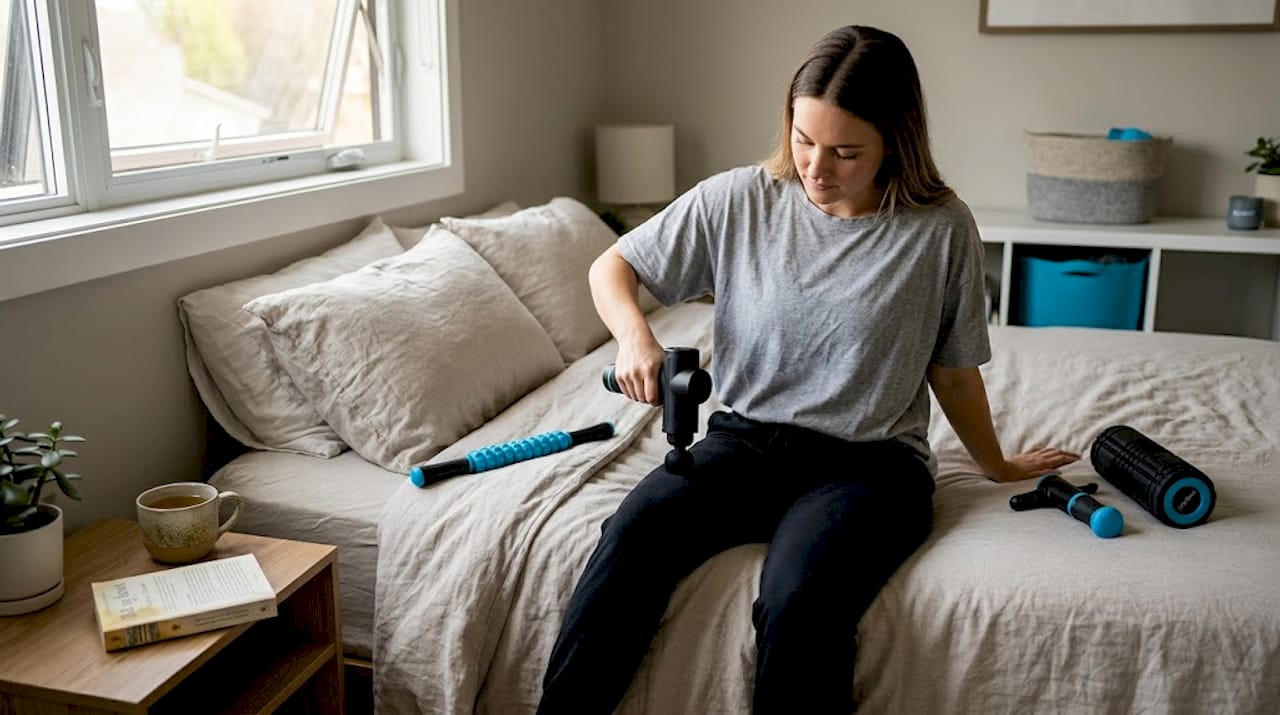
Massage reduces creatine kinase (CK) levels in the blood, increases GABA (a calming neurotransmitter that reduces pain perception), and aids central nervous system modulation. CK is a marker of muscle damage, so lower post-exercise CK levels suggest faster tissue repair. The effects on direct performance are more mixed, but the recovery and pain relief benefits are well supported.
Vibration therapy shortens muscle contraction time and enhances neuromuscular responsiveness after fatigue, making it a strong option for athletes who need to recover quickly between training sessions or competition rounds.
Comparison of massage tool types:
| Tool type | Best for | Mobility impact | Pain relief | Performance effect |
|---|
| Percussive (massage gun) | Targeted deep tissue | Moderate | High | Mixed |
| Manual (rollers, sticks) | General soreness | Moderate | Moderate | Minimal |
| Vibration therapy | Neuromuscular recovery | High | Moderate | Positive |
| Foam rolling | Broad muscle groups | High | Moderate | Minimal |
Understanding muscle protein synthesis and massage helps explain why consistent massage work supports long-term muscle health. By improving circulation and reducing inflammation, massage tools create a more favorable environment for tissue repair and growth.
“Percussive tools hit spots that foam rollers can’t reach precisely. For the IT band, glutes, and upper traps, nothing else comes close for quick, targeted relief.” — Physical therapist perspective
Explore advanced recovery methods to see how combining massage tools with other strategies amplifies results across your full training week.
Compression, electrical stimulation, and light therapy
Technology has brought entirely new forms of recovery to athletes who want more than mechanical or thermal tools. Three high-tech options stand out: compression therapy, electrical muscle stimulation (EMS/NMES), and red light therapy.
Compression works by applying external pressure to limbs or muscle groups, which supports venous return (blood flowing back to the heart) and reduces swelling. Compression provides perceptual soreness relief for up to 24 hours after exercise, but performance gains in acute settings are generally small. It is most useful for athletes who need to feel better quickly rather than those chasing measurable performance metrics.
EMS and NMES (neuromuscular electrical stimulation) devices use electrical current to stimulate muscle contractions without requiring voluntary effort. EMS induces non-fatiguing contractions that enhance blood flow, reduce soreness, and support recovery without adding to your fatigue load. Here is a simple step-by-step approach for using EMS effectively:
- Apply electrode pads to the target muscle group according to device instructions.
- Start at the lowest intensity and increase gradually until you feel a comfortable contraction.
- Use a recovery-specific program (low frequency, rhythmic) rather than a strength-building program.
- Run sessions for 20 to 30 minutes post-workout or on rest days.
- Follow with light stretching or mobility work to maximize blood flow benefits.
Explore affordable EMS options and EMS for muscle recovery to understand how these tools integrate into a broader recovery plan.
Red light therapy (also called photobiomodulation) uses specific wavelengths of red and near-infrared light to penetrate tissue. Red light therapy stimulates mitochondrial function, reduces inflammation at the cellular level, and aids tissue repair. It is particularly effective for chronic soreness, joint pain, and soft tissue injuries that haven’t responded to other methods.
| Tool | Soreness relief | Mobility benefit | Recovery speed | Best use case |
|---|
| Compression | High (perceptual) | Low | Moderate | Post-event swelling |
| EMS/NMES | High | Moderate | High | Rest day recovery |
| Red light therapy | Moderate | Moderate | High | Chronic pain, tissue repair |
Beyond cold and mechanical tools, heat-based recovery is a timeless, research-backed option that many athletes underutilize. Heat therapy works by increasing local blood flow, relaxing muscle tissue, and reducing stiffness in connective tissue. Saunas, infrared panels, heating pads, and warm water immersion all fall into this category.
Sauna and heat therapy promote cardiovascular recovery and circulation through thermal contrast, making them especially valuable after endurance training or on active recovery days.
Best practices for heat therapy:
- Use heat 24 to 48 hours after training, not immediately after acute injury
- Keep sessions to 15 to 20 minutes to avoid dehydration
- Combine with light stretching while muscles are warm for better mobility gains
- Use infrared saunas for deeper tissue penetration at lower ambient temperatures
- Pair with cold exposure (contrast therapy) for enhanced circulation effects
Heat therapy and immunity are also linked, with regular sauna use showing positive effects on immune function and stress hormone regulation.
“Heat is the most underrated recovery tool in most athletes’ routines. It relaxes the nervous system, loosens tight tissue, and gets you mentally ready for the next session in ways that cold alone never does.” — Sports conditioning coach
Here is the honest take after reviewing every tool in this guide: no single recovery method wins across all situations. The athletes who recover fastest and stay healthiest over the long term are not the ones who found the perfect tool. They are the ones who learned to cycle between tools based on where they are in their training week.
Most athletes find better results when they rotate cold, heat, and mechanical tools based on the training phase. After a heavy strength session, mechanical release and light heat work better than aggressive cold. After a long endurance event or a competition day, cold therapy earns its place. On rest days, EMS, light therapy, and sauna work support tissue repair without adding stress to the body.
There is also an adaptation problem with using the same tool every day. Your nervous system and tissue respond to novelty. Rotating methods keeps the stimulus fresh and prevents the plateau effect that comes from overreliance on one approach.
Here is a practical weekly layout that works for most active athletes:
- Day 1 (heavy training): Foam rolling or SMR post-workout, heat therapy in the evening
- Day 2 (moderate training): Percussive massage or vibration, light compression
- Day 3 (rest or active recovery): EMS session, red light therapy, sauna
- Day 4 (high-intensity or competition): Cold therapy post-event, compression overnight
- Day 5 (recovery day): Full SMR session, heat, light movement
Balanced recovery habits built around variety and consistency outperform any single trendy device every time. The goal is not to find the one perfect tool. The goal is to build a system that keeps you training hard and feeling good week after week.
Pro Tip: Rotate your recovery tools across the week rather than stacking everything into one post-workout session. Spread the stimulus, and your body will respond better to each individual method.
You now have the science and the strategy. The next step is putting the right tools in your hands.
Thrival’s line of muscle recovery tools is built to deliver professional-grade relief for the back, hips, neck, and shoulders, with US-made durability and FDA-registered quality behind every product. Whether you need deep tissue relief for stubborn trigger points or a versatile setup that covers your full recovery routine, Thrival has a targeted solution. Every product comes with instructional content and app-guided routines so you know exactly how to get results. Ready to build a smarter recovery system? Shop for recovery devices and find the tools that match your training, your body, and your goals.
Frequently asked questions
Cold therapy tools like ice baths reduce inflammation and soreness most rapidly for acute recovery, making them the fastest-acting option in the first 24 hours post-exercise.
Can foam rolling improve flexibility long-term?
Foam rolling improves immediate mobility and reduces DOMS transiently, but lasting flexibility gains require consistent stretching and movement practice alongside regular rolling.
Is electrical stimulation safe for everyday use?
EMS induces non-fatiguing contractions that support blood flow and soreness relief without adding fatigue, making it safe for daily use when applied correctly and at appropriate intensities.
Are heat and sauna therapies as effective as cold therapy?
Heat therapies primarily boost circulation, muscle relaxation, and cardiovascular recovery, while cold therapy excels at rapid inflammation control, making each best suited for different recovery scenarios.
Yes. Strategically rotating cold, heat, mechanical, and electrical tools throughout the week delivers more complete recovery benefits and prevents adaptation to any single method.
Recommended