Tuesday, December 23, 2025
There are about 250 objects in “State Fairs: Growing American Craft,” on view at the Smithsonian American Art Museum’s Renwick Gallery through Sept. 7, 2026. But that’s if you only count the more than 700 glass canning jars once.
You know I. M. Pei’s pyramid at the Louvre? Well, you might say the Renwick’s got an A&P pyramid, courtesy of Rodney Zeitler, MD.

“Curious Regard,” a butter cow sculpted by Sarah, Hannah and Grace Pratt, in her octagonal refrigerated stall at the Renwick.
“This Iowa grandpa and his Blue Ribbon canning empire are going to the Smithsonian,” the Des Moines Register announced last August.
Doc Zietler’s prize-winning preserves — lovingly containerized fruits, vegetables, meats, jams and jellies — are stacked in a spotlit 11-by-11-foot ziggurat with a supersized glass pear on top. (The pear, made by Flora C. Mace and Joey Kirkpatrick in 1994, is from SAAM’s collection.)
Talk about a can-do attitude. Says Zeitler, 73, who began to can in his 40s: “There are some things you don’t can, but there’s nothing I haven’t canned that I’ve tried to can.”
Though 43 states and tribal nations are represented in “State Fairs,” curated by Mary Savig, the Renwick’s Fleur and Charles Bresler Curator-in-Charge, the Hawkeye State naturally looms large. The Iowa State Fair, which opened its gates in 1854, is one of the nation’s oldest, not to mention that it’s the setting for the novel, film and Rodgers and Hammerstein musical titled (nothing fancy) “State Fair.”

Linda Paulsen’s 2014 portrait of Taylor Swift in timothy grass, red and German millet, amaranth, trefoil, balloon plant, gypsophila, green needlegrass, alfalfa, alyssum, white clover, African cosmos and corn husk.
Adjacent to Mount Zeitner, an octagonal gallery holds an octagonal refrigerated stall for “Curious Regard,” a life-size, anatomically correct dairy cow sculpted by Sarah Pratt and her twin daughters, Hannah and Grace, from a dairy product. Made from somewhere between 650 and 800 pounds of butter, the critter is in a line dating to 1911. An apprentice to former Iowa State Fair butter sculptor Nora “Duffy” Lyon for 15 years, Pratt took over in 2006.
But enough about Iowa. The Lone Star State welcomes Renwick visitors with the steel, Styrofoam and fiberglass cowboy boots of 55-foot-tall Big Tex, flanking the museum entrance, and, in the first gallery, a vertical marquee from a 2022 Starlight Parade float spelling out HOWDY FOLKS.
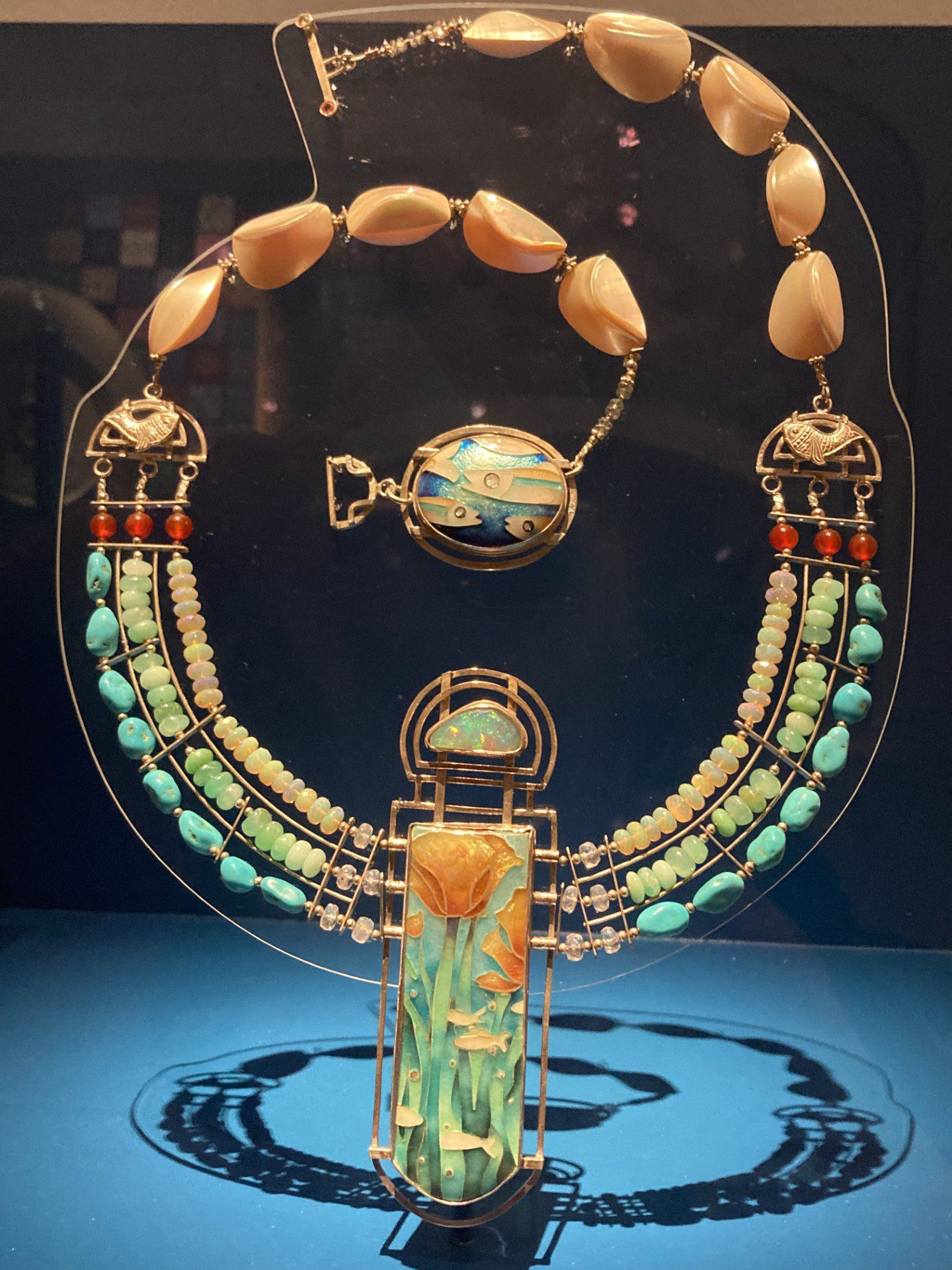
“Delta Smelt with Poppies,” 2022. Adriana Griffin, Rosedale, California.
The majority of the objects in the exhibition — quilts and other textiles, baskets, ceramics, jewelry, sculptures and broom benches (“PLEASE SIT”) made by Kentucky’s Berea College Student Craft program to Katie Bister’s designs — are on the first floor. As one soon realizes: “Most of the works on view were made by women, emphasizing their creative contributions to both American art and rural life.”
The show’s subtitle, “Growing American Craft,” indicates that the emphasis is on a continuing and blossoming tradition of art making, broadly defined. However, objects from as far back as the 19th century uncover that tradition’s roots.
- Ethel Upham of Concord, age 9, won first prize at the 1882 New Hampshire State Fair “in the ‘plain sewing by a girl under age ten’ category in the needlework division of the ‘Ladies’ Department’” for her sewing samples. Josephine Daly of Antelope won first prize at the 1885 California State Fair “in the miscellaneous category, where other entries included handsewn buckskin gloves, apple jelly and a peacock feather duster,” for a wreath made of human hair.
I counted 14 quilts on the first floor, including “one of the best-known American quilts,” made in the early 1940s by Grace Snyder of North Platte, Nebraska, who stitched together 87,000 tiny triangles (give or take) in a floral design, giving “the illusion of needlepoint on a pieced quilt.” A label by another quilt, made by the Battered Offenders Self-Help (BOSH) group of the Kentucky Correction Institution for Women, reads: “This artwork contains depictions of graphic violence, physical abuse and sexual assault.”

“Storyteller with Twenty Figures,” c. 1985. Helen Cordero, Cochiti Pueblo, New Mexico.
Insightful juxtapositions bridge the decades, sometimes the centuries. The Zephyr, a toy steamboat made by William K. Thomas, age 12, exhibited in 1835 at a fair in Portland, Maine, is paired with “Miss Sea,” a model Mississippi paddleboat of balsa wood and basswood made by Jim Ernst of Beverly Hills (the one in Florida) that won Best in Show at the 2021 Florida State Fair.
“Vessel No. 27” of 1990 by South Korea-born Lee Sipe of Columbia, South Carolina, a basket made of pine needles and raffia that “mimics the shape of large ceramic storage jars,” stands next to “Facing the Unexpected” of 2013, a group of interwoven slumped baskets by Polly Adams Sutton of Seattle’s Northwest Basket Weavers Guild.
Two smaller first-floor galleries zero in on folk art genres. On opposite walls in the first are two dozen “grainy” images of FDR and Eleanor, Johnny and Oprah, Dolly and Willie, Elvis (of course) and other notable Americans.
Crop portraiture sprouted when Owatonna hairdresser Lillian Colton won Best in Show at the Minnesota State Fair for a portrait based on a 1969 magazine cover photo of President Nixon. Her 1987 depiction of Prince is made from timothy grass, rapeseed, poppy, grits and bromegrass. Colton’s daughter, Linda Paulsen, has carried on with, for example, a 2014 portrait of Taylor Swift in timothy grass, red and German millet, amaranth, trefoil, balloon plant, gypsophila, green needlegrass, alfalfa, alyssum, white clover, African cosmos and corn husk.
In the second gallery, fish decoys carved this year and last by Rick and Connie Whittier of Lidgerwood, North Dakota, dangle above great blue heron and egret decoys crafted by Laurel Dabbs of Westfield Center, Ohio, since 2017. The little sculptures are bathed in blue light, which casts watery shadows on the walls.
The first upstairs gallery is titled “Who Is The American Farmer?” Perhaps to be challenged by the Executive Branch, the text reads: “The success of American agriculture owed much to the disenfranchisement and relocation of Indigenous people, who have known and cultivated the land for generations, along with the exploitation of enslaved people in the plantation system.” Further: “Until the mid-twentieth century, many state fairs enforced racial segregation.”
Two artists are featured. Margarita Cabrera of El Paso is represented by “Arbol de la Vida—John Deere Tractor Model #790” of 2007, a ceramic tractor that references Mexican “tree of life” sculptures; and Syd Carpenter of Philadelphia by “Our Home Places” of 2014, three abstract standing assemblages of clay and steel inspired by African American farmers, whose photos are shown.
“Making the Future” focuses on the involvement of young people in 4-H and Native American fairs and powwows. In the center of the gallery are elaborate costumes from Native American pageants.
Past the cow and pyramid, a photo of Big Tex is the backdrop for a rodeo gallery displaying three saddles, including one awarded to Miss Rodeo Arkansas of 1966, Mary Ann Searcy, then passed on to the new queen every year until 2019. Also of note: a case of prize-winning steel horseshoes, circa 1920, by Danish-born blacksmith Christ Christiansen of Racine, Wisconsin.
Visitors can decompress in the Renwick’s Grand Salon, now home to Justin Favela’s site-specific installation “Capilla de Maíz (Maize Chapel).” A sort of Twilight of the Cobs, the “chapel” is bordered by eight huge cornstalks constructed of polyester, cement and steel.
Born in Las Vegas, Nevada, of Guatemalan and Mexican descent, Favela, who studied art at UNLV, works in the piñata-making tradition known as cartonería. The huge room, with a Gene Davis-like striped carpet, is awash in colored light — hot pink, blue, orange, yellow-green, green, etc. — a “7:10-minute sequence conjuring a daily weather cycle” by SAAM’s lighting designer, Scott Rosenfeld.
Photos by Richard Selden.